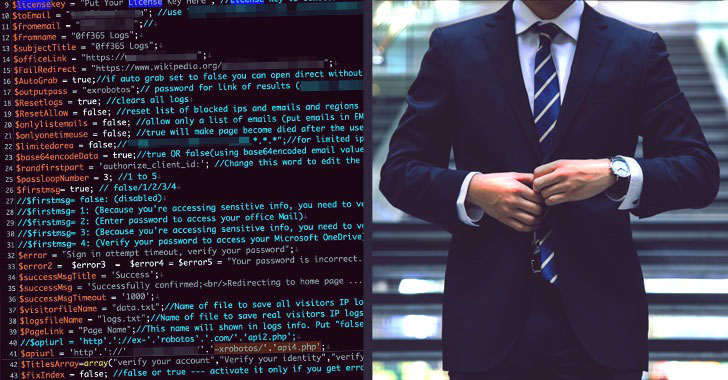
An evolving phishing campaign observed at least since May 2020
has been found to target high-ranking company executives across
manufacturing, real estate, finance, government, and technological
sectors with the goal of obtaining sensitive information.
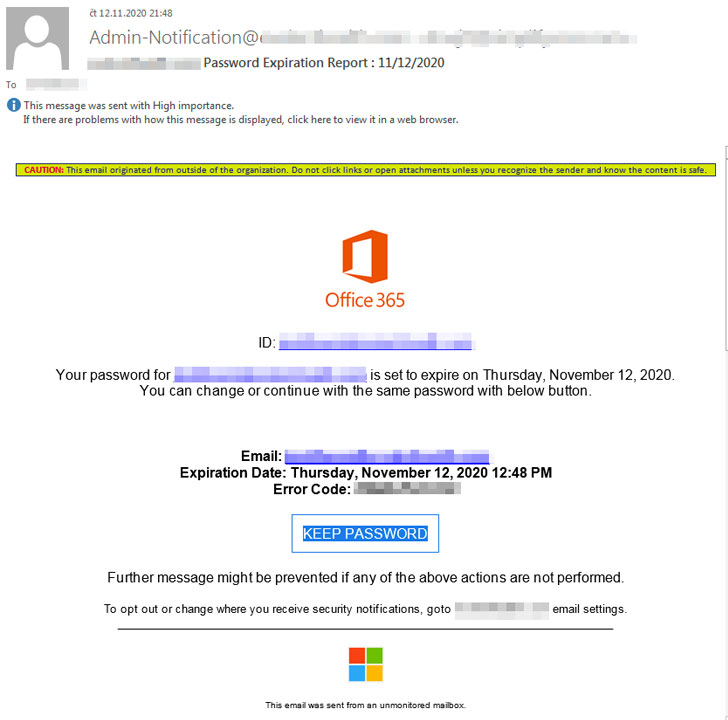
The campaign hinges on a social engineering trick that involves
sending emails to potential victims containing fake Office 365
password expiration notifications as lures. The messages also
include an embedded link to retain the same password that, when
clicked, redirects users to a phishing page for credential
harvesting.
“The attackers target high profile employees who may not be as
technically or cybersecurity savvy, and may be more likely to be
deceived into clicking on malicious links,” Trend Micro researchers
said[1]
in a Monday analysis.
“By selectively targeting C-level employees, the attacker
significantly increases the value of obtained credentials as they
could lead to further access to sensitive personal and
organizational information, and used in other attacks.”
According to the researchers, the targeted email addresses were
mostly collected from LinkedIn, while noting that the attackers
could have purchased such target lists from marketing websites that
offer CEO/CFO email and social media profile data.
The Office 365 phishing kit, currently in its fourth iteration
(V4), is said to have been originally released in July 2019, with
additional features added to detect bot scanning or crawling
attempts and provide alternative content when bots are detected.
Interestingly, the alleged developer behind the malware announced
V4’s availability on their “business” Facebook page in
mid-2020.
Aside from selling the phishing kit, the actor has also been
found to peddle account credentials of CEOs, chief financial
officers (CFOs), finance department members, and other high-profile
executives on social media pages.
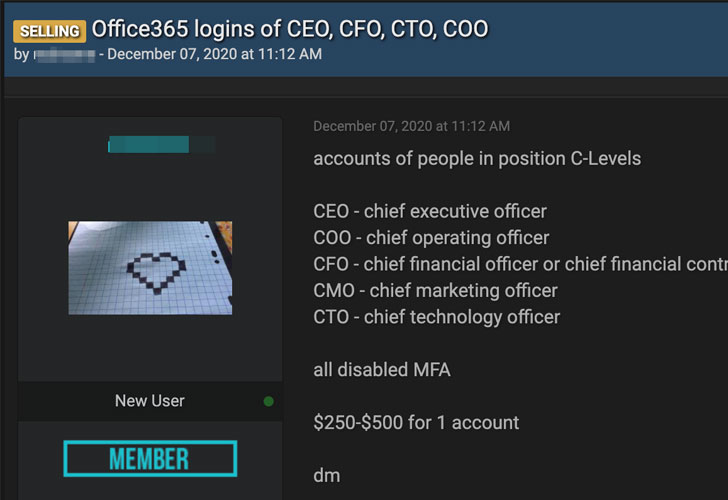
What’s more, Trend Micro’s investigation unearthed a possible
link to a user handle on underground forums that was spotted
selling a credential harvester tool as well as stolen C-Level
account passwords anywhere between $250 to $500, echoing previous reports[2]
late last year.
The researchers uncovered at least eight compromised phishing
sites hosting the V4 phishing kit, raising the possibility that
they were used by different actors for a wide range of phishing
campaigns directed against CEOs, presidents, board members, and
founders of companies located in the U.S., the U.K., Canada,
Hungary, the Netherlands, and Israel.
“While organizations are aware and wary of the information they
include in public-facing websites and platforms, their respective
employees should be constantly reminded to be mindful of the
details they disclose on personal pages,” the researchers
concluded. “These can be easily used against them for attacks using
social engineering techniques.”
References
- ^
said
(www.trendmicro.com) - ^
previous
reports (www.zdnet.com)