Skip to content

hACkErS.NG

  • TESTS
  • SOCIAL
    • Site Activity
    • TRAIN.I.NG
      • Course 1
      • Student Registration
      • Instructor Registration
    • Social Log In
    • ANSWERS SEARCH ENGINE
    • Questions
      • POSTS
    • Social Site Registration
    • FREE NET
      • SECURITY NEWS
      • FORENSICS ACCOUNTING
      • accounting
  • QUIZ
  • Portal
  • IMAGES
  • CHATGPT

Take Down Robert E lee Statue But The KKK Is Still Not a Banned Organistion in America !

Jun 10, 2020

Search Results

Top stories
Architectural Digest

.

Confederate Statue of
Robert E. Lee in
Virginia to Be
Removed

.

18 hours ago

NPR

.

Robert E. Lee Statue In
Virginia To Be
Removed

.

1 day ago

CBS News

.

Virginia governor
announces plans to
take down Robert E.
Lee Confederate statue in Richmond

.

12 hours ago

Alabama newspaper editor calls on KKK to lynch Democrats

  • 19 February 2019


  • Previously Last Year
Ku Klux Klan parade in DC in 1927
Image caption Ku Klux Klan parade in DC in 1927

The editor and publisher of a local paper in Alabama is under fire for penning an editorial calling for mass lynchings by the Ku Klux Klan (KKK).

The opinion piece ran in his print-only newspaper, the Democrat-Reporter, last Thursday, Goodloe Sutton confirmed on Tuesday.

He said Democrats were going to raise taxes and that the KKK should hang them and raid Washington DC.

Alabama lawmakers have called for Sutton to resign.
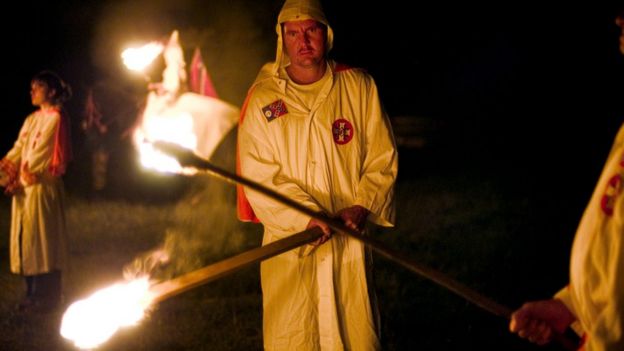
 

Ku Klux Klan members light torches as they begin a cross-lighting ceremony at the White Heritage Days Festival in Alabama in 2004.

The KKK is one of the oldest white supremacy groups in the US, formed just after the civil war. The group was behind many of the lynchings, rapes and violent attacks on African Americans in the 1900s.

The editorial began garnering attention online after students from Auburn University in Auburn, Alabama, tweeted photographs of the article.

Sutton could not be immediately reached for comment on the matter.

He was once a celebrated journalist, commended for his ethics by other news outlets – including the New York Times and American Journalism Review.

What did the editorial say?

A short editorial piece published without a byline on 14 February was entitled: “Klan needs to ride again.”

“Time for the Ku Klux Klan to night ride again,” the article said, referencing the KKK’s terrorising raids through black communities.

“Democrats in the Republican Party and Democrats are plotting to raise taxes in Alabama… This socialist-communist ideology sounds good to the ignorant, the uneducated, and the simple-minded people.”

“Seems like the Klan would be welcome to raid the gated communities up there.”

Sutton later confirmed to the Montgomery Advertiser that he had written the article.

“If we could get the Klan to go up there and clean out DC we’d all been better off,” he said. “We’ll get the hemp ropes out, loop them over a tall limb and hang all of them.”

“It’s not calling for the lynchings of Americans. These are socialist-communists we’re talking about.”

Sutton also told the paper he did not believe the Klan was a violent organisation.

“They didn’t kill but a few people. The Klan wasn’t violent until they needed to be.”

According to the Southern Poverty Law Center, there are currently around 5,000 to 8,000 KKK members across the US; during the Klan’s heyday in the 1900s, there were as many as four million members.

Image copyright David Holloway via Getty Images
Image caption Klan members light torches at White Heritage Days Festival in Alabama in 2004

More voices on US race issues:


Ku Klux Klan
KKK.svg

KKK-Flag.svg

Ku Klux Klan emblem and flag
In existence
1st Klan 1865–1871
2nd Klan 1915–1944
3rd Klan 1946–present
Members
1st Klan Unknown
2nd Klan 3,000,000–6,000,000[1] (peaked in 1924–1925)
3rd Klan 5,000–8,000[2]
Properties
Political ideologies
  • Nordicism
  • Neo-Confederate (first and third Klans)
  • White supremacy
  • White nationalism
  • Nativism (second and third Klans)[3]
  • Anti-immigration (second and third Klans)
  • Anti-communism (second and third Klan)
  • Christian terrorism[4][5]
  • Anti-Catholicism (second Klan)
  • Prohibition (second Klan)
  • Antisemitism (second and third Klans)
  • Neo-fascism (third Klan)
  • Neo-Nazism (third Klan)
  • Anti-Islam (third Klan)
  • Anti-LGBT (third Klan)
Political position Far-right
Espoused religion
  • Protestantism (second Klan)[6]
  • Christian Identity (second and third Klans)[7]

The Ku Klux Klan (/ˌkuː klʌks ˈklæn, ˌkjuː-/),[a] commonly called the KKK or the Klan, is an American white supremacist hate group, whose primary target is African Americans.[8] The Klan has existed in three distinct eras at different points in time during the history of the United States. Each has advocated extremist reactionary positions such as white nationalism, anti-immigration and—especially in later iterations—Nordicism[9][10] and anti-Catholicism. Historically, the first Klan used terrorism – both physical assault and murder – against politically active blacks and their allies in the South in the late 1860s, until it was suppressed around 1872. All three movements have called for the “purification” of American society and all are considered “right-wing extremist” organizations.[11][12][13][14] In each era, membership was secret and estimates of the total were highly exaggerated by both friends and enemies.

The first Klan flourished in the Southern United States in the late 1860s during Reconstruction, then died out by the early 1870s. It sought to overthrow the Republican state governments in the South, especially by using violence against African-American leaders. Each chapter was autonomous and highly secret as to membership and plans. Its numerous chapters across the South were suppressed around 1871, through federal law enforcement. Members made their own, often colorful, costumes: robes, masks and conical hats, designed to be terrifying and to hide their identities.[15][16]

Post navigation

George Floyd Updates – Witness in George Floyd’s car – Autopsy: Floyd Had Corona Virus ? Floyd Was on Drugs
Donald Trump – I did More For Black People than Abraham Lincoln – Black Female Fox News Reporter Asks LincolnFreed Slaves !?

Related Post

Dot dotifi dotifi.com swordpress

WHATSAPP 6 Useful Methods To Fix “Sorry, This Media File Doesn’t Exist ” … www.dotifi.com

Aug 25, 2023
canada Dot dotifi dotifi.com swordpress

Africa: Internet Did NOT start in Nigeria – How Africa’s Regional Internet Network Started With One Driven Intern On a Quest for a LAN dotifi.com

Aug 25, 2023
Dot dotifi dotifi.com swordpress

How To Become A Web Developer in 2023 – A Complete Guide You cant Miss From Dotifi.com

Aug 17, 2023
ANAKYST SEARCH
BUY 1 Million UK US EMAILS AND START RESELLING ON ADVERTIS.I.NG
CISSP Exam emulation practice test #1 – Hard difficulty – Results

SSCP Systems Security Certified Practitioner Exam Cissp Practice Test 1 125 Questions
  • Cryptography vs. Encryption
  • Encryption Symmetric & Asymmetric – AES RSA All you need to know about Encryption using this methods .
  • An Email in the Daily Life of a Agile Project manager
  • ISC2 doesn’t like to share much about their exam questions. So, here’s a candid description of what you can expect:
  • The Best Bulk Mail Sending software (for cold emailing newsletters, promos, spam etc).
  • UEBA (User and Entity Behavior Analytics) and UBA (User Behavior Analytics)
  • Question 19 – When using the formal approval process, what is required to access data? CISSP and Formal Approval Process for Data Access
  • Top CRMs for Sending Emails to your Clients
  • Chief Information Officer (CIO), Chief Technology Officer (CTO), aand more recently a Chief Information Security Officer (CISO)
  • Identification vs Authentication, and Authorization
OWASP TOP !0
Injection. Injection flaws, such as SQL, NoSQL, OS, and LDAP injection, occur when untrusted data is sent to an interpreter as part of a command or query. The attacker’s hostile data can trick the interpreter into executing unintended commands or accessing data without proper authorization. Broken Authentication. Application functions related to authentication and session management are often implemented incorrectly, allowing attackers to compromise passwords, keys, or session tokens, or to exploit other implementation flaws to assume other users’ identities temporarily or permanently. Sensitive Data Exposure. Many web applications and APIs do not properly protect sensitive data, such as financial, healthcare, and PII. Attackers may steal or modify such weakly protected data to conduct credit card fraud, identity theft, or other crimes. Sensitive data may be compromised without extra protection, such as encryption at rest or in transit, and requires special precautions when exchanged with the browser. XML External Entities (XXE). Many older or poorly configured XML processors evaluate external entity references within XML documents. External entities can be used to disclose internal files using the file URI handler, internal file shares, internal port scanning, remote code execution, and denial of service attacks. Broken Access Control. Restrictions on what authenticated users are allowed to do are often not properly enforced. Attackers can exploit these flaws to access unauthorized functionality and/or data, such as access other users’ accounts, view sensitive files, modify other users’ data, change access rights, etc. Security Misconfiguration. Security misconfiguration is the most commonly seen issue. This is commonly a result of insecure default configurations, incomplete or ad hoc configurations, open cloud storage, misconfigured HTTP headers, and verbose error messages containing sensitive information. Not only must all operating systems, frameworks, libraries, and applications be securely configured, but they must be patched/upgraded in a timely fashion. Cross-Site Scripting XSS. XSS flaws occur whenever an application includes untrusted data in a new web page without proper validation or escaping, or updates an existing web page with user-supplied data using a browser API that can create HTML or JavaScript. XSS allows attackers to execute scripts in the victim’s browser which can hijack user sessions, deface web sites, or redirect the user to malicious sites. Insecure Deserialization. Insecure deserialization often leads to remote code execution. Even if deserialization flaws do not result in remote code execution, they can be used to perform attacks, including replay attacks, injection attacks, and privilege escalation attacks. Using Components with Known Vulnerabilities. Components, such as libraries, frameworks, and other software modules, run with the same privileges as the application. If a vulnerable component is exploited, such an attack can facilitate serious data loss or server takeover. Applications and APIs using components with known vulnerabilities may undermine application defenses and enable various attacks and impacts. Insufficient Logging & Monitoring. Insufficient logging and monitoring, coupled with missing or ineffective integration with incident response, allows attackers to further attack systems, maintain persistence, pivot to more systems, and tamper, extract, or destroy data. Most breach studies show time to detect a breach is over 200 days, typically detected by external parties rather than internal processes or monitoring.

You missed

anakyst

Protected: Rotary VI EAST

February 28, 2026 admin
anakyst

Protected: BetterCyberCareer Group

February 28, 2026 admin
anakyst

Protected: Benin Club 1931 – Official

February 28, 2026 admin
anakyst

Protected: Whatsapp AI Automation Group

February 28, 2026 admin

hACkErS.NG

Proudly powered by WordPress | Theme: Newsup by Themeansar.

  • Home
  • About us
  • Account
  • All Courses
  • All Groups
  • Apply To Job
  • Ask Question
  • Become A Teacher
  • Blog
  • Cart
  • Cart
  • Change Password
  • Checkout
  • Checkout
  • Checkout
    • Confirmation
    • Purchase Confirmation
    • Purchase History
    • Transaction Failed
  • Checkout
  • Complete Registration
  • Contact
  • Dashboard
  • Dashboard
  • Default User Group
  • Department
  • Facility
  • Forgot Password
  • Forgot Password
  • Forgot Password?
  • Groups
  • Helpie FAQ
  • Home
  • Home
  • homer
  • Instructor Registration
  • Login
  • Login
  • Login
  • Members
  • Messages
  • My account
  • My AI Account
  • My Profile
  • Notifications
  • Password Reset
  • photos
  • Photos
  • post
  • Professionals
  • Profile
  • Profile
  • Questions
    • Activities
    • Ask a question
    • Categories
    • Profile
    • Tags
  • QUIZ
  • Recent Activity
  • Register
  • Registration
  • Reset Password
  • Reset Password
  • SEARCH
  • search
  • Search Users
  • Secifi.com jobboard
  • Secifi.com Security By Dotifi – Our Services
  • Shop
  • Student Registration
  • Submit New Blog Post
  • Term Conditions
  • Testimonial
  • TESTS
  • User Blogs
  • User Profile
  • Users
  • Users List Item
  • Vendor Registration
  • Wishlist
  • You are about to be redirected