In a sign that threat actors continuously shift tactics and
update their defensive measures, the operators of the SolarMarker
information stealer and backdoor have been found leveraging
stealthy tricks to establish long-term persistence on compromised
systems.
Cybersecurity firm Sophos, which spotted the new behavior, said
that the remote access implants are still being detected on
targeted networks despite the campaign witnessing a decline in
November 2021.
Boasting of information harvesting and backdoor capabilities,
the .NET-based malware has been linked to at least three different
attack waves in 2021. The first set, reported in April[1], took advantage of
search engine poisoning techniques to trick business professionals
into visiting sketchy Google sites that installed SolarMarker on
the victim’s machines.
Then in August, the malware was observed[2]
targeting healthcare and education sectors with the goal of
gathering credentials and sensitive information. Subsequent
infection chains documented by Morphisec[3]
in September 2021 highlighted the use of MSI installers to ensure
the delivery of the malware.
The SolarMarker modus operandi commences with redirecting
victims to decoy sites that drop the MSI installer payloads, which,
while executing seemingly legitimate install programs such as Adobe
Acrobat Pro DC, Wondershare PDFelement or Nitro Pro, also launches
a PowerShell script to deploy the malware.
“These SEO efforts, which leveraged a combination of Google
Groups discussions and deceptive web pages and PDF documents hosted
on compromised (usually WordPress) websites, were so effective that
the SolarMarker lures were usually at or near the top of search
results for phrases the SolarMarker actors targeted,” Sophos
researchers Gabor Szappanos and Sean Gallagher said[4]
in a report shared with The Hacker News.
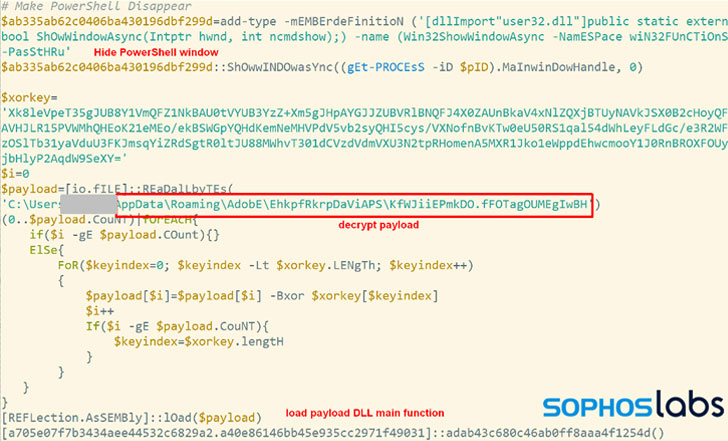
The PowerShell installer is designed to alter the Windows
Registry and drop a .LNK file into Windows’ startup directory to
establish persistence. This unauthorized change results in the
malware getting loaded from an encrypted payload hidden amongst
what the researchers called a “smokescreen” of 100 to 300 junk
files created specifically for this purpose.
“Normally, one would expect this linked file to be an executable
or script file,” the researchers detailed. “But for these
SolarMarker campaigns the linked file is one of the random junk
files, and cannot be executed itself.
What’s more, the unique and random file extension used for the
linked junk file is utilized to create a custom file type key,
which is ultimately employed to execute the malware during system
startup by running a PowerShell command from the Registry.
The backdoor, for its part, is ever-evolving, featuring an array
of functionalities that allow it to steal information from web
browsers, facilitate cryptocurrency theft, and execute arbitrary
commands and binaries, the results of which are exfiltrated back to
a remote server.
“Another important takeaway […], which was also seen in the
ProxyLogon vulnerabilities[5] targeting Exchange
servers, is that defenders should always check whether attackers
have left something behind in the network that they can return to
later,” Gallagher said. “For ProxyLogon this was web shells, for
SolarMarker this is a stealthy and persistent backdoor that
according to Sophos telematics is still active months after the
campaign ended.”
References
- ^
reported
in April (thehackernews.com) - ^
observed
(thehackernews.com) - ^
Morphisec
(thehackernews.com) - ^
said
(news.sophos.com) - ^
ProxyLogon vulnerabilities
(thehackernews.com)
Read more https://thehackernews.com/2022/02/solarmarker-malware-uses-novel.html