
A cyber-espionage group has been observed increasingly targeting
Indian government personnel as part of a broad campaign to infect
victims with as many as four new custom remote access trojans
(RATs), signaling a “boost in their development operations.”
Attributed to a group tracked as SideCopy, the intrusions
culminate in the deployment of a variety of modular plugins,
ranging from file enumerators to browser credential stealers and
keyloggers (Xeytan and Lavao), Cisco Talos said in a report
published Wednesday.
“Targeting tactics and themes observed in SideCopy campaigns
indicate a high degree of similarity to the Transparent Tribe APT
(aka APT36) also targeting India,” researchers Asheer Malhotra and
Justin Thattil said[1]. “These include using
decoys posing as operational documents belonging to the military
and think tanks and honeytrap-based infections.”
First documented in September 2020 by Indian cybersecurity firm
Quick Heal, SideCopy[2]
has a history of mimicking infections chains implemented by the
Sidewinder APT to deliver its own set of malware — in an attempt to
mislead attribution and evade detection — while constantly
retooling payloads that includes additional exploits in its
weaponry after a reconnaissance of the victim’s data and
environment.
The adversary is also believed to be of Pakistani origin, with
suspected ties to the Transparent Tribe[3]
(aka Mythic Leopard) group, which has been linked to several
attacks targeting the Indian military and government entities. Past
campaigns undertaken by the threat actor involve using government
and military-related lures to single out Indian defense units and
armed forces personnel and deliver malware capable of accessing
files, clipboard data, terminating processes, and even executing
arbitrary commands.
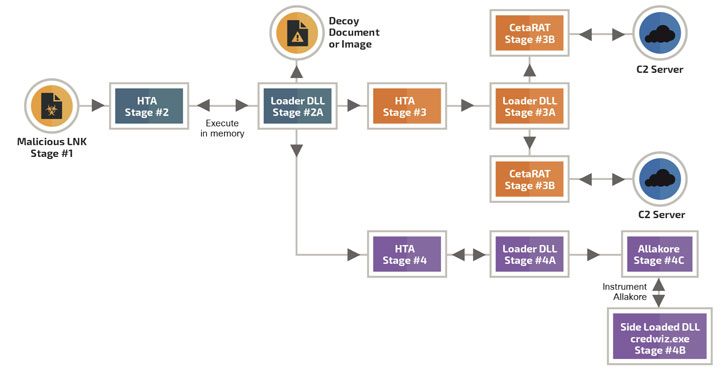
The latest wave of attacks leverages a multitude of TTPs,
including malicious LNK files and decoy documents, to deliver a
combination of bespoke and commercially available commodity RATs
such as CetaRAT, DetaRAT, ReverseRAT, MargulasRAT, njRAT, Allakore,
ActionRAT, Lillith, and Epicenter RAT. Apart from military themes,
SideCopy has also been found employing calls for proposals and job
openings related to think tanks in India to target potential
victims.
“The development of new RAT malware is an indication that this
group of attackers is rapidly evolving its malware arsenal and
post-infection tools since 2019,” Malhotra and Thattil noted. The
improvements demonstrate an effort to modularize the attack chains,
while also demonstrating an increase in sophistication of the
group’s tactics, the researchers said.
Besides deploying full-fledged backdoors, SideCopy has also been
observed utilizing plugins to carry out specific malicious tasks on
the infected endpoint, chief among which is a Golang-based module
called “Nodachi” that’s designed to conduct reconnaissance and
steal files targeting a government-mandated two-factor
authentication solution called Kavach[4], which is required to
access email services.
The goal, it appears, is to steal access credentials from Indian
government employees with a focus on espionage, the researchers
said, adding the threat actor developed droppers for MargulasRAT
that masqueraded as installers for Kavach on Windows.
Malware researcher @0xrb[5], who is also
independently tracking the campaign, reached out to The Hacker News
with two more IPs used by SideCopy attackers to connect to the
command-and-control server — 103[.]255.7.33 and 115[.]186.190.155 —
both of which are located in the city of Islamabad, lending
credence to the threat actor’s Pakistani provenance.
“What started as a simple infection vector by SideCopy to
deliver a custom RAT (CetaRAT), has evolved into multiple variants
of infection chains delivering several RATs,” the researchers
concluded. “The use of these many infection techniques — ranging
from LNK files to self-extracting RAR EXEs and MSI-based installers
— is an indication that the actor is aggressively working to infect
their victims.”
References
Read more http://feedproxy.google.com/~r/TheHackersNews/~3/4lU_0vXVGNw/sidecopy-hackers-target-indian.html