Amazon has addressed a number of flaws in its Kindle e-reader
platform that could have allowed an attacker to take control of
victims’ devices by simply sending them a malicious e-book.
Dubbed “KindleDrip,” the exploit chain takes advantage of
a feature called “Send to Kindle[1]” to send a malware-laced
document to a Kindle device that, when opened, could be leveraged
to remotely execute arbitrary code on the device and make
unauthorized purchases.
“The code runs as root, and the attacker only needs to know the
email address assigned to the victim’s device,” said[2]
Yogev Bar-On, a security researcher for Readlmode Labs, in a
technical write-up on Thursday.
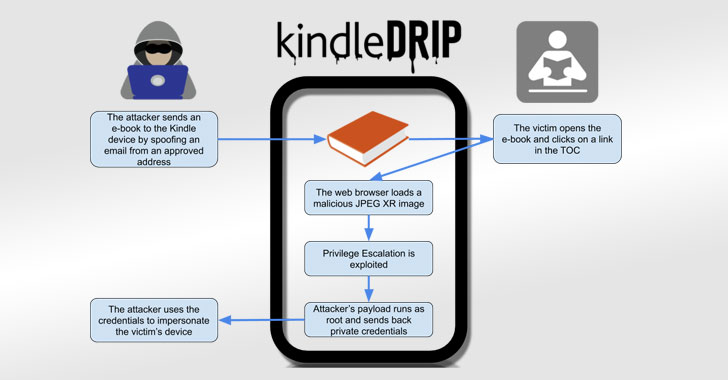
The first vulnerability lets a bad actor send an e-book to a
Kindle, the second flaw allows for remote code execution while the
e-book is parsed, and a third issue makes it possible to escalate
privileges and run the code as the “root” user.
When linked together, these weaknesses could be abused to swipe
device credentials and make purchases on e-books sold by the
attackers themselves on the Kindle store using the target’s credit
card.
Amazon fixed[3]
the flaws on December 10, 2020, for all Kindle models released
after 2014 following Bar-On’s responsible disclosure on October 17.
He was also awarded $18,000 as part of the Amazon Vulnerability
Research Program.
Sending a Malicious e-book from a Spoofed Address
An important aspect of the Send to Kindle feature is that it
only works when a document is sent as an attachment to a
“kindle.com” email address ([name]@kindle.com) from email accounts
that have been previously added to an “Approved Personal Document E-mail
List[4].”
Or that’s how it ideally should. What Bar-On instead found was
that Amazon not only did not verify the authenticity of the email
sender, an e-book that was sent from an approved-but-spoofed[5]
address automatically appeared on the library with no indication
that it was received from an email message.
But pulling this off successfully requires knowledge of the
destination Kindle email address, a unique “[name]@kindle.com”
address that’s assigned to each Kindle device or app upon
registration. Although, in some cases, the name is suffixed by a
random string, Bar-On argues that the entropy on most of the
addresses is low enough to be trivially guessed using a brute-force
approach.
However, once the e-book is sent to a victim device, the attack
moves to the next stage. It exploits a buffer overflow flaw in the
JPEG XR image format library as well as a privilege escalation bug
in one of the root processes (“stackdumpd”) to inject arbitrary
commands and run the code as root.
Thus when an unsuspecting user opens the e-book and taps on one
of the links in the table of contents, the Kindle would open an
HTML page in the browser that contained a specially-crafted JPEG XR
image and parse the image file to run the attack code — thereby
allowing the adversary to steal the user’s credentials, take
control over the device, and virtually access personal information
associated with the victim.
Amazon has now remediated the security holes by sending users a
verification link to a pre-approved address in scenarios where a
document is sent from an unrecognized email address.
Software updates on Kindle devices are by default downloaded and
installed when connected wirelessly. Users can head to Settings →
Menu → Device Info to check if their firmware is up-to-date, and if
not, manually download and install the 5.13.4 update to mitigate
the flaws.
References
- ^
Send to
Kindle (www.amazon.com) - ^
said
(medium.com) - ^
fixed
(www.amazon.com) - ^
Approved
Personal Document E-mail List
(www.amazon.com) - ^
spoofed
(en.wikipedia.org)