Researchers have demonstrated a novel class of attacks that
could allow a bad actor to potentially circumvent existing
countermeasures and break the integrity protection of digitally
signed PDF documents.
Called “Shadow attacks[1]” by academics from
Ruhr-University Bochum, the technique uses the “enormous
flexibility provided by the PDF specification so that shadow
documents remain standard-compliant.”
The findings were presented yesterday at the Network and
Distributed System Security Symposium (NDSS), with 16 of the 29 PDF
viewers tested — including Adobe Acrobat, Foxit Reader, Perfect
PDF, and Okular — found vulnerable to shadow attacks.
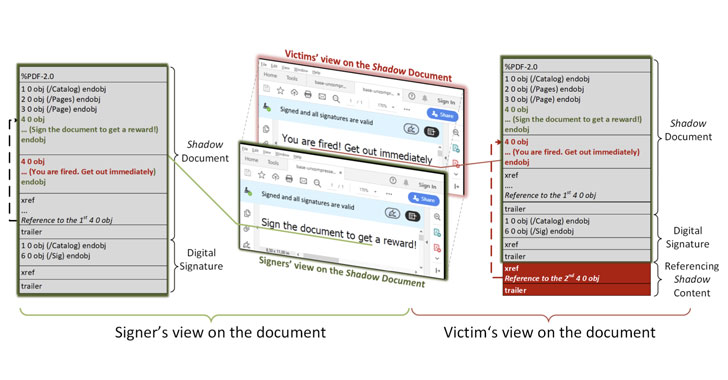
To carry out the attack, a malicious actor creates a PDF
document with two different contents: one which is the content
that’s expected by the party signing the document, and the other, a
piece of hidden content that gets displayed once the PDF is
signed.
“The signers of the PDF receive the document, review it, and
sign it,” the researchers outlined. “The attackers use the signed
document, modify it slightly, and send it to the victims. After
opening the signed PDF, the victims check whether the digital
signature was successfully verified. However, the victims see
different content than the signers.”
In the analog world, the attack is equivalent to deliberately
leaving empty spaces in a paper document and getting it signed by
the concerned party, ultimately allowing the counterparty to insert
arbitrary content in the spaces.
Shadow attacks build upon a similar threat devised by the
researchers in February 2019[2], which found that it was
possible to alter an existing signed document without invalidating
its signature, thereby making it possible to forge a PDF
document.

Although vendors have since applied security measures to fix the
issue, the new study aims to extend this attack model to ascertain
the possibility that an adversary can modify the visible content of
a digitally signed PDF without invalidating its signature, assuming
that they can manipulate the PDF before it’s signed.
At its core, the attacks leverage “harmless” PDF features which
do not invalidate the signature, such as “incremental update” that
allows for making changes to a PDF (e.g., filling out a form) and
“interactive forms” (e.g., text fields, radio buttons, etc.) to
hide the malicious content behind seemingly innocuous overlay
objects or directly replace the original content after it’s
signed.
A third variant called “hide and replace[3]” can be used to combine
the aforementioned methods and modify the contents of an entire
document by simply changing the object references in the PDF.
“The attacker can build a complete shadow document influencing
the presentation of each page, or even the total number of pages,
as well as each object contained therein,” the researchers
said.
Put simply, the idea is to create a form, which shows the same
value before and after signing, but a completely different set of
values post an attacker’s manipulation.
To test the attacks, the researchers have published[4]
two new open-source tools called PDF-Attacker and PDF-Detector that
can be used to generate shadow documents and test a PDF for
manipulation before it’s signed and after it’s been altered.

The flaws — tracked as CVE-2020-9592[5]
and CVE-2020-9596[6]
— have been since addressed by Adobe in an update[7]
released on May 12, 2020. As of December 17, 2020, 11 of the 29
tested PDF applications remain unpatched.
This is not the first time PDF security has come under the lens.
The researchers have previously demonstrated[8]
methods to extract contents of a password-protected PDF file by
taking advantage of partial encryption supported natively by the
PDF specification to remotely exfiltrate content once a user opens
that document.
Separately, the researchers last month uncovered[9]
another set of 11 vulnerabilities impacting the PDF standard
(CVE-2020-28352 through CVE-2020-28359, and from CVE-2020-28410 to
CVE-2020-28412) that could lead to denial-of-service, information
disclosure, data manipulation attacks, and even arbitrary code
execution.
References
- ^
Shadow
attacks (www.ndss-symposium.org) - ^
February
2019 (www.pdf-insecurity.org) - ^
hide and
replace (www.pdf-insecurity.org) - ^
published
(www.pdf-insecurity.org) - ^
CVE-2020-9592
(nvd.nist.gov) - ^
CVE-2020-9596
(nvd.nist.gov) - ^
update
(helpx.adobe.com) - ^
previously demonstrated
(thenextweb.com) - ^
uncovered
(www.ndss-symposium.org)