Security Information and Event Management (SIEM) systems what are they give the top ten real world examples free open source and proprietary
Alright — let’s unpack Security Information and Event Management (SIEM) and list the top 10 real-world examples, including free/open-source and proprietary solutions.
What is a SIEM System?
- Definition: A SIEM (Security Information and Event Management) system collects, aggregates, analyzes, and correlates security log data from across an organization’s network (servers, firewalls, endpoints, apps, cloud, etc.) in real time.
- Purpose:
- Detect security incidents
- Investigate anomalies and threats
- Respond quickly to potential breaches
- Meet compliance requirements (e.g., GDPR, HIPAA, PCI DSS)
- How it works:
- Log Collection – Pulls data from multiple sources (syslog, agents, APIs).
- Normalization – Converts data into a common format.
- Correlation – Links events across systems to identify patterns.
- Alerting – Notifies security teams about suspicious activity.
- Reporting & Forensics – Provides compliance reports and historical analysis.
Top 10 Real-World SIEM Solutions
Free & Open-Source SIEMs
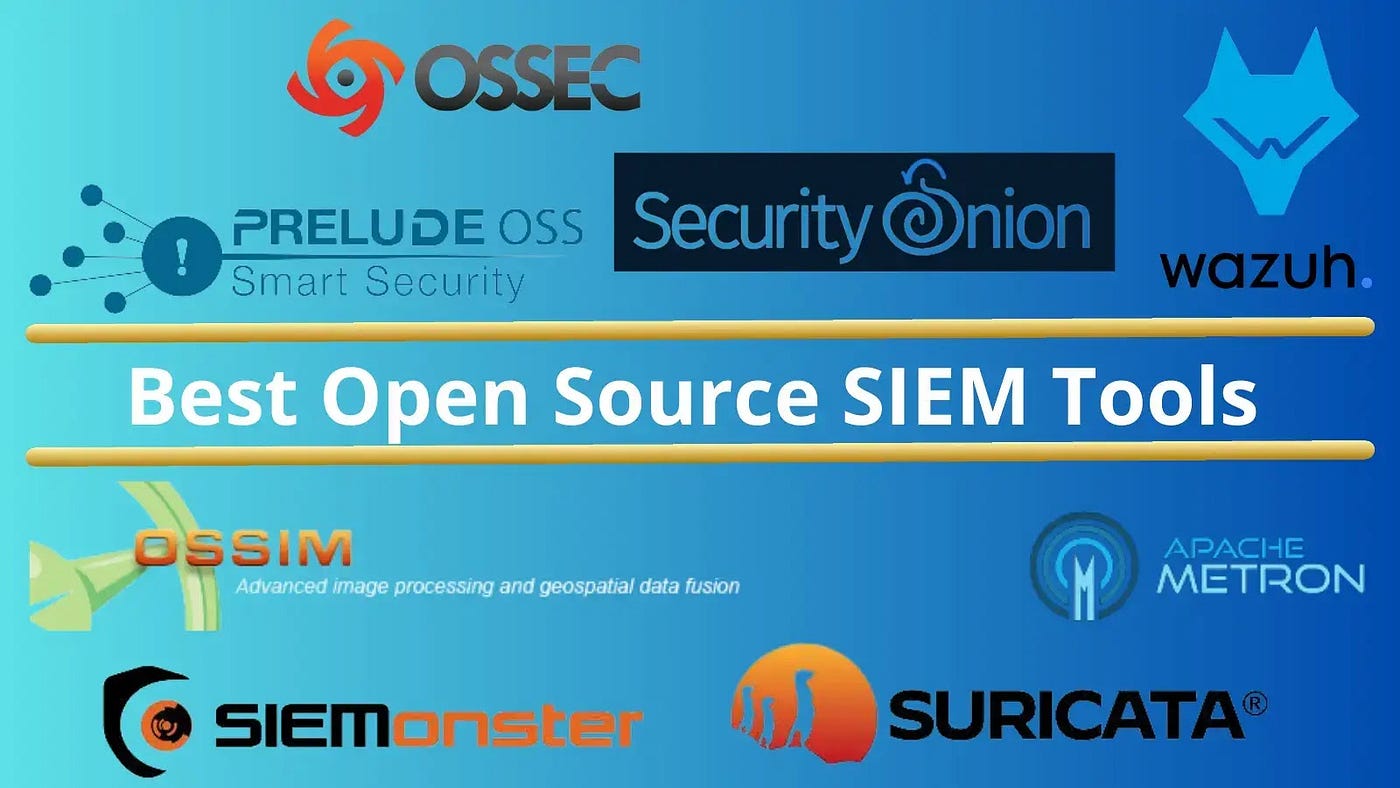
- Wazuh
- Open-source security platform with SIEM, intrusion detection, and compliance.
- Strong integration with Elastic Stack.
- https://wazuh.com
- OSSIM (Open Source Security Information Management) – by AlienVault
- Includes log management, asset discovery, vulnerability assessment.
- https://cybersecurity.att.com/products/ossim
- Security Onion
- Linux distro for intrusion detection, log management, and network security monitoring.
- Uses Suricata, Zeek, and Elastic Stack.
- https://securityonion.net
- ELK Stack (Elasticsearch, Logstash, Kibana) with SIEM features
- Free for basic use; powerful log ingestion and visualization.
- Can be customized for SIEM-like monitoring.
- https://www.elastic.co/what-is/elk-stack
- SIEMonster Community Edition
- Open-source SIEM platform built on Elastic Stack, Wazuh, and other tools.
- https://siemonster.com
Proprietary / Commercial SIEMs
- Splunk Enterprise Security
- Industry leader in big data security analytics; highly customizable.
- Strong app ecosystem.
- https://www.splunk.com
- IBM QRadar
- Powerful correlation rules, machine learning, and integrations.
- Popular in large enterprises.
- https://www.ibm.com/qradar
- ArcSight Enterprise Security Manager (Micro Focus)
- Advanced correlation and compliance reporting.
- Well-established in security operations centers (SOCs).
- https://www.microfocus.com/en-us/cyberres/secops/arcsight
- LogRhythm NextGen SIEM
- Combines SIEM, UEBA (User and Entity Behavior Analytics), and SOAR (Security Orchestration).
- https://logrhythm.com
- Microsoft Sentinel
- Cloud-native SIEM on Azure.
- AI-driven threat detection and integration with Microsoft 365 Defender.
- https://azure.microsoft.com/services/microsoft-sentinel/
Quick Comparison
| Type | Best For | Examples |
|---|---|---|
| Free/Open-Source | Small to medium businesses, budget-conscious orgs, SOC learning labs | Wazuh, OSSIM, Security Onion |
| Proprietary | Enterprises needing advanced analytics, automation, and compliance | Splunk ES, IBM QRadar, Microsoft Sentinel |
If you want, I can make you a side-by-side comparison table showing cost, features, and best use cases for each of these 10 SIEMs so you can instantly pick the right one. That way you’ll see which open-source options come closest to enterprise tools like Splunk.
What are Security Information and Event Management (SIEM) systems?
Security Information and Event Management (SIEM) is a security solution that helps organizations detect and respond to cyber threats by collecting and analyzing security data from across their entire IT infrastructure. It combines two core functions:
- Security Information Management (SIM): The long-term storage, management, and analysis of security log data for compliance, reporting, and forensic purposes.
- Security Event Management (SEM): The real-time monitoring and analysis of security events to provide immediate threat detection and alerting.
A SIEM system aggregates log data from a wide range of sources—including firewalls, servers, applications, and network devices—and uses correlation rules, behavioral analytics, and threat intelligence to identify suspicious activity and potential threats. The goal is to provide a unified, “single pane of glass” view of an organization’s security posture, enabling security teams to quickly detect, investigate, and respond to incidents.
Top Ten SIEM Solutions (Real-World Examples)
Here are top SIEM solutions, categorized into free/open-source and proprietary, with real-world examples. The market for SIEM and security analytics is highly dynamic, so some products may be part of a broader platform or have evolved their offerings.
Free and Open-Source Solutions
These solutions are popular for organizations with limited budgets or for security professionals who want to learn and build custom security monitoring systems. They often require more technical expertise to set up and maintain compared to their proprietary counterparts.
- ELK Stack (Elasticsearch, Logstash, Kibana): While not a SIEM out of the box, the ELK Stack is a powerful foundation for building one.
- Elasticsearch: The search and analytics engine.
- Logstash: The data collection and processing pipeline.
- Kibana: The visualization and dashboard tool.
- Example: A small business uses ELK to collect and analyze logs from their web servers and firewall. They create custom dashboards in Kibana to monitor traffic and receive alerts for failed login attempts.
- Wazuh: A free and open-source security platform that offers SIEM capabilities along with host-based intrusion detection (HIDS), file integrity monitoring, and vulnerability detection.
- Example: A university deploys Wazuh agents on all its servers to monitor for malware, detect unauthorized file changes, and collect logs for a central SIEM server, all for compliance and security monitoring.
- Graylog: A popular log management and SIEM platform with an intuitive interface. The open-source version provides a solid foundation for log collection and analysis, with a commercial version available for more advanced features.
- Example: A security professional uses Graylog in their home lab to centralize and analyze logs from various devices on their network, using its powerful search and alerting features to understand network activity.
- Security Onion: An open-source Linux distribution specifically designed for threat hunting, network security monitoring, and log management. It bundles many open-source security tools, including the ELK Stack, Suricata (an IDS/IPS), and others.
- Example: A security analyst at a non-profit uses Security Onion to monitor all network traffic and logs, leveraging the pre-packaged tools for deep analysis and threat detection.
- OSSIM (Open Source Security Information Management) / AlienVault OSSIM: A robust open-source SIEM that includes asset discovery, vulnerability assessment, and intrusion detection in a single platform. It was originally developed by AlienVault, which is now part of AT&T Cybersecurity.
- Example: A small to medium-sized business (SMB) uses OSSIM to get an all-in-one view of their security posture, without the need for multiple different tools.
Proprietary Solutions
These are enterprise-grade solutions offered by vendors. They typically offer more advanced features, scalability, professional support, and integrations out of the box, but come with licensing costs.
- Splunk Enterprise Security (ES): One of the most well-known and powerful SIEMs on the market. It’s renowned for its scalable data ingestion, powerful search language (SPL), and advanced analytics capabilities.
- Example: A large financial institution uses Splunk ES to ingest petabytes of security data, correlate events in real time, and conduct forensic analysis during a major incident.
- Microsoft Sentinel: A cloud-native SIEM solution from Microsoft, built on the Azure platform. It leverages AI and machine learning to analyze massive volumes of security data and is designed for multi-cloud and hybrid environments.
- Example: A company that is heavily invested in the Microsoft Azure ecosystem uses Sentinel to monitor their cloud workloads, Office 365, and on-premises infrastructure from a single platform.
- IBM Security QRadar: A highly respected SIEM solution that provides strong threat detection, network activity monitoring, and user behavior analytics (UBA). It’s known for its robust correlation engine.
- Example: A global telecommunications company uses QRadar to monitor its complex network infrastructure and detect sophisticated, multi-stage attacks.
- LogRhythm: A next-gen SIEM platform that combines SIEM with UEBA (User and Entity Behavior Analytics) and SOAR (Security Orchestration, Automation, and Response) to help security teams detect and respond to threats more efficiently.
- Example: An enterprise uses LogRhythm’s UBA to detect an insider threat when an employee’s access patterns suddenly change and they start accessing sensitive data they shouldn’t.
- Exabeam: A SIEM solution that focuses heavily on behavioral analytics and machine learning to build a “timeline” of user and asset activity. This helps security analysts quickly understand the full scope of an attack.
- Example: A company’s security team uses Exabeam to investigate a breach by automatically building a timeline of all the attacker’s actions, from the initial compromise to data exfiltration.
What are SIEM Systems?
Security Information and Event Management (SIEM) systems are security platforms that collect, analyze, and correlate security events from across an organization’s IT infrastructure in real-time. They combine two key functions:
- Security Information Management (SIM): Long-term storage and analysis of log data
- Security Event Management (SEM): Real-time monitoring and correlation of security events
SIEM systems help organizations detect threats, comply with regulations, and respond to security incidents by providing centralized visibility into their security posture.
Top 10 SIEM Solutions
Open Source/Free SIEM Tools
1. Wazuh Free and open source security platform that unifies XDR and SIEM protection for endpoints and cloud workloads
- Features: Host-based intrusion detection, file integrity monitoring, vulnerability detection
- Best for: Small to medium organizations wanting comprehensive free security monitoring
2. ELK Stack (Elasticsearch, Logstash, Kibana) The ELK Stack, which consists of Elasticsearch, Logstash, and Kibana, is a powerful tool
- Features: Log aggregation, real-time search, data visualization
- Best for: Organizations with technical expertise to customize and maintain
3. OSSIM (AlienVault Open Source) OSSIM (open source security information management) by AlienVault is a leading free open source SIEM tool
- Features: Asset discovery, vulnerability assessment, intrusion detection
- Note: AlienVault OSSIM is free to use as an open-source SIEM, but support ended in 2024
4. Apache Metron Open-source SIEMs like Apache Metron can generate large data volumes
- Features: Real-time big data security analytics platform
- Best for: Large organizations with big data security needs
5. OSSEC While OSSEC does have SIEM-like capabilities, it is not a full-featured SIEM
- Features: Host-based intrusion detection, log analysis, file integrity monitoring
- Best for: Host-based monitoring and compliance
Proprietary/Commercial SIEM Solutions
6. Splunk Enterprise Security
- Features: Advanced analytics, machine learning, extensive integrations
- Splunk leads in SIEM innovation over IBM QRadar offering reduced alert fatigue, improved security visibility, and access to a vast ecosystem of integrations
- Best for: Large enterprises with complex security requirements
7. IBM Security QRadar IBM® Security QRadar® SIEM consolidates log source event data from thousands of devices endpoints and applications distributed throughout a network
- Features: Over 700 integrations, and recently, it expanded the product offering by adding Red Hat OpenShift to its stack
- Best for: IBM-centric environments
8. Microsoft Sentinel (Azure Sentinel)
- Features: Cloud-native SIEM, AI-powered analytics, integration with Microsoft ecosystem
- Best for: Organizations heavily invested in Microsoft Azure/Office 365
9. LogRhythm SIEM LogRhythm SIEM is a security solution designed to enhance threat detection and response capabilities within organizations. It integrates various security functions such as log management
- Features: Integrated SIEM and SOAR capabilities, threat intelligence
- Best for: Mid-market organizations wanting integrated security operations
10. Exabeam Fusion
- Features: User and Entity Behavior Analytics (UEBA), timeline analysis
- Best for: Organizations focused on insider threat detection and advanced analytics
Key Considerations
Open Source Advantages:
- Cost-effective for budget-conscious organizations
- Customizable and flexible
- No vendor lock-in
Open Source Challenges:
- Requires in-house expertise
- Limited commercial support
- Establish clear data retention policies and optimize storage formats to avoid performance issues
Proprietary Advantages:
- Professional support and maintenance
- Advanced features and analytics
- Easier deployment and management
Proprietary Challenges:
- Higher costs
- Potential vendor lock-in
- Less customization flexibility
The choice between open source and proprietary SIEM depends on your organization’s budget, technical expertise, compliance requirements, and specific security needs.
