Humans are an organization’s strongest defence against evolving
cyber threats, but security awareness training alone often isn’t
enough to transform user behaviour.
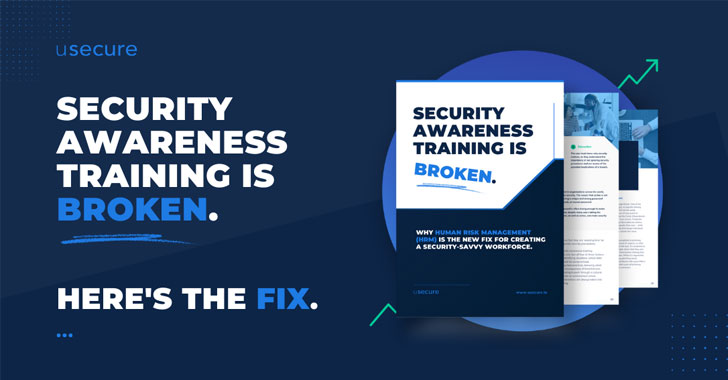
In this guide, usecure looks at why Human Risk Management (HRM)
is the new fix for building a security-savvy workforce.
Don’t be fooled…
Businesses are investing more than ever into strengthening their
employee security awareness efforts, but a big problem still
plagues SMBs and enterprises in every sector —
human-related data breaches.
Even with more businesses rolling out staff security awareness
training programs to combat evolving cyber threats, over 90% of
data breaches still stem from human error.
So, why are human-related data breaches still so prevalent?
Access Now: Security Awareness Training is
Broken. HRM is the Fix [Free eBook] →[1]
Security awareness training often isn’t enough
It’s easy to think that rolling out some security awareness
courses and sending a few email bulletins from time to time can
stop staff from engaging with phishing emails or re-using awful
passwords. But, as many businesses are finding out, security
awareness training alone often isn’t enough to truly boost user
resilience and drive secure human behaviour.
Here’s why:
- The training isn’t always fit for purpose –
Countless programs are created through a rushed recipe for failure
— e.g., infrequent, unengaging, and generic training courses being
chucked out, with the hope that employees won’t click that next
phishing email and that the necessary compliance boxes are
checked. - Training courses are wrongly seen as a silver bullet
– Regular training is vital for helping employees
strengthen their security behaviour, but computer-based courses are
just one tool for tackling human cyber risk. Staff needs to know
their responsibilities through refined policy communications, and
practical risk assessments — like phishing simulations and dark web
breach scans — need to be conducted regularly to keep staff
resilient to modern threats. - Training results aren’t truly reflecting the human risk
– Many user training programs fail to give businesses a
true reflection of their ongoing human cyber risk and, instead,
rely solely on security awareness training grades and (maybe) the
results of sporadic phishing simulations as a way of assessing
their security posture. This doesn’t paint a full picture of human
risk, and, often, measuring the overall impact of training
is difficult to measure accurately.
So, how can businesses understand, tackle, and monitor their
human cyber risk better?
Access Now: Security Awareness Training is
Broken. HRM is the Fix [Free eBook] →[2]
Introducing Human Risk Management (HRM) – usecure’s new class
of user-focused security
Human Risk Management (HRM) empowers IT pros and managed service
providers to measure, mitigate and monitor ongoing human cyber risk
without hindering the productivity of the workforce.
usecure simplifies HRM by automating user-tailored security
awareness training, periodic phishing simulations, simplified
policy management, and ongoing dark web breach monitoring — with
continuous human risk scoring clearly showcasing the impact on risk
over time.
Take a look at usecure’s free guide to learn more about why
traditional security awareness training often falls flat, and how
to start driving secure user behaviour through automated Human Risk
Management (HRM).
Access Now: Security Awareness Training is
Broken. HRM is the Fix [Free eBook] →[3]