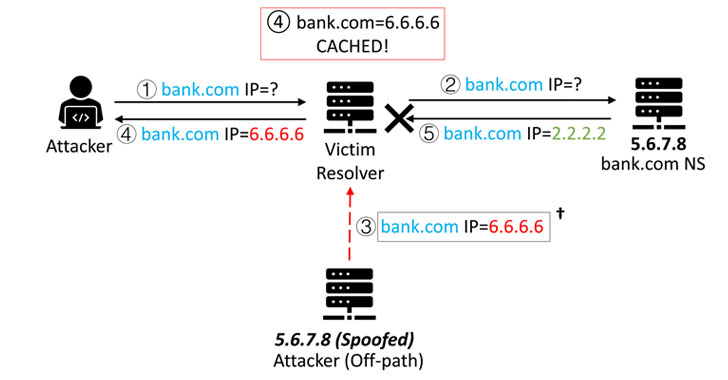
A group of academics from the University of California and
Tsinghua University has uncovered a series of critical security
flaws that could lead to a revival of DNS cache poisoning
attacks.
Dubbed “SAD DNS attack[1]” (short for Side-channel
AttackeD DNS), the technique makes it possible for a malicious
actor to carry out an off-path attack, rerouting any traffic
originally destined to a specific domain to a server under their
control, thereby allowing them to eavesdrop and tamper with the
communications.
“This represents an important milestone — the first weaponizable
network side channel attack that has serious security impacts,” the
researchers said. “The attack allows an off-path attacker to inject
a malicious DNS record into a DNS cache.”
Tracked as CVE-2020-25705, the findings were presented at the
ACM Conference on Computer, and Communications Security (CCS ’20)
held this week.
The flaw affects operating systems Linux 3.18-5.10, Windows
Server 2019 (version 1809) and newer, macOS 10.15 and newer, and
FreeBSD 12.1.0 and newer.
DNS Forwarders Become New Attack Surface
DNS resolvers typically cache responses to IP address queries
for a specific period as a means to improve response performance in
a network. But this very mechanism can be exploited to poison the caches[2]
by impersonating the IP address DNS entries for a given website and
redirect users attempting to visit that website to another site of
the attacker’s choice.
However, the effectiveness of such attacks has taken a hit in
part due to protocols such as DNSSEC[3]
(Domain Name System Security Extensions) that creates a secure domain name[4]
system by adding cryptographic signatures to existing DNS records
and randomization-based defenses that allow the DNS resolver to use
a different source port and transaction ID (TxID) for every
query.

Noting that the two mitigation measures are still far from being widely deployed[5] due to “incentives and
compatibility” reasons, the researchers said they devised a
side-channel attack that can be successfully used against the most
popular DNS software stacks, thus rendering public DNS resolvers
like Cloudflare’s 1.1.1.1 and Google’s 8.8.8.8 vulnerable.
A Novel Side-Channel Attack
The SAD DNS attack works by making use of a compromised machine
in any network that’s capable of triggering a request out of a DNS
forwarder or resolver, such as a public wireless network managed by
a wireless router in a coffee shop, a shopping mall, or an
airport.
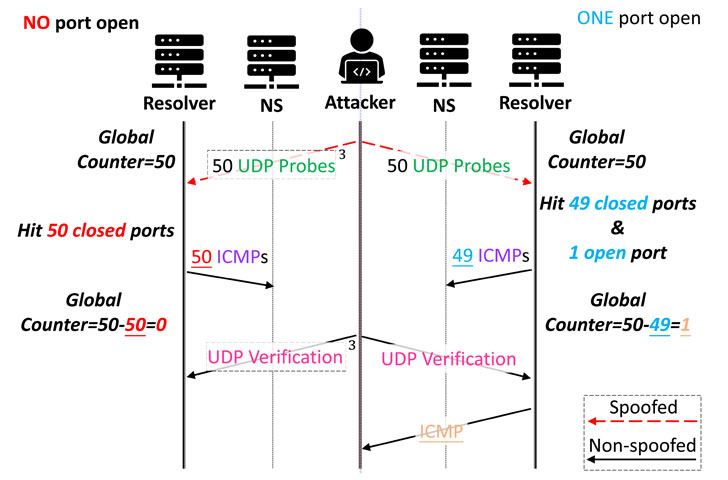
It then leverages a side channel in the network protocol stack
to scan and discover which source ports are used to initiate a DNS
query and subsequently inject a large number of spoofed DNS replies
by brute-forcing the TxIDs.
More specifically, the researchers used a channel used in the
domain name requests to narrow down the exact source port number by
sending spoofed UDP[6]
packets, each with different IP addresses, to a victim server and
infer whether the spoofed probes have hit the right source port
based on the ICMP[7]
responses received (or lack thereof).
This port scan method achieves a scanning speed of 1,000 ports
per second, cumulatively taking a little over 60 seconds to
enumerate the entire port range consisting of 65536 ports. With the
source port thus derandomized, all an attacker has to do is to
insert a malicious IP address to redirect website traffic and
successfully pull off a DNS cache poisoning attack.
Mitigating SAD DNS Attacks
Aside from demonstrating ways to extend the attack window that
permits an attacker to scan more ports and also inject additional
rogue records to poison the DNS cache, the study found that over
34% of the open resolvers on the Internet are vulnerable, 85% of
which comprise of popular DNS services like Google and
Cloudflare.
To counter SAD DNS, the researchers recommend disabling outgoing
ICMP responses and setting the timeout of DNS queries more
aggressively.
The researchers have also put together a tool to check for DNS servers[8]
that are vulnerable to this attack. In addition, the group worked
with the Linux kernel security team for a patch[9]
that randomizes the ICMP global rate limit to introduce noises to
the side channel.
The research “presents a novel and general side channel based on
[the] global ICMP rate limit, universally implemented by all modern
operating systems,” the researchers concluded. “This allows
efficient scans of UDP source ports in DNS queries. Combined with
techniques to extend the attack window, it leads to a powerful
revival of the DNS cache poisoning attack.”
References
- ^
SAD DNS
attack (www.cs.ucr.edu) - ^
poison
the caches (www.cloudflare.com) - ^
DNSSEC
(www.icann.org) - ^
secure
domain name (www.cloudflare.com) - ^
far from
being widely deployed (blog.apnic.net) - ^
UDP
(en.wikipedia.org) - ^
ICMP
(en.wikipedia.org) - ^
check
for DNS servers (61244516.www.saddns.net) - ^
patch
(git.kernel.org)