Dec 20, 2022Ravie Lakshmanan

The Russia-linked Gamaredon group attempted to unsuccessfully
break into a large petroleum refining company within a NATO member
state earlier this year amid the ongoing Russo-Ukrainian war.
The attack, which took place on August 30, 2022, is just one of
multiple attacks orchestrated by the advanced persistent threat
(APT) that’s attributed to Russia’s Federal Security Service
(FSB[1]).
Gamaredon[2], also known by the
monikers Actinium, Armageddon, Iron Tilden, Primitive Bear,
Shuckworm, Trident Ursa, and Winterflounder, has a history of
primarily going after Ukrainian entities and, to a lesser extent,
NATO allies to harvest sensitive data.
“As the conflict has continued on the ground and in cyberspace,
Trident Ursa has been operating as a dedicated access creator and
intelligence gatherer,” Palo Alto Networks Unit 42 said[3]
in a report shared with The Hacker News. “Trident Ursa remains one
of the most pervasive, intrusive, continuously active and focused
APTs targeting Ukraine.”
Unit 42’s continued monitoring of the group’s activities has
uncovered more than 500 new domains, 200 malware samples, and
multiple shifts in its tactics over the past 10 months in response
to ever-changing and expanding priorities.
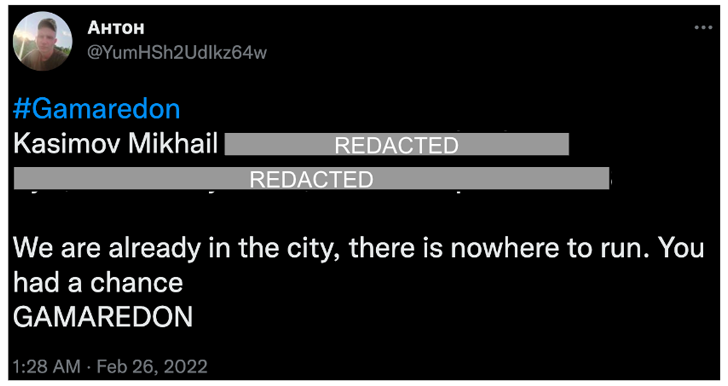
Beyond cyberattacks, the larger security community is said to
have been at the receiving end of threatening tweets from a
purported Gamaredon associate, highlighting the intimidation
techniques adopted by the adversary.
Other noteworthy methods include the use of Telegram pages to
look up command-and-control (C2) servers and fast flux DNS[4]
to rotate through many IP addresses in a short span of time to make
IP-based denylisting and takedown efforts harder.
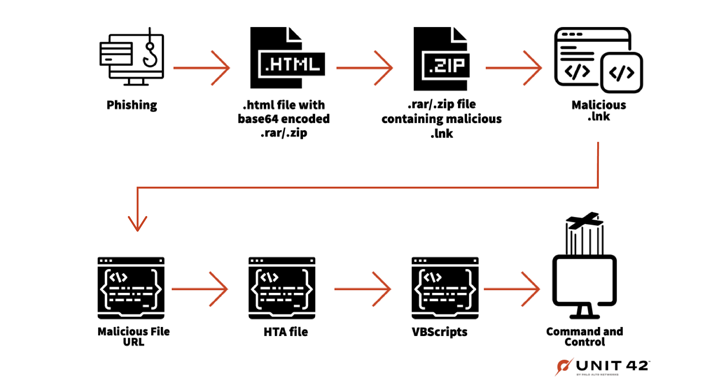
The attacks themselves entail the delivery of weaponized
attachments embedded within spear-phishing emails to deploy a
VBScript backdoor on the compromised host that’s capable of
establishing persistence and executing additional VBScript code
supplied by the C2 server.
Gamaredon infection chains have also been observed leveraging
geoblocking to limit the attacks to specific locations along with
utilizing dropper executables to launch next-stage VBScript
payloads, which subsequently connect to the C2 server to execute
further commands.
The geoblocking mechanism functions as a security blindspot as
it reduces the visibility of the threat actor’s attacks outside of
the targeted countries and makes its activities more difficult to
track.
“Trident Ursa remains an agile and adaptive APT that does not
use overly sophisticated or complex techniques in its operations,”
the researchers said. “In most cases, they rely on publicly
available tools and scripts – along with a significant amount of
obfuscation – as well as routine phishing attempts to successfully
execute their operations.”
Found this article interesting? Follow us on Twitter [5]
and LinkedIn[6]
to read more exclusive content we post.
References
Read more https://thehackernews.com/2022/12/russian-hackers-target-major-petroleum.html