
The Russia-linked Gamaredon hacking group attempted to
compromise an unnamed Western government entity operating in
Ukraine last month amidst ongoing geopolitical tensions between the
two countries.
Palo Alto Networks’ Unit 42 threat intelligence team, in a
new report[1]
publicized on February 3, said that the phishing attack took place
on January 19, adding it “mapped out three large clusters of their
infrastructure used to support different phishing and malware
purposes.”
The threat actor, also known as Shuckworm, Armageddon, or
Primitive Bear, has historically focused its offensive cyber
attacks against Ukrainian government officials and organizations
since 2013. Last year, Ukraine disclosed[2]
the collective’s ties to Russia’s Federal Security Service
(FSB).
To carry out the phishing attack, the operators behind the
campaign leveraged a job search and employment platform within the
country as a conduit to upload their malware downloader in the form
of a resume for an active job listing related to the targeted
entity.
“Given the steps and precision delivery involved in this
campaign, it appears this may have been a specific, deliberate
attempt by Gamaredon to compromise this Western government
organization,” the researchers noted.
Additionally, Unit 42 uncovered evidence of a Gamaredon campaign
targeting the State Migration Service (SMS) of Ukraine on December
1, 2021, which used a Word document as a lure to install the
open-source UltraVNC[3]
virtual network computing (VNC) software for maintaining remote
access to infected computers.
“Gamaredon actors pursue an interesting approach when it comes
to building and maintaining their infrastructure,” researchers
said. “Most actors choose to discard domains after their use in a
cyber campaign in order to distance themselves from any possible
attribution. However, Gamaredon’s approach is unique in that they
appear to recycle their domains by consistently rotating them
across new infrastructure.”
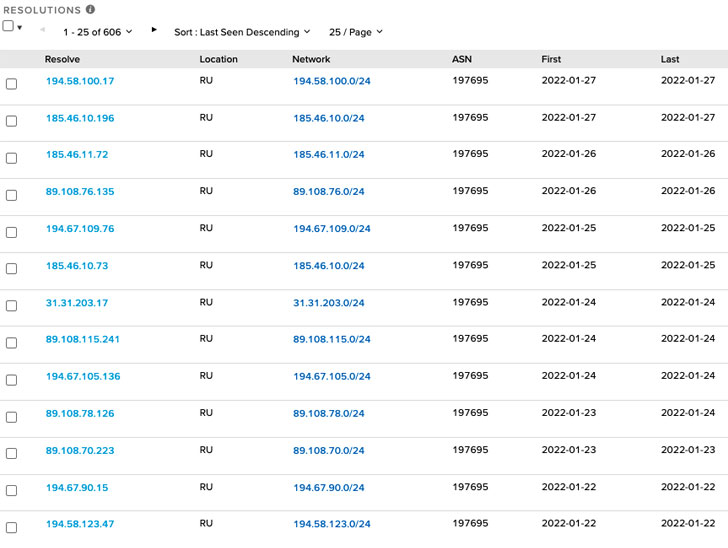
Taken together, the attack infrastructure spans across no fewer
than 700 rogue domains, 215 IP addresses, and over 100 samples of
malware, with the clusters used to host weaponized documents that
are engineered to execute malicious code when opened and serve as
command-and-control servers for its Pterodo[4]
(aka Pteranodon) remote access trojan.
The findings arrive less than a week after Broadcom-owned
Symantec revealed details[5]
of another attack orchestrated by the same group between July and
August 2021 targeting an unidentified Ukrainian organization to
deploy the Pterodo RAT for post-exploitation activities.
References
- ^
new
report (unit42.paloaltonetworks.com) - ^
disclosed
(thehackernews.com) - ^
UltraVNC
(en.wikipedia.org) - ^
Pterodo
(malpedia.caad.fkie.fraunhofer.de) - ^
revealed
details (thehackernews.com)
Read more https://thehackernews.com/2022/02/russian-gamaredon-hackers-targeted.html