Dec 05, 2022Ravie Lakshmanan
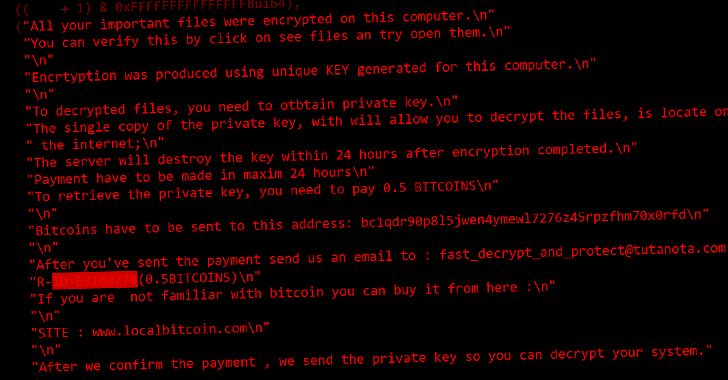
A new data wiper malware called CryWiper has
been found targeting Russian government agencies, including mayor’s
offices and courts.
“Although it disguises itself as a ransomware and extorts money
from the victim for ‘decrypting’ data, [it] does not actually
encrypt, but purposefully destroys data in the affected system,”
Kaspersky researchers Fedor Sinitsyn and Janis Zinchenko said[1]
in a write-up.
Additional details of the attacks were shared by the
Russian-language news publication Izvestia[2]. The intrusions have not
been attributed to a specific adversarial group so far.
A C++-based malware, CryWiper is configured to establish
persistence via a scheduled task and communicate with a
command-and-control (C2) server to initiate the malicious
activity.
Besides terminating processes related to database and email
servers, the malware is equipped with capabilities to delete shadow
copies of files and modify the Windows Registry to prevent RDP
connections in a likely attempt to obstruct incident response
efforts.
As the last step, the wiper corrupts all files with the
exception of those with “.exe,” “.dll,” “lnk,” “.sys,” and “.msi”
extensions, while also skipping specific directories, including
C:\Windows, Boot, and tmp, which could otherwise render the machine
inoperable.
The files overwritten with garbage data are subsequently
appended with an extension called “.CRY,” following which a ransom
note is dropped to give the impression that it’s a ransomware
program, urging the victim to pay 0.5 Bitcoin to recover
access.
“The activity of CryWiper once again shows that the payment of
the ransom does not guarantee the recovery of files,” the
researchers said, stating the malware “deliberately destroys the
contents of files.”
CryWiper is the second retaliatory wiper malware strain[3] aimed at Russia after
RURansom[4], a .NET-based wiper that
was found targeting entities in the country earlier this March.
The ongoing conflict between Russia and Ukraine has involved the
deployment of multiple wipers, with the latter hit with a wide
range of malware such as WhisperGate, HermeticWiper, AcidRain,
IsaacWiper, CaddyWiper, Industroyer2, and DoubleZero.
“Wipers can be effective regardless of the technical skills of
the attacker, as even the simplest wiper can wreak havoc on
affected systems,” Trellix researcher Max Kersten said[5]
in an analysis of destructive malware last month.
“The required time to create such a piece of malware is low,
especially when compared to complex espionage backdoors and the
often-accompanying vulnerabilities that are used. The return of
investment need not be high in those cases, although it is unlikely
that a few wipers are to wreak that much havoc in and of
themselves.”
Found this article interesting? Follow us on Twitter [6]
and LinkedIn[7]
to read more exclusive content we post.
References
Read more https://thehackernews.com/2022/12/russian-courts-targeted-by-new-crywiper.html