Apr 04, 2023Ravie Lakshmanan
Cybersecurity researchers have taken the wraps off a previously
undocumented ransomware strain called Rorschach
that’s both sophisticated and fast.
“What makes Rorschach stand out from other ransomware strains is
its high level of customization and its technically unique features
that have not been seen before in ransomware,” Check Point Research
said[1]
in a new report. “In fact, Rorschach is one of the fastest ransomware strains[2] ever observed, in terms
of the speed of its encryption.”
The cybersecurity firm said it observed the ransomware deployed
against an unnamed U.S.-based company, adding it found no branding
or overlaps that connect it to any previously known ransomware
actors.
However, further analysis of Rorschach’s source code reveals
similarities to Babuk ransomware[3], which suffered a leak
in September 2021, and LockBit 2.0[4]. On top of that, the
ransom notes sent out to the victims appear to be inspired by that
of Yanluowang[5]
and DarkSide[6].
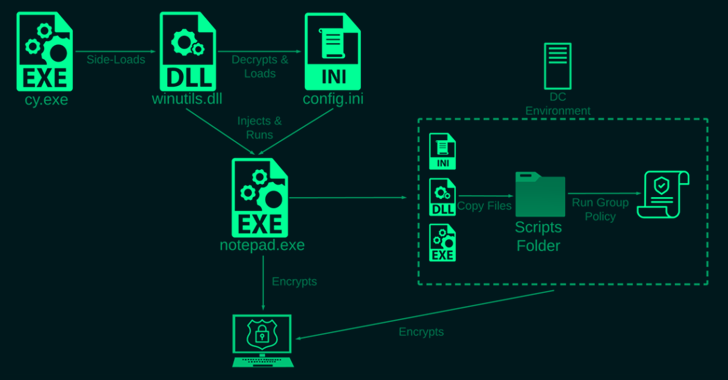
The most significant aspect of the intrusion is the use of a
technique called DLL side-loading[7]
to load the ransomware payload, a method not observed in such
attacks. The development marks a new sophistication in the
approaches adopted by financially motivated groups to sidestep
detection.
Specifically, the ransomware is said to have been deployed by
abusing Palo Alto Network’s Cortex XDR Dump Service Tool (cy.exe)
to sideload a library named “winutils.dll.”
Another unique characteristic is its highly customizable nature
and the use of direct syscalls to manipulate files and bypass
defense mechanisms.
Rorschach ransomware is also tasked with terminating a
predefined list of services, deleting shadow volumes and backups,
clearing Windows events logs to erase forensic trail, disabling the
Windows firewall, and even deleting itself after completing its
actions.
Internal propagation is achieved by compromising the domain
controller and creating a group policy[8], according to Check
Point and South Korean cybersecurity company AhnLab, which
erroneously attributed[9]
the infection chain to DarkSide earlier this February.
The ransomware, like other malware strains observed in the wild,
skips machines[10] that are located in the
Commonwealth of Independent States (CIS) countries by checking the
system language.
THN WEBINAR
Become an Incident Response Pro!
Unlock the secrets to bulletproof incident response – Master the
6-Phase process with Asaf Perlman, Cynet’s IR Leader!
Don’t Miss Out –
Save Your Seat![11]
“The Rorschach ransomware employs a highly effective and fast
hybrid-cryptography scheme, which blends the curve25519 and eSTREAM
cipher hc-128 algorithms for encryption purposes,” researchers Jiri
Vinopal, Dennis Yarizadeh, and Gil Gekker explained.
This process is designed to only encrypt a specific portion of
the original file content instead of the entire file, and employs
additional compiler optimization methods that make it a “speed
demon.”
In five separate tests carried out by Check Point in a
controlled environment, 220,000 files were encrypted using
Rorschach within four minutes and 30 seconds on average. LockBit 3.0[12], on the other hand,
took approximately seven minutes.
“Its developers implemented new anti-analysis and defense
evasion techniques to avoid detection and make it more difficult
for security software and researchers to analyze and mitigate its
effects,” the researchers said.
“Additionally, Rorschach appears to have taken some of the
‘best’ features from some of the leading ransomwares leaked online,
and integrated them all together. In addition to Rorschach’s
self-propagating capabilities, this raises the bar for ransom
attacks.”
The findings come as the Fortinet FortiGuard Labs detailed[13] two emerging ransomware
families called PayMe100USD, a Python-based file-locking malware,
and Dark Power, which is written in the Nim programming language[14].
Found this article interesting? Follow us on Twitter [15] and LinkedIn[16] to read more exclusive
content we post.
References
- ^
said
(research.checkpoint.com) - ^
fastest
ransomware strains (www.splunk.com) - ^
Babuk
ransomware (thehackernews.com) - ^
LockBit
2.0 (thehackernews.com) - ^
Yanluowang
(thehackernews.com) - ^
DarkSide
(thehackernews.com) - ^
DLL
side-loading (attack.mitre.org) - ^
group
policy (en.wikipedia.org) - ^
attributed
(asec.ahnlab.com) - ^
skips
machines (www.malwarebytes.com) - ^
Don’t Miss Out – Save Your Seat!
(thn.news) - ^
LockBit 3.0
(thehackernews.com) - ^
detailed
(www.fortinet.com) - ^
Nim
programming language (thehackernews.com) - ^
Twitter
(twitter.com) - ^
LinkedIn
(www.linkedin.com)
Read more https://thehackernews.com/2023/04/rorschach-ransomware-emerges-experts.html