your home, especially when you’re away, but even a thought that
someone could be spying on you through the same surveillance system
would shiver up your spine.
Following several recent reports of hackers gaining access to
people’s internet-connected Ring doorbell and security cameras,
Amazon yesterday announced to make two-factor authentication
security feature mandatory for all Ring users.
Until now, enabling the two-factor authentication in Ring
devices was optional, which definitely would have prevented most
Ring hacks, but of course, many never bothered to enable it.
That means, from now onwards, at the time of login after
entering the account’s username and password, every user needs to
input a secret six-digit authentication code sent to them via their
phone or email.
Two-factor authentication is an effective defense because it acts
as a deterrent, preventing unauthorized users from gaining access
to your account even when they have your username and password.
“The same goes for any Shared Users that you have on your
account. You can choose to receive this one-time passcode via the
email address you have listed on your Ring account or on your phone
as a text message (SMS),” Ring said in a blog
post[1].
Well, better late than never. Ring’s announcement comes a week
after Google announced[2]
it will require two-factor authentication for all Nest accounts
that aren’t connected to a Google account.
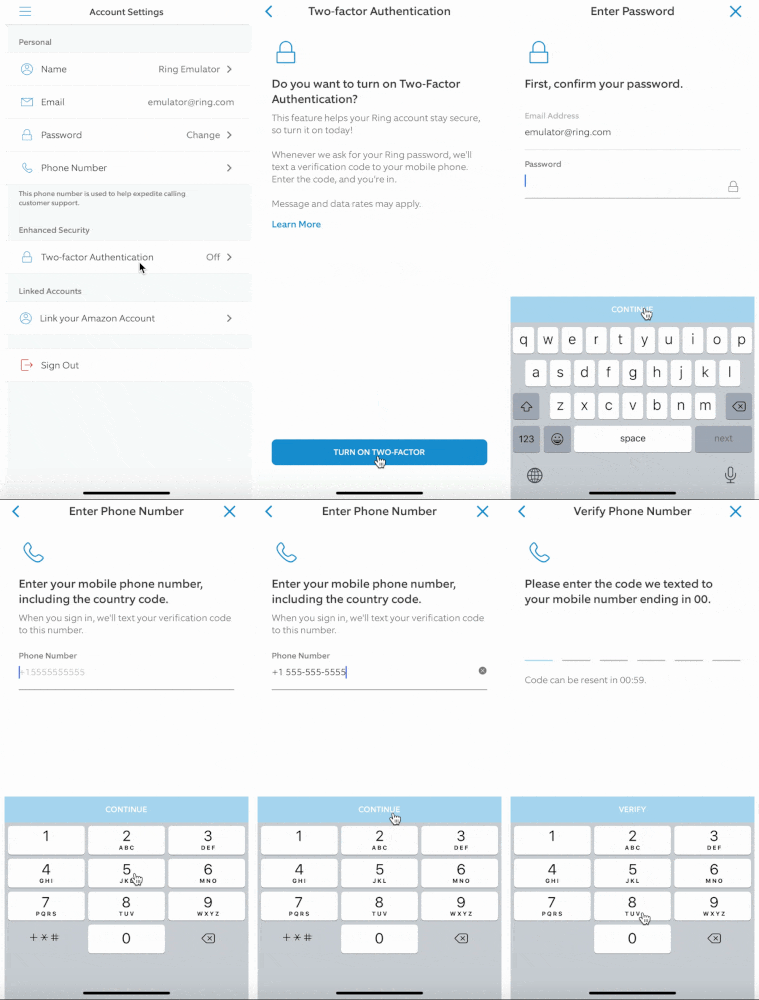
Ring accounts that aims to alert users anytime someone successfully
logs into their account from a new device or browser.
However, there’s still no indication that alerts or prevents
users from using passwords that are known to be exposed to previous
data breaches; thus, it is important to make sure you’re using a
password that is hard to guess and is unique to your Ring
account.
Besides all these security enhancements, the Amazon-owned
service has also paused the use of most third-party analytics
services and offers a new opt-out option aiming to let users stop
Ring from sharing their data with third parties.
“You can now opt-out of sharing your information with third-party
service providers for the purpose of receiving personalized ads. If
you opt-out, Ring will not share the information required to serve
you personalized ads, though you may still see non-personalized
Ring ads from time to time,” the company said.
To opt-out of third-party data sharing, go to the Menu of Ring
app > click ‘Control Center’ > open ‘Privacy information and
control’ > then ‘Third-party service providers’ > then
‘Personalized advertising,’ and then toggle the switch to
disable.
The company says the changes will be rolling out starting today,
and that all Ring users should have access to them in the coming
week.
Read more http://feedproxy.google.com/~r/TheHackersNews/~3/TaSmgf1FD_g/ring-cameras-cybersecurity.html