Dec 23, 2022Ravie Lakshmanan
A new targeted phishing campaign has zoomed in on a two-factor
authentication solution called Kavach that’s used by Indian
government officials.
Cybersecurity firm Securonix dubbed the activity
STEPPY#KAVACH, attributing it to a threat actor
known as SideCopy based on tactical overlaps with prior
attacks.
“.LNK files are used to initiate code execution which eventually
downloads and runs a malicious C# payload, which functions as a
remote access trojan (RAT),” Securonix researchers Den Iuzvyk, Tim
Peck, and Oleg Kolesnikov said[1]
in a new report.
SideCopy, a hacking crew[2]
believed to be of Pakistani origin and active since at least 2019,
is said to share ties with another actor called Transparent Tribe[3]
(aka APT36 or Mythic Leopard).
It’s also known to impersonate attack chains leveraged by
SideWinder[4], a prolific nation-state
group that disproportionately singles out Pakistan-based military
entities, to deploy its own toolset.
That said, this is not the first time Kavach has emerged as a
target for the actor. In July 2021, Cisco Talos detailed an
espionage operation[5]
that was undertaken to steal credentials from Indian government
employees.
Kavach-themed decoy apps have since been co-opted by Transparent
Tribe in its attacks targeting India[6]
since the start of the year.
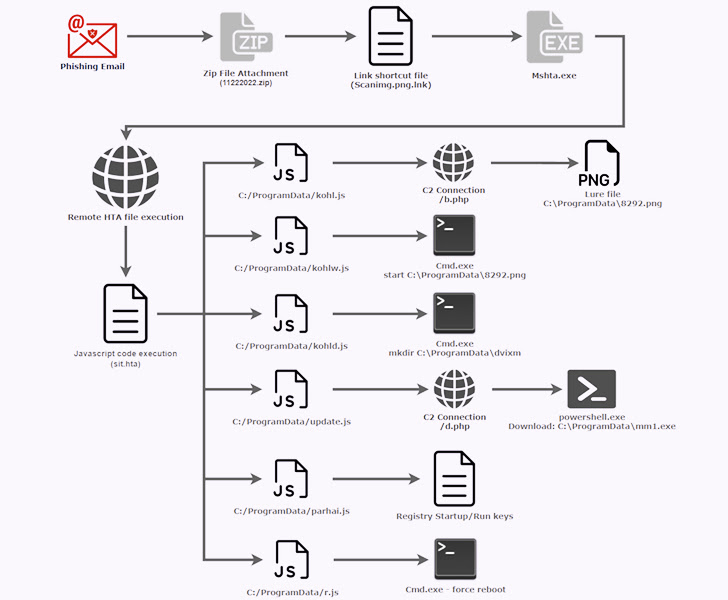
The latest attack sequence observed by Securonix over the past
couple of weeks entails using phishing emails to lure potential
victims into opening a shortcut file (.LNK) to execute a remote
.HTA payload using the mshta.exe[7]
Windows utility.
The HTML application, the company said, “was discovered being
hosted on a likely compromised website, nested inside an obscure
‘gallery’ directory designed to store some of the site’s
images.”
The compromised website in question is incometaxdelhi[.]org, the
official website for India’s Income Tax department pertaining to
the Delhi region. The malicious file is no longer available on the
portal.
In the next phase, running the .HTA file leads to the execution
of obfuscated JavaScript code that’s designed to show a decoy image
file that features an announcement[8]
from the Indian Ministry of Defence a year ago in December
2021.
The JavaScript code further downloads an executable from a
remote server, establishes persistence via Windows Registry
modifications, and reboots the machine to automatically launch the
binary post startup.
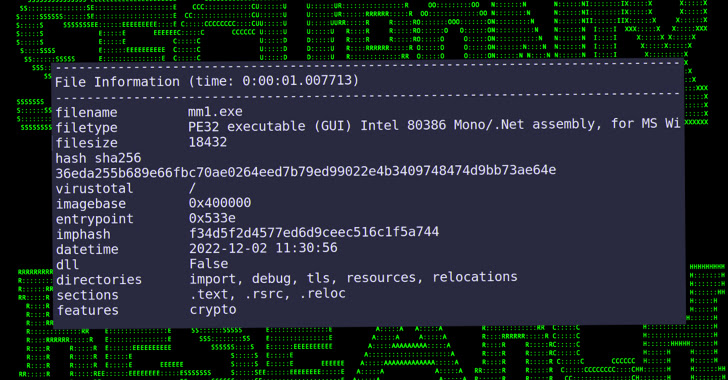
The binary file, for its part, functions as a backdoor that
enables the threat actor to execute commands sent from an
attacker-controlled domain, fetch and run additional payloads, take
screenshots, and exfiltrate files.
The exfiltration component also includes an option to
specifically search for a database file (“kavach.db”) created by
the Kavach app on the system to store the credentials.
It’s worth noting that the aforementioned infection chain was
disclosed[9]
by the MalwareHunterTeam in a series of tweets on December 8, 2022,
describing the remote access trojan as MargulasRAT[10].
“Based on correlated data from the binary samples obtained of
the RAT used by the threat actors, this campaign has been going on
against Indian targets undetected for the last year,” the
researchers said.
Found this article interesting? Follow us on Twitter [11] and LinkedIn[12] to read more exclusive
content we post.
References
- ^
said
(www.securonix.com) - ^
hacking
crew (www.malwarebytes.com) - ^
Transparent Tribe
(thehackernews.com) - ^
SideWinder
(thehackernews.com) - ^
espionage operation
(thehackernews.com) - ^
attacks
targeting India (thehackernews.com) - ^
mshta.exe
(attack.mitre.org) - ^
announcement
(pib.gov.in) - ^
disclosed
(twitter.com) - ^
MargulasRAT
(thehackernews.com) - ^
Twitter
(twitter.com) - ^
LinkedIn
(www.linkedin.com)
Read more https://thehackernews.com/2022/12/researchers-warn-of-kavach-2fa-phishing.html