
A critical vulnerability uncovered in Real-Time Automation’s
(RTA) 499ES EtherNet/IP (ENIP[1]) stack could open up the
industrial control systems to remote attacks by adversaries.
RTA’s ENIP stack is one of the widely used industrial automation
devices and is billed as the “standard for factory floor I/O
applications in North America.”
“Successful exploitation of this vulnerability could cause a
denial-of-service condition, and a buffer overflow may allow remote
code execution,” the US cybersecurity and infrastructure agency
(CISA) said in an advisory[2].
As of yet, no known public exploits have been found to target
this vulnerability. However, “according to public search engines
for Internet-connected devices (e.g. shodan.io) there are more than
8,000 ENIP-compatible internet-facing devices.”
Tracked as CVE-2020-25159, the flaw is rated 9.8 out of
10 in severity by the industry-standard Common Vulnerability
Scoring System (CVSS) and impacts all versions of EtherNet/IP Adapter Source Code
Stack[3] prior to 2.28, which was
released on November 21, 2012.
The stack overflow vulnerability was disclosed to CISA[4]
last month by Sharon Brizinov, a security researcher for
operational technology security company Claroty.
Although it appears that RTA removed the attackable code from
its software as early as 2012, it’s suspected that many vendors may
have bought vulnerable versions of this stack before the 2012
update and integrated it into their own firmware, thereby putting
multiple devices at risk.
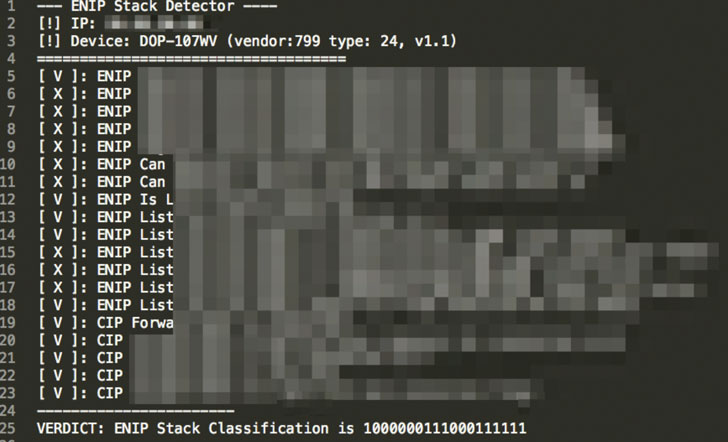
“Eleven devices were found to be running RTA’s ENIP stack in
products from six unique vendors,” the researchers said.
The flaw in itself concerns an improper check in the path
parsing mechanism employed in Common Industrial Protocol (CIP[5]) — a communication
protocol used for organizing and sharing data in industrial devices
— allowing an attacker to open a CIP request with a large
connection path size (greater than 32) and cause the parser to
write to a memory address outside the fixed-length buffer, thus
leading to the potential execution of arbitrary code.
“The older code in the RTA device attempted to reduce RAM usage
by limiting the size of a particular buffer used in an EtherNet/IP
Forward Open request,” RTA said in its disclosure[6]. “By limiting the RAM,
it made it possible for an attacker to attempt to overrun the
buffer and use that to try to get control of the device.”
Claroty researchers scanned 290 different ENIP-compatible
modules, of which 11 devices from six different vendors were found
to be using RTA’s ENIP stack. There are currently more than 8,000
ENIP-compatible internet-facing devices, according to a search on
Shodan.
“Similarly to previous disclosures, such as Ripple20[7]
or Urgent/11[8], this is another case of
a vulnerable third-party core library putting products from
[Industrial Control System] vendors at risk,” Brizinov noted in an
analysis.
It’s recommended that operators update to current versions of
the ENIP stack to mitigate the flaw. CISA also advised users to
minimize network exposure for all control system devices and ensure
that they are not accessible from the Internet.
“Locate control system networks and remote devices behind
firewalls, and isolate them from the business network,” CISA
said[9]
in its alert. “When remote access is required, use secure methods,
such as Virtual Private Networks (VPNs), recognizing that VPNs may
have vulnerabilities and should be updated to the most current
version available.”
References
- ^
ENIP
(en.wikipedia.org) - ^
advisory
(us-cert.cisa.gov) - ^
EtherNet/IP Adapter Source Code
Stack (www.rtautomation.com) - ^
disclosed to CISA
(www.claroty.com) - ^
CIP
(www.rtautomation.com) - ^
disclosure
(www.rtautomation.com) - ^
Ripple20
(thehackernews.com) - ^
Urgent/11
(thehackernews.com) - ^
said
(us-cert.cisa.gov)
Read more http://feedproxy.google.com/~r/TheHackersNews/~3/0GMh8BacG_I/researchers-warn-of-critical-flaws.html