Socially engineered SMS messages are being used to install
malware on Android devices as part of a widespread phishing
campaign that impersonates the Iranian government and social
security services to make away with credit card details and steal
funds from victims’ bank accounts.
Unlike other variants of banking malware[1]
that bank of overlay attacks to capture sensitive data without the
knowledge of the victim, the malicious applications uncovered by
Check Point Research are designed to trick the targets into handing
over their credit card information by sending them a
legitimate-looking SMS message that contains a link, which, when
clicked, downloads a malicious app on to their devices.
“The malicious application not only collects the victim’s credit
card numbers, but also gains access to their 2FA authentication
SMS, and turn[s] the victim’s device into a bot capable of
spreading similar phishing SMS to other potential victims,” Check
Point researcher Shmuel Cohen said[2]
in a new report published Wednesday.
The cybersecurity firm said it uncovered several hundred
different phishing Android applications that masqueraded as device
tracking apps, Iranian banks, dating and shopping sites,
cryptocurrency exchanges, and government-related services, with
these botnets sold as a “ready-to-use mobile campaign kit” on
Telegram channels for anywhere between $50 to $150.
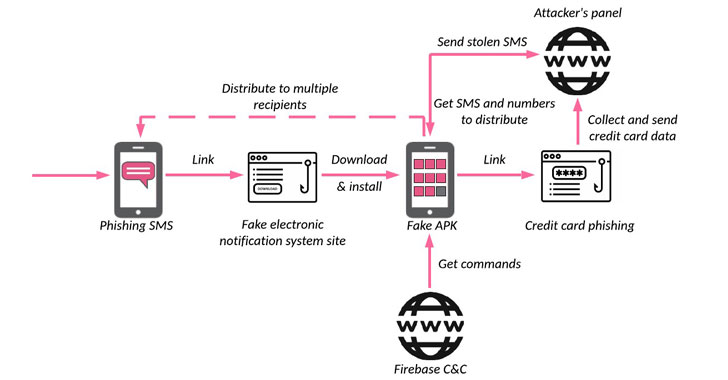
The smishing botnet’s infection chain commences with a fake
notification from the Iranian Judiciary urging users to review a
supposed complaint filed against the recipients of the message. The
link to the complaint directs the victims to what ostensibly looks
like a government website, where they are asked to enter their
personal information (e.g., name, phone number, etc.) and download
an Android APK file.
Once installed, the rogue application not only requests for
invasive permissions to perform activities that are not generally
associated with such government apps, it also presents a fake login
screen that mimics Sana, the country’s electronic judicial notice
system, and prompts the victim that they need to pay a $1 fee to
proceed further.
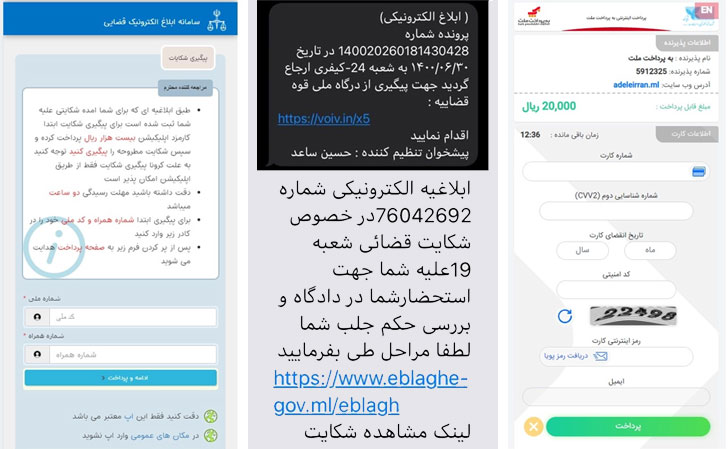
Users opting to do so are then redirected to a fake payment page
that collects the credit card information entered, while the
installed app functions as a stealthy backdoor to surreptitiously
steal one-time passcodes sent by the credit card company and
facilitate additional theft.
Furthermore, the malware comes with a wealth of capabilities
that allow it to exfiltrate all SMS messages received by a device
to an attacker-controlled server, hide its icon from the home
screen to thwart attempts to remove the app, deploy additional
payloads, and acquire worm-like powers to expand its attack surface
and spread custom smishing messages to a list of phone numbers
retrieved from the server.
“This allows the actors to distribute phishing messages from the
phone numbers of typical users instead of from a centralized place
and not be limited to a small set of phone numbers that could be
easily blocked,” Cohen explained. “This means that technically,
there are no ‘malicious’ numbers that can be blocked by the
telecommunication companies or traced back to the attacker.”
Making matters worse, the attackers behind the operation have
been found to follow poor operational security (OPSEC), thereby
making it possible for any third party to freely access the phone
numbers, contacts, SMS messages, and the list of all the online
bots hosted on their servers.
“Stealing 2FA dynamic codes allows the actors to slowly but
steadily withdraw significant amounts of money from the victims’
accounts, even in cases when due to the bank limitations each
distinct operation might garner only tens of dollars,” Cohen noted.
“Together with the easy adoption of the ‘botnet as a service’
business model, it should come as no surprise that the number of
such applications for Android and the number of people selling them
is growing.”
References
- ^
banking
malware (thehackernews.com) - ^
said
(research.checkpoint.com)
Read more https://thehackernews.com/2021/12/researchers-warn-iranian-users-of.html