Feb 01, 2023Ravie Lakshmanan

Cybersecurity researchers have disclosed details of two security
flaws in the open source ImageMagick software[1]
that could potentially lead to a denial-of-service (DoS) and
information disclosure.
The two issues, which were identified by Latin American
cybersecurity firm Metabase Q in version 7.1.0-49, were addressed[2]
in ImageMagick version 7.1.0-52[3], released in November
2022.
A brief description of the flaws is as follows –
- CVE-2022-44267 – A DoS vulnerability that
arises when parsing a PNG image with a filename that’s a single
dash (“-“) - CVE-2022-44268 – An information disclosure
vulnerability that could be exploited to read arbitrary files from
a server when parsing an image
That said, an attacker must be able to upload a malicious image
to a website using ImageMagick so as to weaponize the flaws
remotely. The specially crafted image, for its part, can be created
by inserting a text chunk[4]
that specifies some metadata of the attacker’s choice (e.g., “-”
for the filename).

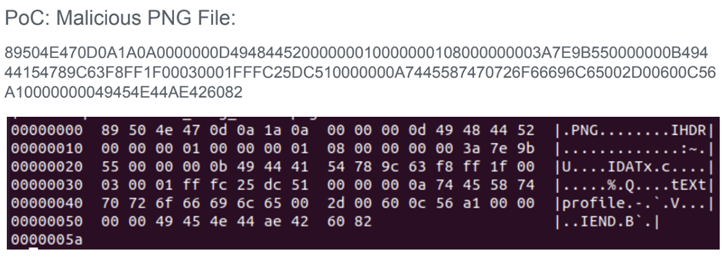
“If the specified filename is ‘-‘ (a single dash), ImageMagick
will try to read the content from standard input potentially
leaving the process waiting forever,” the researchers said in a
report[5]
shared with The Hacker News.
In the same manner, if the filename refers to an actual file
located in the server (e.g., “/etc/passwd”), an image processing
operation carried out on the input could potentially embed the
contents of the remote file after it’s complete.
This is not the first time security vulnerabilities have been
discovered in ImageMagick. In May 2016, multiple flaws were
disclosed in the software, one of which, dubbed ImageTragick[6], could have been abused
to gain remote code execution when processing user-submitted
images.
A shell injection vulnerability[7] was subsequently
revealed in November 2020, wherein an attacker could insert
arbitrary commands when converting encrypted PDFs to images via the
“-authenticate” command line parameter.
Found this article interesting? Follow us on Twitter [8]
and LinkedIn[9]
to read more exclusive content we post.
References
- ^
ImageMagick software
(imagemagick.org) - ^
addressed
(github.com) - ^
version
7.1.0-52 (github.com) - ^
text
chunk (www.w3.org) - ^
report
(www.metabaseq.com) - ^
ImageTragick
(imagetragick.com) - ^
shell
injection vulnerability
(insert-script.blogspot.com) - ^
Twitter
(twitter.com) - ^
LinkedIn
(www.linkedin.com)
Read more https://thehackernews.com/2023/02/researchers-uncover-new-bugs-in-popular.html