The North Korean nation-state group Kimusky has been linked to a
new set of malicious activities directed against political and
diplomatic entities located in its southern counterpart in early
2022.
Russian cybersecurity firm Kaspersky codenamed the cluster
GoldDragon[1], with the infection
chains leading to the deployment of Windows malware designed to
file lists, user keystrokes, and stored web browser login
credentials.
Included among the potential victims are South Korean university
professors, think tank researchers, and government officials.
Kimsuky[2], also known as Black
Banshee, Thallium, and Velvet Chollima, is the name given to a
prolific North Korean advanced persistent threat (APT) group that
targets entities globally, but with a primary focus on South Korea,
to gain intelligence on various topics of interest to the
regime.
Known to be operating since 2012, the group has a history of
employing social engineering tactics, spear-phishing, and watering
hole attacks to exfiltrate desired information from victims.
Late last month, cybersecurity firm Volexity attributed[3]
the actor to an intelligence gathering mission designed to siphon
email content from Gmail and AOL via a malicious Chrome browser
extension dubbed Sharpext.
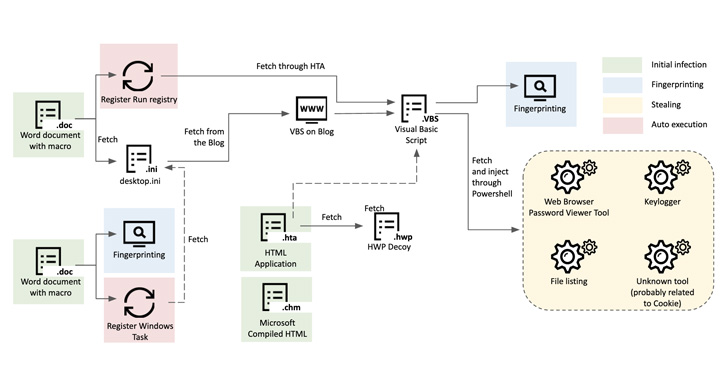
The latest campaign follows a similar modus operandi wherein the
attack sequence is initiated via spear-phishing messages containing
macro-embedded Microsoft Word documents that purportedly feature
content related to geopolitical issues in the region.
Alternative initial access routes are also said to take
advantage of HTML Application (HTA) and Compiled HTML Help (CHM)
files as decoys to compromise the system.
Regardless of the method used, the initial access is followed by
dropping a Visual Basic Script from a remote server that’s
orchestrated to fingerprint the machine and retrieve additional
payloads, including an executable capable of exfiltrating sensitive
information.
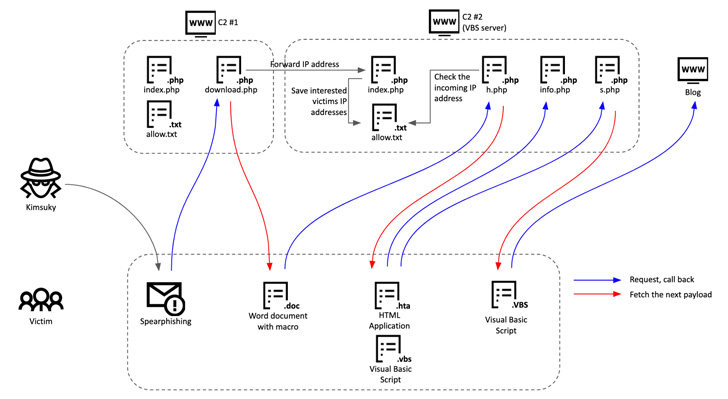
What’s novel about the attack is the transmission of the
victim’s email address to the command-and-control (C2) server
should the recipient click a link in the email to download
additional documents. If the request doesn’t contain an expected
email address, a benign document is returned.
To further complicate the kill chain, the first-stage C2 server
forwards the victim’s IP address to another VBS server, which then
compares it with an incoming request that’s generated after the
target opens the lure document.
The “victim verification methodology” in the two C2 servers
ensures that the VBScript is delivered only when the IP address
checks are successful, indicating a highly targeted approach.
“The Kimsuky group continuously evolves its malware infection
schemes and adopts novel techniques to hinder analysis,” Kaspersky
researcher Seongsu Park said. “The main difficulty in tracking this
group is that it’s tough to acquire a full-infection chain.”
References
- ^
GoldDragon
(securelist.com) - ^
Kimsuky
(thehackernews.com) - ^
attributed
(thehackernews.com)
Read more https://thehackernews.com/2022/08/researchers-uncover-kimusky-infra.html