A North Korean threat actor active since 2012 has been behind a
new espionage campaign targeting high-profile government officials
associated with its southern counterpart to install an Android and
Windows backdoor for collecting sensitive information.
Cybersecurity firm Malwarebytes attributed[1]
the activity to a threat actor tracked as Kimsuky, with the
targeted entities comprising of the Korea Internet and Security
Agency (KISA), Ministry of Foreign Affairs, Ambassador of the
Embassy of Sri Lanka to the State, International Atomic Energy
Agency (IAEA) Nuclear Security Officer, Deputy Consul General at
Korean Consulate General in Hong Kong, Seoul National University,
and Daishin Securities.
The development is only the latest in a series of surveillance
efforts aimed at South Korea. Believed to be operating on behalf of
the North Korean regime, Kimsuky (aka Velvet Chollima, Black
Banshee, and Thallium) has a track record of singling out South
Korean entities while expanding their victimology to the U.S.,
Russia, and various nations in Europe.
Last November, the adversary was linked to a new modular spyware
suite called “KGH_SPY[2]” that allows it to carry
out reconnaissance of target networks, log keystrokes, and steal
confidential information, as well as a stealthy malware under the
name “CSPY Downloader” that’s designed to thwart analysis and
download additional payloads.
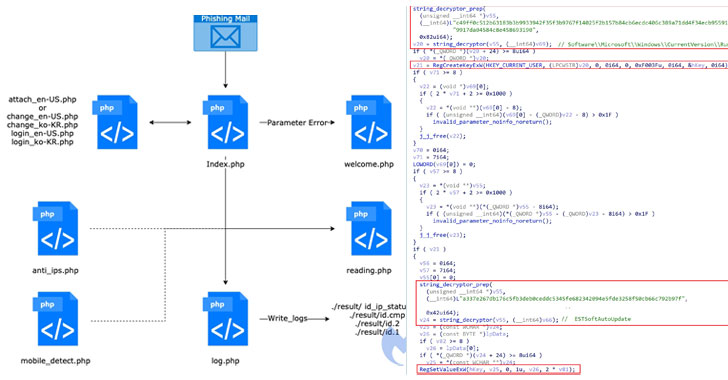
Kimsuky’s attack infrastructure consists of various phishing
websites that mimic well-known websites such as Gmail, Microsoft
Outlook, and Telegram, with an aim to trick victims into entering
their credentials. “This is one of the main methods used by this
actor to collect email addresses that later will be used to send
spear-phishing emails,” Malwarebytes researcher Hossein Jazi
said.
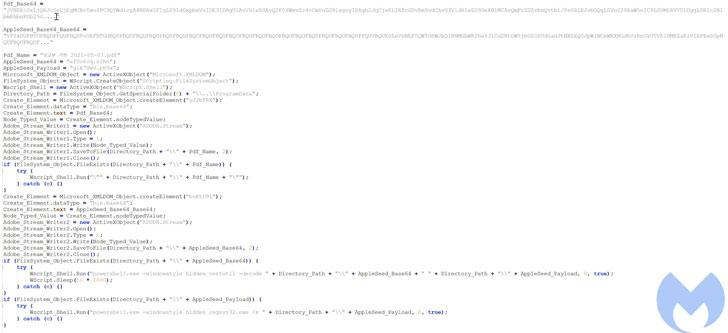
In using social engineering as a core component of its
operations, the goal is to distribute a malware dropper that takes
the form of a ZIP archive file attached to the emails, which
ultimately leads to the deployment of an encoded DLL payload called
AppleSeed[3], a backdoor that’s been
put to use by Kimusky as early as 2019[4].
“Besides using the AppleSeed backdoor to target Windows users,
the actor also has used an Android backdoor to target Android
users,” Jazi noted. “The Android backdoor can be considered as the
mobile variant of the AppleSeed backdoor. It uses the same command
patterns as the Windows one. Also, both Android and Windows
backdoors have used the same infrastructure.”
AppleSeed has all the hallmarks of a typical backdoor, with
myriad capabilities to record keystrokes, capture screenshots,
collect documents with specific extensions (.txt, .ppt, .hwp, .pdf,
and .doc), and gather data from removable media devices connected
to the machine that is then uploaded to a remote
command-and-control server.
But perhaps the most interesting discovery of all is that the
threat actor calls themselves Thallium in the malware source code,
which is the moniker assigned by Microsoft[5]
based on its tradition of naming nation-state hacking groups after
chemical elements.
References
- ^
attributed
(blog.malwarebytes.com) - ^
KGH_SPY
(thehackernews.com) - ^
AppleSeed
(malpedia.caad.fkie.fraunhofer.de) - ^
as early
as 2019 (www.virusbulletin.com) - ^
assigned
by Microsoft (blogs.microsoft.com)