A financially motivated threat actor notorious for setting its
sights on retail, hospitality, and entertainment industries has
been observed deploying a completely new backdoor on infected
systems, indicating the operators are continuously retooling their
malware arsenal to avoid detection and stay under the radar.
The previously undocumented malware has been dubbed
“Sardonic” by Romanian cybersecurity technology company
Bitdefender, which it encountered during a forensic investigation[1]
in the wake of an unsuccessful attack carried out by FIN8 aimed at
an unnamed financial institution located in the U.S.
Said to be under active development, “Sardonic backdoor is
extremely potent and has a wide range of capabilities that help the
threat actor leverage new malware on the fly without updating
components,” Bitdefender researchers Eduard Budaca and Victor
Vrabie said in a report[2]
shared with The Hacker News.
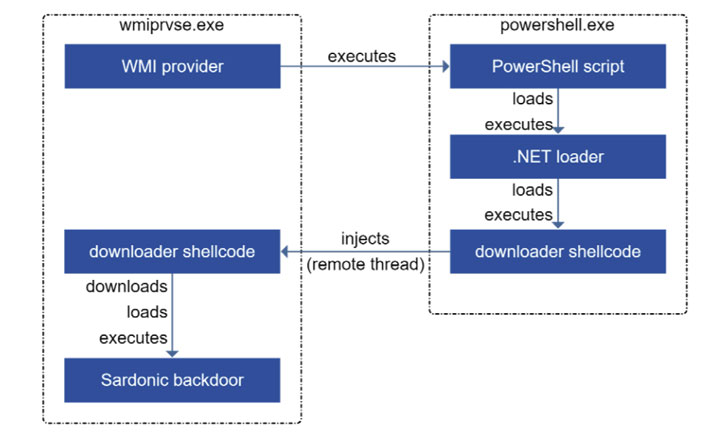
Since emerging on the scene in January 2016, FIN8 has leveraged
a multitude of techniques such as spear-phishing and malicious
software such as PUNCHTRACK[3]
and BADHATCH[4]
to steal payment card data from point-of-sale (POS) systems.
The threat group, which is known for taking extended breaks in
between campaigns to fine-tune its tactics and increase the success
rate of its operations, conducts cyber incursions primarily through
“living off the land” attacks, using built-in tools and interfaces
like PowerShell as well as taking advantage of legitimate services
like sslip.io to disguise their activity.
Earlier this March, Bitdefender revealed[5]
FIN8’s return after a year-and-a-half hiatus to target insurance,
retail, technology, and chemical industries in the U.S., Canada,
South Africa, Puerto Rico, Panama, and Italy with a revamped
version of the BADHATCH implant featuring upgraded capabilities,
including screen capturing, proxy tunneling, credential theft, and
fileless execution.
In the latest incident analyzed by the firm, the attackers are
said to have infiltrated the target network to conduct detailed
reconnaissance, before carrying out lateral movement and privilege
escalation activities to deploy the malware payload. “There were
multiple attempts to deploy the Sardonic backdoor on domain
controllers in order to continue with privilege escalation and
lateral movement, but the malicious command lines were blocked,”
the researchers said.
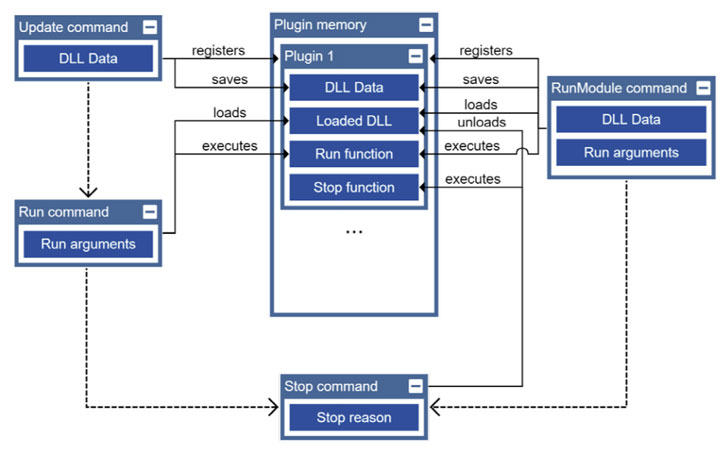
Written in C++, Sardonic not only takes steps to establish
persistence on the compromised machine, but also comes equipped
with capabilities that allow it to obtain system information,
execute arbitrary commands, and load and execute additional
plugins, the results of which are transmitted to a remote
attacker-controlled server.
If anything, the latest development is yet another sign of
FIN8’s shift in tactics by strengthening its capabilities and
malware delivery infrastructure. To mitigate the risk associated
with financial malware, companies are recommended to separate their
POS networks from those used by employees or guests, train
employees to better spot phishing emails, and improve email
security solutions to filter potentially suspicious
attachments.
References
- ^
forensic
investigation
(businessinsights.bitdefender.com) - ^
report
(www.bitdefender.com) - ^
PUNCHTRACK
(www.fireeye.com) - ^
BADHATCH
(blog.gigamon.com) - ^
revealed
(thehackernews.com)