
Capping off a busy week of charges
and sanctions[1] against Iranian
hackers, a new research offers insight into what’s a six-year-long
ongoing surveillance campaign targeting Iranian expats and
dissidents with an intention to pilfer sensitive information.
The threat actor, suspected to be of Iranian origin, is said to
have orchestrated the campaign with at least two different moving
parts — one for Windows and the other for Android — using a wide
arsenal of intrusion tools in the form of info stealers and
backdoors designed to steal personal documents, passwords, Telegram
messages, and two-factor authentication codes from SMS
messages.
Calling the operation “Rampant
Kitten[2],” cybersecurity firm
Check Point Research said the suite of malware tools had been
mainly used against Iranian minorities, anti-regime organizations,
and resistance movements such as the Association of Families of
Camp Ashraf and Liberty Residents (AFALR), Azerbaijan National
Resistance Organization, and citizens of Balochistan.
Windows Info-Stealer Targets KeePass and Telegram
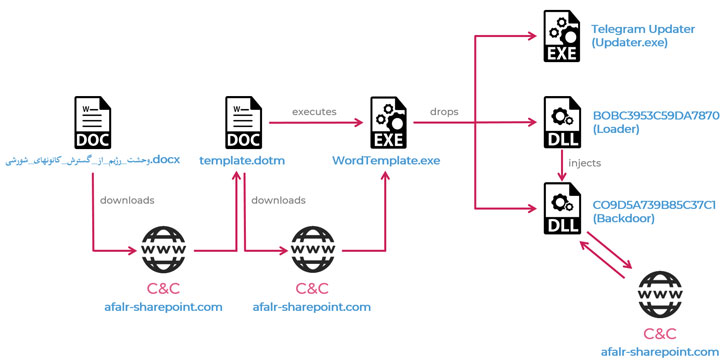
Per Check Point, the infection chain was first traced to a
malware-laced Microsoft Word document (“The Regime Fears the Spread
of the Revolutionary Cannons.docx”), which, when opened, executes a
next-stage payload that checks for the presence of the Telegram app
on the Windows system, and if so, drop three additional malicious
executables to download auxiliary modules and exfiltrate relevant
Telegram Desktop and KeePass files from the victim’s computer.
In doing so, the exfiltration allows the attacker to hijack the
individual’s Telegram account and steal the messages, as well as
amass all files with specific extensions to a server under their
control.
The research also confirms an advisory[3] from the US
Cybersecurity and Infrastructure Security Agency (CISA) earlier
this week, which detailed the use of PowerShell scripts by an
Iranian cyber actor to access encrypted password credentials stored
by the KeePass password management software.
What’s more, information from Telegram accounts was stolen using
a separate tactic that involved hosted phishing pages impersonating
Telegram, including using fake feature update messages to gain
unauthorized access to accounts.
Capture Google SMS 2FA Codes
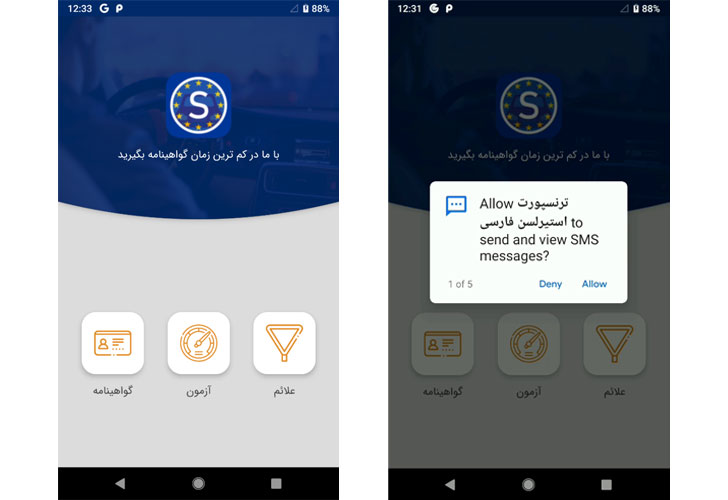
On the other hand, the Android backdoor, which comes equipped
with capabilities to record the infected phone’s surroundings and
retrieve contact details, is installed through an app that
masquerades as a service to help Persian-language speakers in
Sweden get their driver’s license.
Especially, the rogue app is engineered to intercept and
transmit all SMS messages that begin with the prefix ‘G-‘ —
typically used for Google’s SMS-based two-factor authentication
(2FA) — to a phone number that it receives from a
command-and-control (C2) server, thus allowing the bad actor to
capture the victim’s Google account credentials using a legitimate
Google account login screen and bypass 2FA.
Check Point said it uncovered multiple malware variants dating
back to 2014, with some of the versions used simultaneously and
featuring significant differences between them.
“We noticed that while some of the variants were used
simultaneously, they were written in different programming
languages, utilized multiple communication protocols and were not
always stealing the same kind of information,” the cybersecurity
firm noted.
A Surveillance Campaign Targeting Dissidents
Given the nature of targets handpicked for Rampant Kitten, like
the Mujahedin-e Khalq (MEK[4]) and the Azerbaijan
National Resistance Organization (ANRO[5]), the hackers are likely
to be working at the behest of the Iranian government, as has been
found in the recent
series of indictments[6]
unsealed by the US Department of Justice.
“The conflict of ideologies between those movements and the
Iranian authorities makes them a natural target for such an attack,
as they align with the political targeting of the regime,” Check
Point said.
“In addition, the backdoor’s functionality and the emphasis on
stealing sensitive documents and accessing KeePass and Telegram
accounts shows that the attackers were interested in collecting
intelligence about those victims, and learning more about their
activities.”
References
- ^
charges and sanctions
(thehackernews.com) - ^
Rampant Kitten
(research.checkpoint.com) - ^
advisory
(us-cert.cisa.gov) - ^
MEK
(en.wikipedia.org) - ^
ANRO
(en.wikipedia.org) - ^
recent series of indictments
(thehackernews.com)
Read more http://feedproxy.google.com/~r/TheHackersNews/~3/c4rUhXabhkU/iran-hacking-dissidents.html