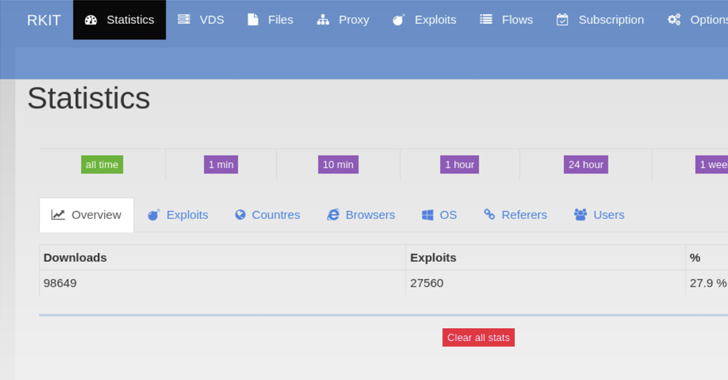
The RIG exploit kit (EK) touched an all-time high successful
exploitation rate of nearly 30% in 2022, new findings reveal.
“RIG EK is a financially-motivated program that has been active
since 2014,” Swiss cybersecurity company PRODAFT said[1]
in an exhaustive report shared with The Hacker News.
“Although it has yet to substantially change its exploits in its
more recent activity, the type and version of the malware they
distribute constantly change. The frequency of updating samples
ranges from weekly to daily updates.”
Exploit kits are programs used to distribute malware to large
numbers of victims by taking advantage of known security flaws in
commonly-used software such as web browsers.
The fact that RIG EK[2]
runs as a service model means threat actors can financially
compensate the RIG EK administrator for installing malware of their
choice on victim machines. The RIG EK operators primarily employ
malvertising to ensure a high infection rate and large-scale
coverage.
As a result, visitors using a vulnerable version of a browser to
access an actor-controlled web page or a compromised-but-legitimate
website are redirected using malicious JavaScript code to a proxy
server, which, in turn, communicates with an exploit server to
deliver the appropriate browser exploit.
The exploit server, for its part, detects the user’s browser by
parsing the User-Agent string and returns the exploit that “matches
the pre-defined vulnerable browser versions.”
“The artful design of the Exploit Kit allows it to infect
devices with little to no interaction from the end user,” the
researchers said. “Meanwhile, its use of proxy servers makes
infections harder to detect.”
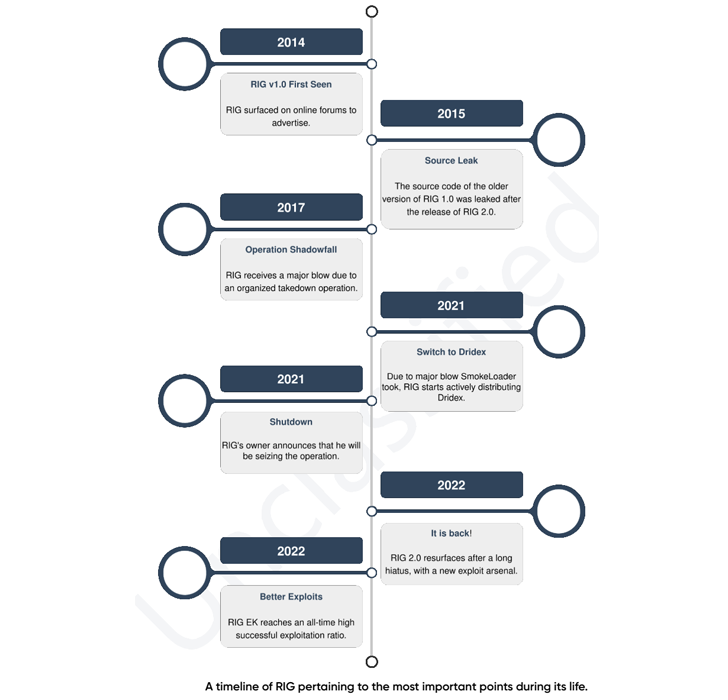
Since arriving on the scene in 2014, RIG EK has been observed
delivering a wide range of financial trojans, stealers, and
ransomware such as AZORult[3], CryptoBit[4], Dridex[5], Raccoon Stealer, and
WastedLoader. The operation was dealt a huge blow[6]
in 2017 following a coordinated action that dismantled its
infrastructure.
Recent RIG EK campaigns have targeted[7]
a memory corruption vulnerability impacting Internet Explorer
(CVE-2021-26411[8], CVSS score: 8.8) to
deploy RedLine Stealer.
Other browser flaws weaponized by the malware include CVE-2013-2551[9], CVE-2014-6332[10], CVE-2015-0313[11], CVE-2015-2419[12], CVE-2016-0189[13], CVE-2018-8174[14], CVE-2019-0752[15], and CVE-2020-0674[16].
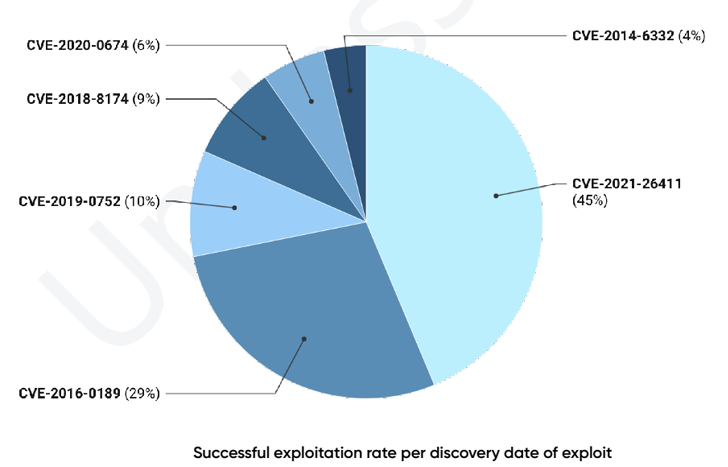
According to data collected by PRODAFT, 45% of the successful
infections in 2022 leveraged CVE-2021-26411, followed by
CVE-2016-0189 (29%), CVE-2019-0752 (10%), CVE-2018-8174 (9%), and
CVE-2020-0674 (6%).
Is Your Business Prepared for the Top SaaS ?️ Security
Challenges of 2023? Learn How to Tackle Them – Join Our Webinar
Now![17]
Besides Dridex, Raccoon, and RedLine Stealer, some of the
notable malware families distributed using RIG EK are SmokeLoader[18], PureCrypter[19], IcedID[20], ZLoader[21], TrueBot[22], Ursnif[23], and Royal ransomware[24].
Furthermore, the exploit kit is said to have attracted traffic
from 207 countries, reporting a 22% success rate over the past two
months alone. The most number of compromises are located in Russia,
Egypt, Mexico, Brazil, Saudi Arabia, Turkey, and several countries
across Europe.
“Interestingly enough, the exploit try rates were the highest on
Tuesday, Wednesday and Thursday – with successful infections taking
place on the same days of the week,” the researchers explained.
PRODAFT, which also managed to gain visibility into the kit’s
control panel, said there are about six different users, two of
whom (admin and vipr) have admin privileges. A user profile with
the alias “pit” or “pitty” has subadmin permissions, and three
others (lyr, ump, and test1) have user privileges.
“admin” is also a dummy user mainly reserved for creating other
users. The management panel, which works with a subscription, is
controlled using the “pitty” user.
However, an operational security blunder that exposed the git
server led PRODAFT to de-anonymize two of the threat actors: a
31-year-old Uzbekistan national named Oleg Lukyanov and a Russian
who goes by the name Vladimir Nikonov.
It also assessed with high confidence that the developer of the
Dridex malware has a “close relationship” with the RIG EK’s
administrators, owing to the additional manual
configuration steps taken to “ensure that the malware was
distributed smoothly.”
“Overall, RIG EK runs a very fruitful business of
exploit-as-a-service, with victims across the globe, a highly
effective exploit arsenal and numerous customers with constantly
updating malware,” the researchers said.
Found this article interesting? Follow us on Twitter [25] and LinkedIn[26] to read more exclusive
content we post.
References
- ^
said
(www.prodaft.com) - ^
RIG
EK (www.trustwave.com) - ^
AZORult
(www.malware-traffic-analysis.net) - ^
CryptoBit
(unit42.paloaltonetworks.com) - ^
Dridex
(thehackernews.com) - ^
dealt a
huge blow (www.bleepingcomputer.com) - ^
targeted
(thehackernews.com) - ^
CVE-2021-26411
(nvd.nist.gov) - ^
CVE-2013-2551
(nvd.nist.gov) - ^
CVE-2014-6332
(nvd.nist.gov) - ^
CVE-2015-0313
(nvd.nist.gov) - ^
CVE-2015-2419
(nvd.nist.gov) - ^
CVE-2016-0189
(nvd.nist.gov) - ^
CVE-2018-8174
(nvd.nist.gov) - ^
CVE-2019-0752
(nvd.nist.gov) - ^
CVE-2020-0674
(nvd.nist.gov) - ^
Join Our Webinar Now!
(thn.news) - ^
SmokeLoader
(thehackernews.com) - ^
PureCrypter
(thehackernews.com) - ^
IcedID
(thehackernews.com) - ^
ZLoader
(thehackernews.com) - ^
TrueBot
(thehackernews.com) - ^
Ursnif
(thehackernews.com) - ^
Royal
ransomware (thehackernews.com) - ^
Twitter
(twitter.com) - ^
LinkedIn
(www.linkedin.com)
Read more https://thehackernews.com/2023/02/researchers-share-new-insights-into-rig.html