FireEye and Microsoft on Thursday said they discovered three
more malware strains in connection with the SolarWinds supply-chain
attack, including a “sophisticated second-stage backdoor,” as the
investigation into the sprawling espionage campaign[1] continues to yield fresh
clues about the threat actor’s tactics and techniques.
Dubbed GoldMax (aka SUNSHUTTLE), GoldFinder, and Sibot, the new
set of malware adds to a growing list of malicious tools such as
Sunspot[2], Sunburst[3]
(or Solorigate), Teardrop[4], and Raindrop[5]
that were stealthily delivered to enterprise networks by alleged Russian operatives[6].
“These tools are new pieces of malware that are unique to this
actor,” Microsoft said[7]. “They are tailor-made
for specific networks and are assessed to be introduced after the
actor has gained access through compromised credentials or the
SolarWinds binary and after moving laterally with Teardrop and
other hands-on-keyboard actions.”
Microsoft also took the opportunity to name the actor behind the
attacks against SolarWinds as NOBELIUM, which is
also being tracked under different monikers by the cybersecurity
community, including UNC2452 (FireEye), SolarStorm (Palo Alto Unit
42), StellarParticle (CrowdStrike), and Dark Halo (Volexity).
While Sunspot was deployed into the build environment to inject
the Sunburst backdoor into SolarWinds’s Orion network monitoring
platform, Teardrop and Raindrop have been primarily used as
post-exploitation tools to laterally move across the network and
deliver the Cobalt Strike Beacon.
Spotted between August to September 2020,
SUNSHUTTLE is a Golang-based malware that acts as
a command-and-control backdoor, establishing a secure connection
with an attacker-controlled server to receive commands to download
and execute files, upload files from the system to the server, and
execute operating system commands on the compromised machine.
For its part, FireEye said it observed the malware at a victim
compromised by UNC2452, but added it hasn’t been able to fully
verify the backdoor’s connection to the threat actor. The company
also stated it discovered SUNSHUTTLE in August 2020 after it was
uploaded to a public malware repository by an unnamed U.S.-based
entity.
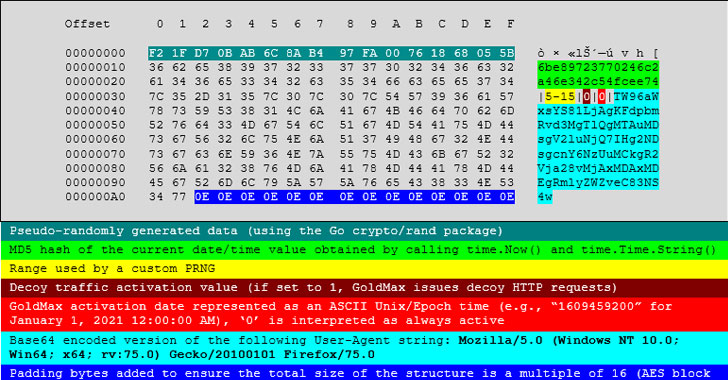
One of the most notable features of GoldMax is the ability to
cloak its malicious network traffic with seemingly benign traffic
by pseudo-randomly selecting referrers[8]
from a list of popular website URLs (such as www.bing.com,
www.yahoo.com, www.facebook.com, www.twitter.com, and
www.google.com) for decoy HTTP GET requests pointing to C2
domains.
“The new SUNSHUTTLE backdoor is a sophisticated second-stage
backdoor that demonstrates straightforward but elegant detection
evasion techniques via its ‘blend-in’ traffic capabilities for C2
communications,” FireEye detailed[9]. “SUNSHUTTLE would
function as a second-stage backdoor in such a compromise for
conducting network reconnaissance alongside other Sunburst-related
tools.”
GoldFinder, also written in Go, is an HTTP
tracer tool for logging the route a packet takes to reach a C2
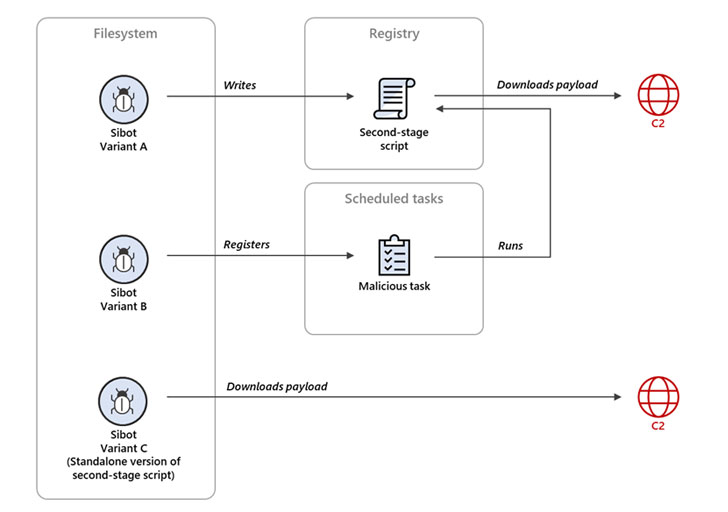
server. In contrast, Sibot is a dual-purpose
malware implemented in VBScript that’s designed to achieve
persistence on infected machines before downloading and executing a
payload from the C2 server. Microsoft said it observed three
obfuscated variants of Sibot.
Even as the different pieces of SolarWinds attack puzzle[10] fall into place, the
development once again underscores the scope and sophistication in
the range of methods used to penetrate, propagate, and persist in
victim environments.
“These capabilities differ from previously known NOBELIUM tools
and attack patterns, and reiterate the actor’s sophistication,”
Microsoft said. “In all stages of the attack, the actor
demonstrated a deep knowledge of software tools, deployments,
security software and systems common in networks, and techniques
frequently used by incident response teams.”
References
- ^
sprawling espionage campaign
(thehackernews.com) - ^
Sunspot
(thehackernews.com) - ^
Sunburst
(thehackernews.com) - ^
Teardrop
(thehackernews.com) - ^
Raindrop
(thehackernews.com) - ^
alleged
Russian operatives (thehackernews.com) - ^
said
(www.microsoft.com) - ^
referrers
(en.wikipedia.org) - ^
detailed
(www.fireeye.com) - ^
SolarWinds attack puzzle
(thehackernews.com)