Cybersecurity researchers on Tuesday revealed details of a
previously undocumented UEFI[1]
(Unified Extensible Firmware Interface) bootkit that has been put
to use by threat actors to backdoor Windows systems as early as
2012 by modifying a legitimate Windows Boot Manager binary to
achieve persistence, once again demonstrating how technology meant
to secure the environment prior to loading the operating system is
increasingly becoming a “tempting target.”
Slovak cybersecurity firm ESET codenamed the new malware
“ESPecter” for its ability to persist on the EFI System Partition
(ESP[2]), in addition to
circumventing Microsoft Windows Driver Signature Enforcement to
load its own unsigned driver that can be used to facilitate
espionage activities such as document theft, keylogging, and screen
monitoring by periodically capturing screenshots.
“ESPecter shows that threat actors are relying not only on UEFI
firmware implants when it comes to pre-OS persistence and, despite
the existing security mechanisms like UEFI Secure Boot, invest
their time into creating malware that would be easily blocked by
such mechanisms, if enabled and configured correctly,” ESET
researchers Martin Smolár and Anton Cherepanov said[3]
in a technical write-up published Tuesday.
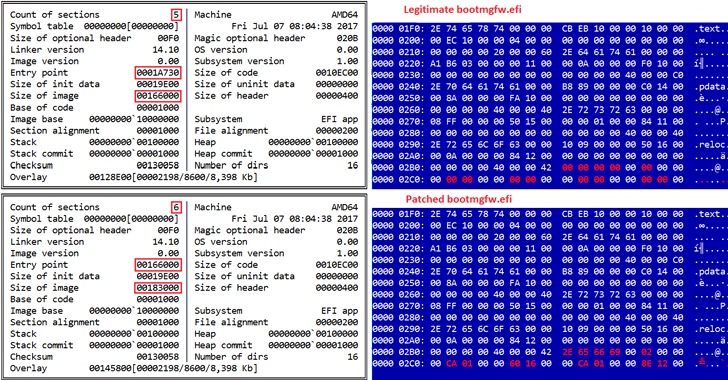
The development marks the fourth time real-world cases of UEFI
malware have been discovered so far, following LoJax[4], MosaicRegressor[5], and most recently
FinFisher[6], the last of which was
found leveraging the same method of compromise to persist on the
ESP in the form of a patched Windows Boot Manager.
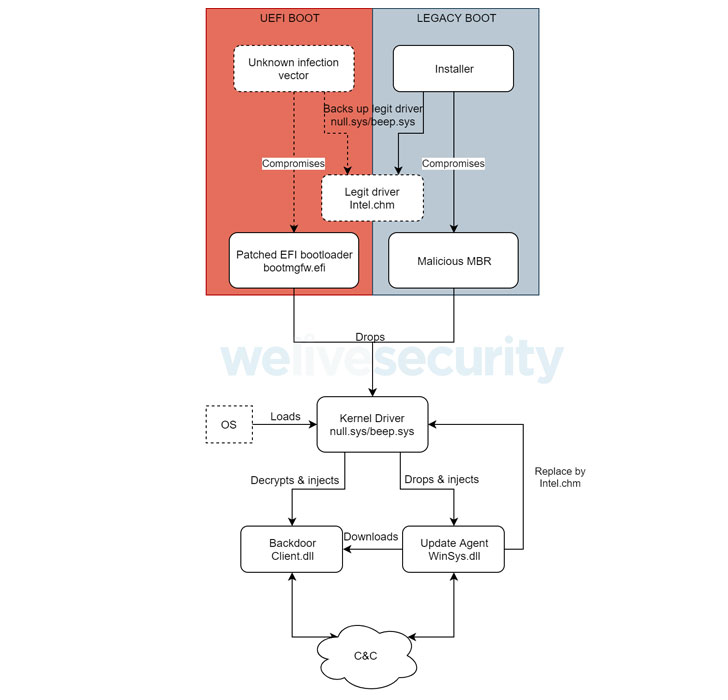
“By patching the Windows Boot Manager, attackers achieve
execution in the early stages of the system boot process, before
the operating system is fully loaded,” the researchers said. “This
allows ESPecter to bypass Windows Driver Signature Enforcement
(DSE) in order to execute its own unsigned driver at system
startup.”
However, on systems that support Legacy BIOS Boot Mode[7], ESPecter gains
persistence by altering the master boot record (MBR[8]) code located in the
first physical sector of the disk drive to interfere with the
loading of the boot manager and load the malicious kernel driver,
which is designed to load additional user-mode payloads and set up
the keylogger, before erasing its own traces from the machine.
In the final phase, the driver is used to inject next-stage
user-mode components into specific system processes to establish
communications with a remote server, thereby enabling an attacker
to commandeer the compromised machine and take over control, not to
mention download and execute more malware or commands fetched from
the server.
ESET did not attribute the bootkit to a particular nation-state
or hacking group, but the use of Chinese debug messages in the
user-mode client payload has raised the possibility that it could
be the work of an unknown Chinese-speaking threat actor.
“Even though Secure Boot stands in the way of executing
untrusted UEFI binaries from the ESP, over the last few years we
have been witness to various UEFI firmware vulnerabilities
affecting thousands of devices that allow disabling or bypassing
Secure Boot,” the researchers noted. “This shows that securing UEFI
firmware is a challenging task and that the way various vendors
apply security policies and use UEFI services is not always
ideal.”
References
Read more http://feedproxy.google.com/~r/TheHackersNews/~3/Az0020v418M/researchers-discover-uefi-bootkit.html