
two new potentially serious CPU vulnerabilities that could allow
attackers to retrieve cryptographic keys protected inside TPM chips
manufactured by STMicroelectronics or firmware-based Intel TPMs.
Trusted Platform Module (TPM) is a specialized hardware
or firmware-based security solution that has been designed to store
and protect sensitive information from attackers even when your
operating system gets compromised.
TMP technology
is being used widely by billion of desktops, laptops, servers,
smartphones, and even by Internet-of-Things (IoT) devices to
protect encryption keys, passwords, and digital certificates.
[1]
Collectively dubbed as TPM-Fail[2], both newly found
vulnerabilities, as listed below, leverage a timing-based
side-channel attack to recover cryptographic keys that are
otherwise supposed to remain safely inside the chips.
According to researchers, elliptic curve signature operations on
TPMs from various manufacturers are vulnerable to timing leakage
issues, which could lead to the recovery of a private key by
measuring the execution time of operation inside the TPM device.
“A privileged adversary can exploit the OS kernel to perform
accurate timing measurement of the TPM, and thus discover and
exploit timing vulnerabilities in cryptographic implementations
running inside the TPM.”
“They are practical [attacks]. A local adversary can recover the
ECDSA key from Intel fTPM in 4-20 minutes, depending on the access
level.”
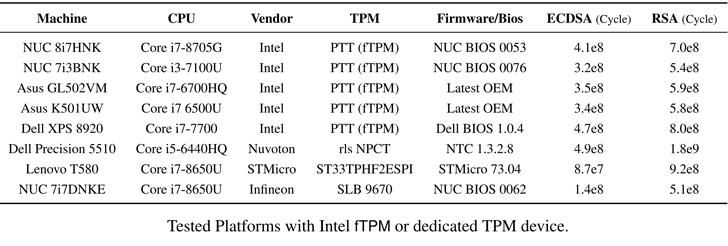
managed to recover 256-bit ECDSA and ECSchnorr private keys by
collecting signature timing data with and without administrative
privileges.
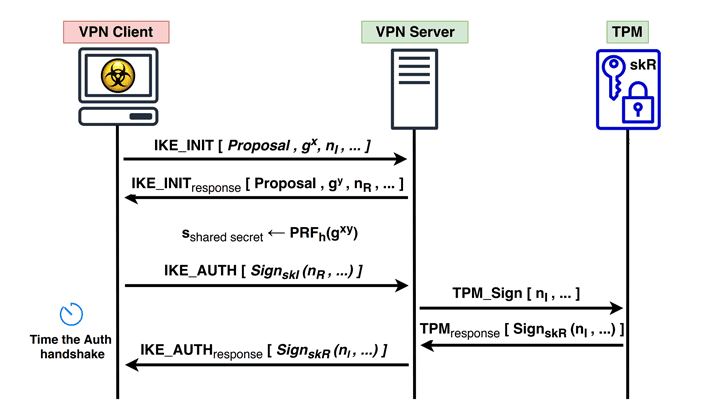
“Further, we managed to recover ECDSA keys from an fTPM-endowed
server running StrongSwan VPN over a noisy network as measured by a
client.”
authentication key by timing only 45,000 authentication handshakes
via a network connection.”
“The fact that a remote attack can extract keys from a TPM
device certified as secure against side-channel leakage underscores
the need to reassess remote attacks on cryptographic
implementations.”
signatures, steal or alter encrypted information, and bypass OS
security features or compromise applications that rely on the
integrity of the keys.
“The vulnerable Intel fTPM is used by many PC and laptop
manufacturers, including Lenovo, Dell, and HP.”
Besides this, researchers also tested TMP solutions manufactured
by Infineon and Nuvoton and found them vulnerable to non-constant
execution timing leakage issues.
Researchers responsibly reported their findings to Intel and
STMicroelectronics in February this year, and the companies just
yesterday released a patch update for affected products.
References
- ^
TMP technology
(thehackernews.com) - ^
TPM-Fail
(tpm.fail) - ^
code on GitHub
(github.com)
Read more http://feedproxy.google.com/~r/TheHackersNews/~3/sGUCG7JW4WY/tpm-encryption-keys-hacking.html