
Security researchers have discovered the first known malware,
dubbed “Siloscope,” targeting Windows Server containers to
infect Kubernetes clusters in cloud environments.
“Siloscape is heavily obfuscated malware targeting Kubernetes
clusters through Windows containers,” said[1]
Unit 42 researcher Daniel Prizmant. “Its main purpose is to open a
backdoor into poorly configured Kubernetes clusters in order to run
malicious containers such as, but not limited to,
cryptojackers.”
Siloscape, first detected in March 2021, is characterized by
several techniques, including targeting common cloud applications
such as web servers to gain an initial foothold via known
vulnerabilities, following which it leverages Windows container
escape techniques to break out of the confines of the container and
gain remote code execution on the underlying node.
A container is an isolated, lightweight silo[2] for running an
application on the host operating system. The malware’s name —
short for silo escape — is derived from its primary goal to escape
the container, in this case, the silo. To achieve this, Siloscape
uses a method called Thread Impersonation.
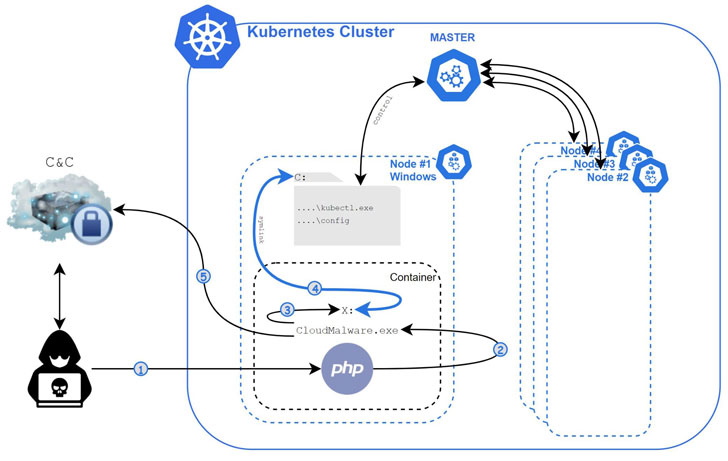
“Siloscape mimics CExecSvc.exe[3]
privileges by impersonating its main thread and then calls
NtSetInformationSymbolicLink on a newly created symbolic link to
break out of the container,” said Prizmant. “More specifically, it
links its local containerized X drive to the host’s C drive.”
Armed with this privilege, the malware then attempts to abuse
the node’s credentials to spread across the cluster, before
anonymously establishing a connection to its command-and-control
(C2) server using a Tor proxy for further instructions, including
taking advantage of the computing resources in a Kubernetes cluster
for cryptojacking and even exfiltrating sensitive data from
applications running in the compromised clusters.
After gaining access to the C2 server, Unit 42 said it found 23
active victims, with the server hosting a total of 313 users. The
campaign is said to have begun at least around Jan. 12, 2020, based
on the creation date of the C2 server, suggesting that the malware
could just be a small part of a larger campaign that started over a
year ago.
“Unlike most cloud malware, which mostly focuses on resource
hijacking and denial of service (DoS), Siloscape doesn’t limit
itself to any specific goal,” Prizmant noted. “Instead, it opens a
backdoor to all kinds of malicious activities.” In addition to
securely configuring Kubernetes clusters, it’s also recommended to
deploy Hyper-V containers if containerization is utilized as a form
of the security boundary.
References
- ^
said
(unit42.paloaltonetworks.com) - ^
isolated, lightweight silo
(docs.microsoft.com) - ^
CExecSvc.exe
(strontic.github.io)
Read more http://feedproxy.google.com/~r/TheHackersNews/~3/26A21V2RALs/researchers-discover-first-known.html