
A group of academics from the North Carolina State University
and Dokuz Eylul University have demonstrated what they say is the
“first side-channel attack” on homomorphic encryption that could be
exploited to leak data as the encryption process is underway.
“Basically, by monitoring power consumption in a device that is
encoding data for homomorphic encryption, we are able to read the
data as it is being encrypted,” Aydin Aysu, one of the authors of
the study, said[1]. “This demonstrates that
even next generation encryption technologies need protection
against side-channel attacks.”
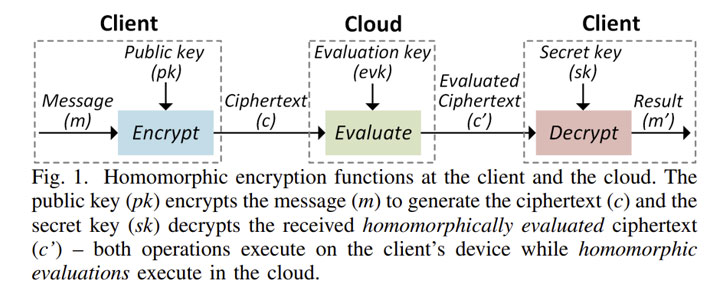
Homomorphic Encryption is a form of encryption[2]
that allows certain types of computation to be performed directly
on encrypted data without having to decrypt it in the first
place.
It’s also meant to be privacy-preserving in that it allows
sharing of sensitive data with other third-party services, such as
data analytics firms, for further processing while the underlying
information remains encrypted, and by extension, inaccessible to
the service provider.
Put differently, the goal of homomorphic encryption is to
facilitate the development of end-to-end encrypted data storage and
computation services where the data owner never needs to share
their secret keys with third-party services.
The data leakage attack proposed by the researchers involves a
vulnerability discovered in Microsoft SEAL[3], the tech giant’s
open-source[4]
implementation[5]
of the technology, which could be exploited in a manner that allows
the recovery of a piece of plaintext message that’s being
homomorphically encrypted, effectively undoing the privacy
protections.
Specifically, the attack, dubbed RevEAL, “targets the
Gaussian sampling[6]
in the SEAL’s encryption phase and can extract the entire message
with a single power measurement,” by taking advantage of a
“power-based side-channel leakage of Microsoft SEAL prior to v3.6
that implements the Brakerski/Fan-Vercauteren (BFV[7]) protocol,” the
researchers said.
The researchers noted[8]
that SEAL versions 3.6, released on December 3, 2020, and later use
a different sampling algorithm, while cautioning that newer
versions of the library may suffer from a “different
vulnerability.”
“Encryption error is sampled from a Centered Binomial
Distribution (CBD[9]) by default unless
‘SEAL_USE_GAUSSIAN_NOISE’ is set to ON,” Kim Laine, Microsoft’s
principal research manager who heads the Cryptography and Privacy
Research Group, said[10] in the release
notes.
“Sampling from a CBD is constant-time and faster than sampling
from a Gaussian distribution, which is why it is used by many of
the NIST PQC[11] finalists,” Laine
further added.
References
- ^
said
(news.ncsu.edu) - ^
form of
encryption (en.wikipedia.org) - ^
Microsoft SEAL
(www.microsoft.com) - ^
open-source
(github.com) - ^
implementation
(docs.microsoft.com) - ^
Gaussian
sampling (en.wikipedia.org) - ^
BFV
(en.wikipedia.org) - ^
noted
(research.ece.ncsu.edu) - ^
CBD
(en.wikipedia.org) - ^
said
(github.com) - ^
NIST
PQC (en.wikipedia.org)
Read more https://thehackernews.com/2022/03/researchers-demonstrate-new-side.html