Dec 30, 2022Ravie Lakshmanan

A security researcher was awarded a bug bounty of $107,500 for
identifying security issues in Google Home smart speakers that
could be exploited to install backdoors and turn them into
wiretapping devices.
The flaws “allowed an attacker within wireless proximity to
install a ‘backdoor’ account on the device, enabling them to send
commands to it remotely over the internet, access its microphone
feed, and make arbitrary HTTP requests within the victim’s LAN,”
the researcher, who goes by the name Matt, disclosed[1]
in a technical write-up published this week.
In making such malicious requests, not only could the Wi-Fi
password get exposed, but also provide the adversary direct access
to other devices connected to the same network. Following
responsible disclosure on January 8, 2021, the issues were
remediated by Google in April 2021.
The problem, in a nutshell, has to do with how the Google Home
software architecture can be leveraged to add a rogue Google user
account to a target’s home automation device.
In an attack chain detailed by the researcher, a threat actor
looking to eavesdrop on a victim can trick the individual into
installing a malicious Android app, which, upon detecting a Google
Home device on the network, issues stealthy HTTP requests to link
an attacker’s account to the victim’s device.
Taking things a notch higher, it also emerged that, by staging a
Wi-Fi deauthentication attack[2] to force a Google Home
device to disconnect from the network[3], the appliance can be
made to enter a “setup mode” and create its own open Wi-Fi
network.
The threat actor can subsequently connect to the device’s setup
network and request details[4]
like device name, cloud_device_id, and certificate, and use them to
link their account to the device.
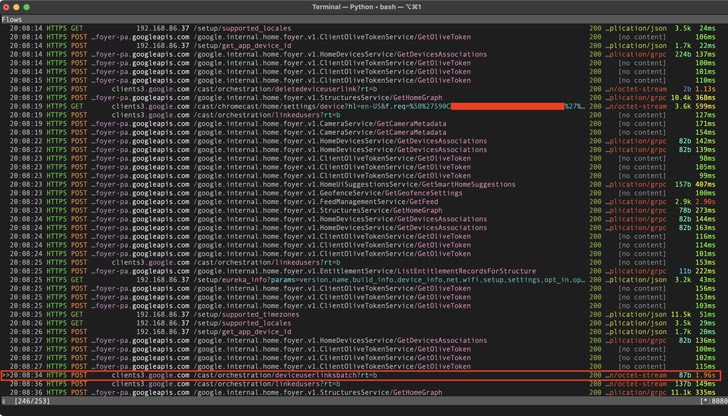
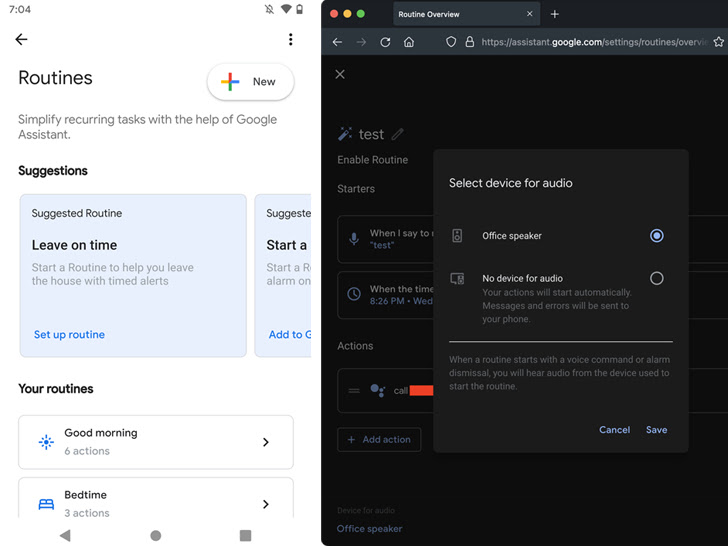
Regardless of the attack sequence employed, a successful link
process enables the adversary to take advantage of Google Home routines[5]
to turn down the volume to zero and call a specific phone number[6] at any given point in
time to spy on the victim through the device’s microphone.
“The only thing the victim may notice is that the device’s LEDs
turn solid blue, but they’d probably just assume it’s updating the
firmware or something,” Matt said. “During a call, the LEDs do not
pulse like they normally do when the device is listening, so there
is no indication that the microphone is open.”
Furthermore, the attack can be extended to make arbitrary HTTP
requests within the victim’s network and even read files or
introduce malicious modifications on the linked device that would
get applied after a reboot.
This is not the first time such attack methods have been devised
to covertly snoop on potential targets through voice-activated
devices.
In November 2019, a group of academics disclosed a technique
called Light Commands[7], which refers to a
vulnerability of MEMS microphones[8]
that permits attackers to remotely inject inaudible and invisible
commands into popular voice assistants like Google Assistant,
Amazon Alexa, Facebook Portal, and Apple Siri using light.
Found this article interesting? Follow us on Twitter [9]
and LinkedIn[10] to read more exclusive
content we post.
References
- ^
disclosed
(downrightnifty.me) - ^
Wi-Fi
deauthentication attack (en.wikipedia.org) - ^
disconnect from the network
(hackernoon.com) - ^
request details
(arxiv.org) - ^
Google
Home routines (support.google.com) - ^
call a
specific phone number (support.google.com) - ^
Light
Commands (thehackernews.com) - ^
MEMS
microphones (thehackernews.com) - ^
Twitter
(twitter.com) - ^
LinkedIn
(www.linkedin.com)
Read more https://thehackernews.com/2022/12/researcher-uncovers-potential.html
