An Indian security researcher has publicly published a
proof-of-concept (PoC) exploit code for a newly discovered flaw
impacting Google Chrome and other Chromium-based browsers like
Microsoft Edge, Opera, and Brave.
Released by Rajvardhan Agarwal, the working exploit[1]
concerns a remote code execution vulnerability in the V8 JavaScript
rendering engine that powers the web browsers. It is believed to be
the same flaw demonstrated by Dataflow Security’s Bruno Keith and
Niklas Baumstark at Pwn2Own 2021 hacking contest[2] last week.
Keith and Baumstark were awarded $100,000 for leveraging the
vulnerability to run malicious code inside Chrome and Edge.
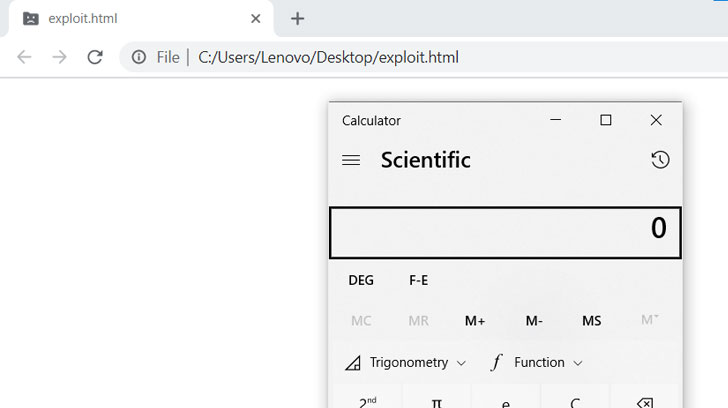
According to the screenshot shared by Agarwal, the PoC HTML
file, and its associated JavaScript file, can be loaded in a
Chromium-based browser to exploit the security flaw and launch the
Windows calculator (calc.exe) app. But it’s worth noting that the
exploit needs to be chained with another flaw that can allow it to
escape Chrome’s sandbox[3]
protections.
It appears that Agarwal was able to put together the PoC by
reverse-engineering the patch that Google’s Chromium team pushed to
the open-source component after details of the flaw were shared
with the company.
“Getting popped with our own bugs wasn’t on my bingo card for
2021,” Baumstark tweeted[4]. “Not sure it was too
smart of Google to add that regression test right away.”
While Google has addressed the issue in the latest version of
V8, it’s yet to make its way to the stable channel, thereby leaving
the browsers vulnerable to attacks. Google is expected to ship
Chrome 90 later today, but it’s not clear if the release will
include a patch for the V8 flaw.
We have reached out to Google, and we will update the story if
we hear back.
References
Read more http://feedproxy.google.com/~r/TheHackersNews/~3/xnTh85fU5Rk/rce-exploit-released-for-unpatched.html