
The Raspberry Robin worm is becoming an
access-as-a-service malware for deploying other payloads, including
IcedID[1], Bumblebee[2], TrueBot[3]
(aka Silence), and Clop ransomware[4].
It is “part of a complex and interconnected malware ecosystem,
with links to other malware families and alternate infection
methods beyond its original USB drive spread,” the Microsoft
Security Threat Intelligence Center (MSTIC) said[5]
in a detailed write-up.
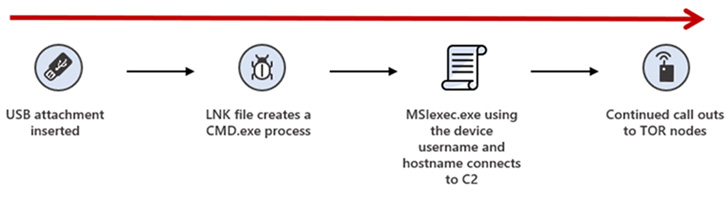
Raspberry Robin[6], also called QNAP Worm
owing to the use of compromised QNAP storage servers for
command-and-control, is the name given to a malware by
cybersecurity company Red Canary that spreads to Windows systems
through infected USB drives.
MSTIC is keeping tabs on the activity group behind the USB-based
Raspberry Robin infections as DEV-0856, adding
it’s aware of at least four confirmed entry points that all have
the likely end goal of deploying ransomware.
The tech giant’s cybersecurity team said that Raspberry Robin
has evolved from a widely distributed worm with no observed
post-infection actions to one of the largest malware distribution
platforms currently active.
According to telemetry data collected from Microsoft Defender
for Endpoint, roughly 3,000 devices spanning nearly 1,000
organizations have encountered at least one Raspberry Robin
payload-related alert in the last 30 days.
The latest development adds to growing evidence of
post-exploitation activities linked to Raspberry Robin, which, in
July 2022, was discovered[7]
acting as a conduit to deliver the FakeUpdates (aka SocGholish)
malware.
This FakeUpdates activity has also been followed by
pre-ransomware behavior attributed to a threat cluster tracked by
Microsoft as DEV-0243 (aka Evil Corp), the infamous Russian
cybercrime syndicate behind the Dridex trojan and a
command-and-control (C2) framework called TeslaGun[8].
Microsoft, in October 2022, said it detected Raspberry Robin
being used in post-compromise activity attributed to a different
threat actor it has codenamed DEV-0950 and which overlaps with
groups monitored publicly as FIN11 and TA505.
While the names FIN11 and TA505 have often been used
interchangeably, Google-owned Mandiant (formerly FireEye) describes[9]
FIN11 as a subset of activity under the TA505 group[10].
It’s also worth pointing out the conflation of Evil Corp and TA505[11], although Proofpoint
assesses[12] “TA505 to be different
than Evil Corp,” suggesting that these clusters share partial
tactical commonalities with one another.
“From a Raspberry Robin infection, the DEV-0950 activity led to
Cobalt Strike hands-on-keyboard compromises, sometimes with a
Truebot infection observed in between the Raspberry Robin and
Cobalt Strike stage,” the researcher said. “The activity culminated
in deployments of the Clop ransomware.”
Microsoft also theorized that the actors behind these Raspberry
Robin-related malware campaigns are paying the worm’s operators for
payload delivery, enabling them to move away from phishing as a
vector to acquire new victims.
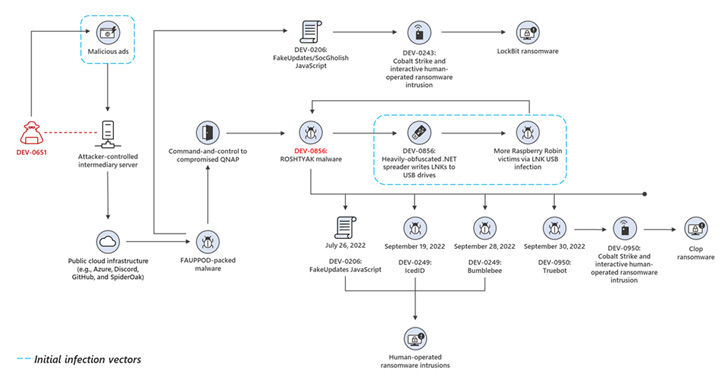
What’s more, a cybercriminal actor dubbed DEV-0651 has been
linked to the distribution of another artifact called Fauppod
through the abuse of legitimate cloud services, which exhibits code
similarities to Raspberry Robin and also drops the FakeUpdates
malware.
The Windows maker further noted wih medium confidence that
Fauppod represents the earliest known link in the Raspberry Robin
infection chain for propagating the latter via LNK files to USB
drives.
To add to the attack puzzle, IBM Security X-Force, early last
month, identified[13] functional similarities
between a loader component used in the Raspberry Robin infection
chain and the Dridex malware. Microsoft is attributing this
code-level connection to Fauppod adopting Dridex’s methods to avoid
execution in specific environments.
“Raspberry Robin’s infection chain is a confusing and complicated map[14] of multiple infection
points that can lead to many different outcomes, even in scenarios
where two hosts are infected simultaneously,” Microsoft said.
References
- ^
IcedID
(thehackernews.com) - ^
Bumblebee
(thehackernews.com) - ^
TrueBot
(thehackernews.com) - ^
Clop
ransomware (thehackernews.com) - ^
said
(www.microsoft.com) - ^
Raspberry Robin
(thehackernews.com) - ^
discovered
(thehackernews.com) - ^
TeslaGun
(thehackernews.com) - ^
describes
(www.mandiant.com) - ^
TA505
group (www.proofpoint.com) - ^
Evil
Corp and TA505 (twitter.com) - ^
assesses
(twitter.com) - ^
identified
(thehackernews.com) - ^
complicated map
(decoded.avast.io)
Read more https://thehackernews.com/2022/10/raspberry-robin-operators-selling.html