Jan 16, 2023Ravie Lakshmanan

A “large and resilient infrastructure” comprising over 250
domains is being used to distribute information-stealing malware
such as Raccoon[1]
and Vidar[2]
since early 2020.
The infection chain “uses about a hundred of fake cracked
software catalogue websites that redirect to several links before
downloading the payload hosted on file share platforms, such as
GitHub,” cybersecurity firm SEKOIA said[3]
in an analysis published earlier this month.
The French cybersecurity company assessed the domains to be
operated by a threat actor running a traffic direction system
(TDS[4]), which allows other
cybercriminals to rent the service to distribute their malware.
The attacks target users searching for cracked versions of
software and games on search engines like Google, surfacing
fraudulent websites on top by leveraging a technique called search
engine optimization (SEO) poisoning to lure victims into
downloading and executing the malicious payloads.
The poisoned result comes with a download link to the promised
software that, upon clicking, triggers a five-stage URL redirection
sequence to take the user to a web page displaying a shortened
link, which points to a password-protected RAR archive file hosted
on GitHub, along with its password.
“Using several redirections complicates automated analysis by
security solutions,” the researchers said. “Carving the
infrastructure as such is almost certainly designed to ensure
resilience, making it easier and quicker to update or change a
step.”
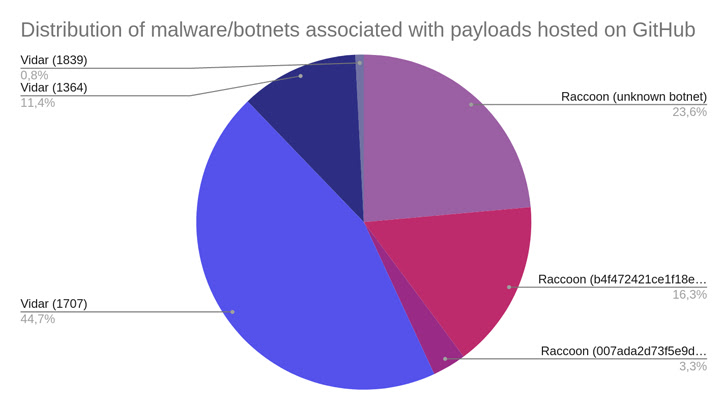
Should the victim uncompress the RAR archive and run the
purported setup executable contained within it, either of the two
malware families, Raccoon or Vidar, are installed on the
system.
The development comes as Cyble detailed[5]
a rogue Google Ads campaign that employs widely-used software such
as AnyDesk, Bluestacks, Notepad++, and Zoom as lures to deliver a
feature-rich stealer known as Rhadamanthys Stealer.
An alternate variant of the attack chain has been observed
taking advantage of phishing emails masquerading as bank statements
to dupe unwitting users into clicking on fraudulent links.
Fabricated websites impersonating the popular remote desktop
solution have also been put to use in the past to propagate a
Python-based information stealer dubbed Mitsu Stealer[6].
Both pieces of malware are equipped to siphon a wide range of
personal information from compromised machines, harvest credentials
from web browsers, and steal data from various cryptocurrency
wallets.
Users are advised to refrain from downloading pirated software
and enforce multi-factor authentication wherever possible to harden
accounts.
“It is crucial for users to exercise caution when receiving spam
emails or to visit phishing websites and to verify the source
before downloading any applications,” the researchers said.
Found this article interesting? Follow us on Twitter [7]
and LinkedIn[8]
to read more exclusive content we post.
References
Read more https://thehackernews.com/2023/01/raccoon-and-vidar-stealers-spreading.html