Today, businesses face a variety of security challenges like
cyber attacks, compliance requirements, and endpoint security
administration. The threat landscape constantly evolves, and it can
be overwhelming for businesses to keep up with the latest security
trends. Security teams use processes and security solutions to curb
these challenges. These solutions include firewalls, antiviruses,
data loss prevention services, and XDRs (Extended Detection and
Response).
Wazuh is a free and open source security platform that unifies
XDR and SIEM (System Information and Event Management)
capabilities. It comprises a universal security agent for event
data collection from various sources and the central components for
event analysis, correlation, and alerting. The central components
include the Wazuh server, dashboard, and indexer. Wazuh offers a
suite of modules capable of providing extended threat detection and
response for on-premises and cloud workloads.
In this article, we emphasize the capabilities of Wazuh that are
beneficial to your organization’s security needs.
Threat intelligence
Wazuh includes the MITRE ATT&CK module with threat detection
rules out-of-the-box. The MITRE ATT&CK module provides details
that allow threat hunters to recognize adversary tactics,
techniques, and procedures (TTPs). These include details such as
the threat groups, software, and mitigation measures. You can use
this information to narrow down threats or compromised endpoints in
your environment. Wazuh threat detection rules are mapped against
their corresponding MITRE ATT&CK IDs.
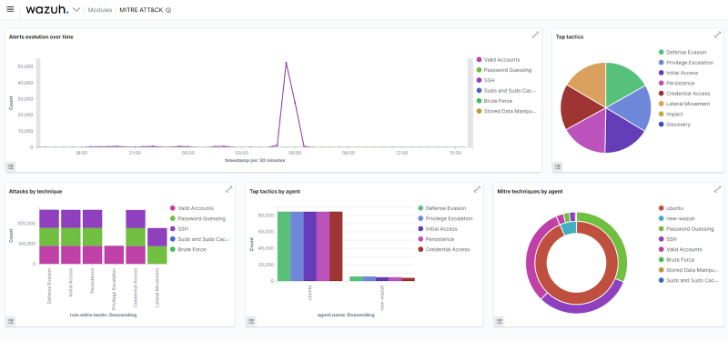 |
| Fig 1: Wazuh MITRE ATT&CK dashboard |
Wazuh integrates seamlessly with third-party threat intelligence
solutions like VirusTotal, MISP, URLHaus, and YARA. These
integrations enable the checking of file hashes, IP addresses, and
URLs against recognized malicious indicators of compromise (IOCs).
Wazuh integration with these solutions improves your business’
overall security posture by providing additional insights on
potential threats, malicious activities, and IOCs.
A Vulnerability is a security weakness or flaw that can be
exploited by threats to perform malicious activities in a computer
system. Wazuh offers the Vulnerability Detector module to help
businesses identify and prioritize vulnerabilities in their
environments. This module uses data from multiple feeds such as
Canonical, Microsoft, the National Vulnerability Database (NVD),
and more to provide real-time information about
vulnerabilities.
Threat detection and response
Wazuh uses its modules, decoders, ruleset, and integration with
third-party solutions to detect and protect your digital assets
from threats. These threats include malware, web, network attacks,
and more.
The Wazuh File Integrity Monitoring module monitors directories
and reports file addition, deletion, and modifications. It is used
to audit sensitive files but can be combined with other
integrations to detect malware. The rootcheck module is used to
detect rootkit behaviors like hidden files, ports, and unusual
processes. The Wazuh active response module provides automated
response actions such as quarantining infected systems, blocking
network traffic, or terminating the ransomware processes. The
combination of these modules allows for a quick response to
mitigate the impact of cyberattacks.
The image below illustrates the combination of the FIM module,
VirusTotal integration, and the active response module in detecting
and responding to malware downloaded on a monitored endpoint.
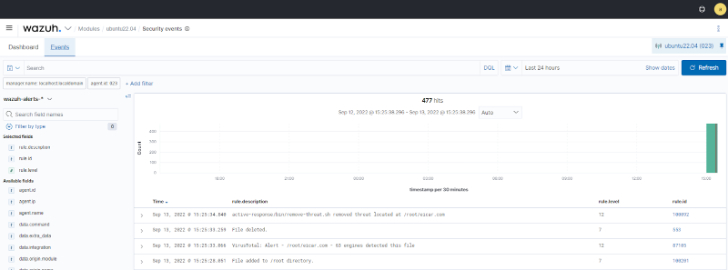 |
| Fig 2: Malicious file detected and deleted from a monitored endpoint |
Audit and regulatory compliance
Security auditing and compliance are two important concepts for
any business that aims to protect itself against cyber attacks.
Security auditing is the systematic process of evaluating an
organization’s information systems, practices, and procedures to
identify vulnerabilities, assess risks, and ensure that security
controls function as intended. Regulatory compliance refers to the
process of certifying that an organization adheres to a set of
established standards, regulations, or laws related to information
security.
Wazuh helps businesses pass security audits and meet regulatory
compliance requirements. Compliance standards offer a set of
guidelines and optimal procedures to guarantee the safety of an
organization’s systems, network, and data. Adhering to these
standards helps lower the likelihood of a security breach. Wazuh
has various modules that help meet compliance standards like PCI
DSS, GDPR, NIST, etc. The post Using the Wazuh SIEM and XDR platform to
meet PCI DSS compliance[1]
shows how Wazuh plays an important role in maintaining PCI
compliance for your organization. The image below shows a Wazuh
NIST dashboard.
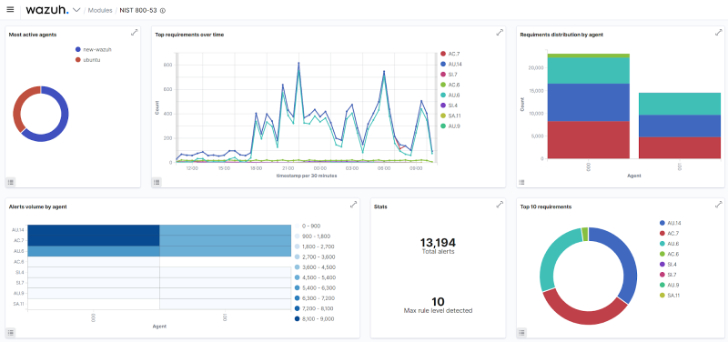 |
| Fig 3: The Wazuh NIST dashboard |
Cloud security
Cloud platforms provide services that manage computing, storage,
and networking operations through the Internet. Businesses are
widely adopting these cloud platforms because of their easy access
to resources, flexibility, and high scalability. As more
organizations leverage the use of the cloud, maintaining the
security of their digital assets remains critical.
Wazuh is a unified XDR and SIEM platform that provides
visibility and security monitoring for cloud environments. It
monitors and protects cloud services running on Amazon Web
Services, Microsoft Azure, and Google Cloud Platform. It achieves
this by collecting and analyzing security event data from various
cloud components. Such data allows Wazuh to perform vulnerability
detection, cloud compliance checks, security monitoring, and
automated responses to detected threats.
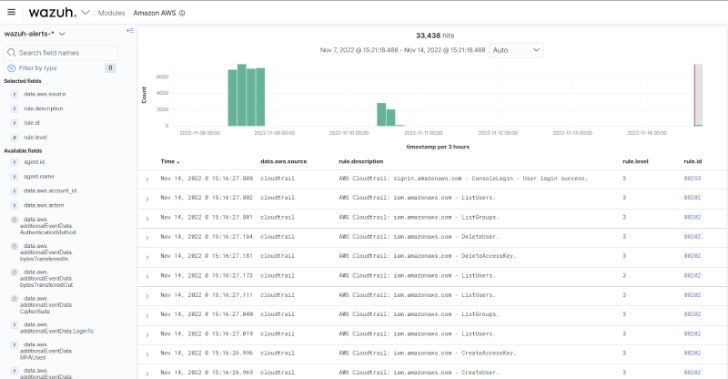 |
| Fig 4: Wazuh monitoring the AWS CloudTrail service |
Endpoint hardening
The Wazuh SCA module performs configuration assessments on
systems and applications, ensuring the host is secure and the
vulnerability surface is reduced. Wazuh uses policy files to scan
endpoints for misconfigurations and vulnerabilities. These policy
files are included out-of-the-box and based on the Center for
Internet Security (CIS) benchmark. The SCA scan results provide
insight into the vulnerabilities present on a monitored endpoint.
These vulnerabilities range from configuration flaws to installed
vulnerable versions of the applications and services. Failed
security checks are displayed alongside their remediation, giving
system administrators a quick resolution pathway.
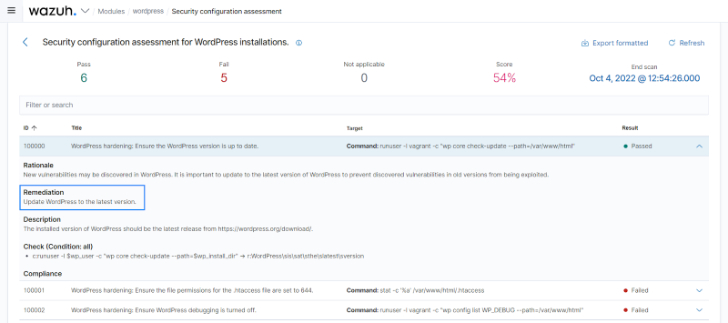 |
| Fig 5: Failed SCA check and remediation for a WordPress installation |
Open source
Wazuh has a fast-growing community[2]
where users, developers, and contributors can ask questions about
the platform and share collaborative ideas. The Wazuh community
provides users with free support, resources, and documentation.
Wazuh, as an open source security platform, provides easy
flexibility and customization. Users can modify the source code to
suit their specific needs or add new features and capabilities. The
Wazuh source code is publicly available on the Wazuh GitHub
repository for users that may wish to perform verification checks
or contributions.
Conclusion
Wazuh is a free and open source platform with robust XDR and
SIEM capabilities. With capabilities such as log data analysis,
file integrity monitoring, intrusion detection, and automated
response, Wazuh gives businesses the ability to quickly and
effectively respond to security incidents.
Found this article interesting? Follow us on Twitter [3]
and LinkedIn[4]
to read more exclusive content we post.
References
Read more https://thehackernews.com/2023/04/protecting-your-business-with-wazuh.html