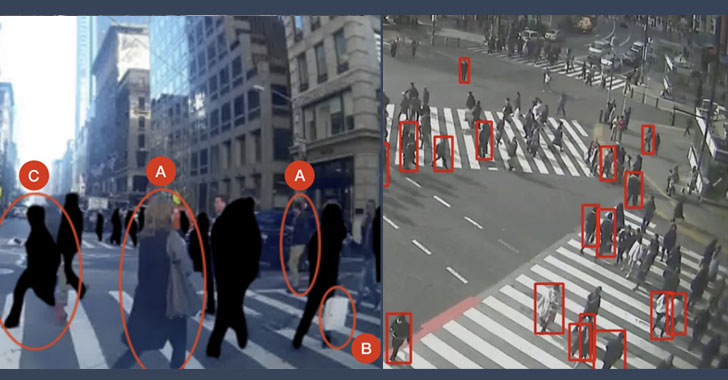
A group of academics has designed a new system known as
“Privid” that enables video analytics in a
privacy-preserving manner to combat concerns with invasive
tracking.
“We’re at a stage right now where cameras are practically
ubiquitous. If there’s a camera on every street corner, every place
you go, and if someone could actually process all of those videos
in aggregate, you can imagine that entity building a very precise
timeline of when and where a person has gone,” Frank Cangialosi,
the lead author of the study and a researcher at the MIT’s Computer
Science and Artificial Intelligence Laboratory (CSAIL), said[1]
in a statement.
“People are already worried about location privacy with GPS —
video data in aggregate could capture not only your location
history, but also moods, behaviors, and more at each location,”
Cangialosi added.
Privid is built on the foundation of differential privacy[2], a statistical technique[3]
that makes it possible to collect and share aggregate information
about users, while safeguarding individual privacy.
This is achieved by adding random noise[4]
to the results to prevent re-identification attacks. The amount of
noise added is a trade-off – adding more noise makes the data more
anonymous, but it also makes the data less useful – and it’s
determined by the privacy budget, which ensures that the results
are still accurate and at the same time configured low enough to
prevent data leakage.
The querying framework involves an approach called
duration-based privacy wherein the target video is chopped
temporally into chunks of same duration that’s then fed separately
into the analyst’s video processing module to produce the “noisy”
aggregate result.
The underlying idea is that by adding specialized types of noise
to the data or analysis methods, it can prevent relevant parties
from identifying an individual while simultaneously not obscuring
findings about societal patterns that emerge when performing
analyses on the video inputs, such as, say, counting the number of
people that passed by a camera in one day, or computing the average
speed of cars observed.
This also prevents a malicious actor from singling out specific
individuals and determining their presence (or lack thereof) in the
videos.
“In building Privid, we do not advocate for the increase of
public video surveillance and analysis. Instead, we observe that it
is already prevalent, and is driven by strong economic and public
safety incentives,” the researchers concluded.
“Consequently, it is undeniable that the analysis of public
video will continue, and thus, it is paramount that we provide
tools to improve the privacy landscape for such analytics.”
References
- ^
said
(news.mit.edu) - ^
differential privacy
(en.wikipedia.org) - ^
statistical technique
(thenextweb.com) - ^
adding
random noise
(accuracyandprivacy.substack.com)
Read more https://thehackernews.com/2022/03/privid-privacy-preserving-surveillance.html