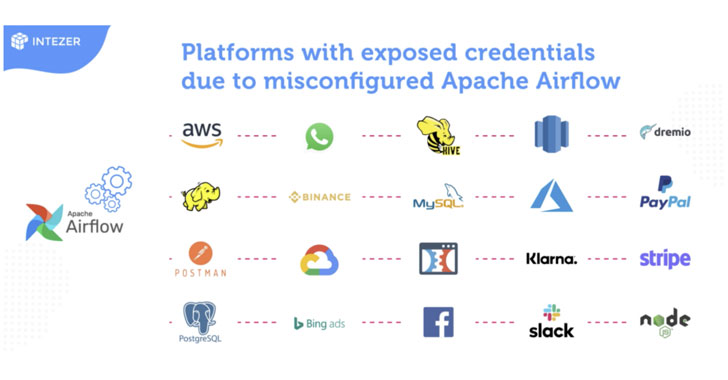
Cybersecurity researchers on Monday discovered misconfigurations
across older versions of Apache Airflow instances belonging to a
number of high-profile companies across various sectors, resulting
in the exposure of sensitive credentials for popular platforms and
services such as Amazon Web Services (AWS), Binance, Google Cloud
Platform (GCP), PayPal, Slack, and Stripe.
“These unsecured instances expose sensitive information of
companies across the media, finance, manufacturing, information
technology (IT), biotech, e-commerce, health, energy,
cybersecurity, and transportation industries,” Intezer said in a
report[1]
shared with The Hacker News.
Originally launched in June 2015, Apache
Airflow[2] is an open-source
workflow management platform that enables programmatic scheduling
and monitoring of workflows on AWS, GCP, Microsoft Azure, and other
third-party services. It’s also one of the most popular task
orchestration tools, followed by Luigi, Kubeflow, and MLflow.
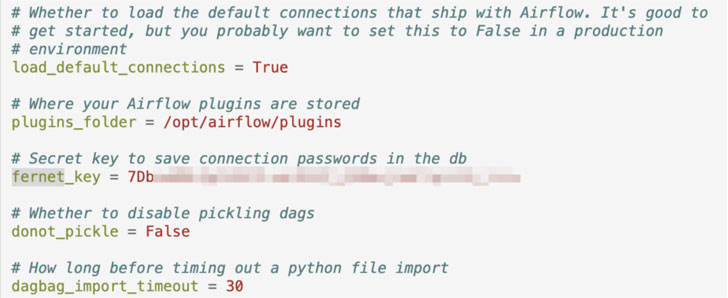
Some of the most common insecure coding practices uncovered by
Intezer include the use of hard-coded database passwords in Python
DAG code or variables[3], plaintext credentials
in the “Extra” field of connections[4], and cleartext keys in
configuration files (airflow.cfg).
Chief among the concerns associated with misconfigured Airflow
instances is the exposure of credentials that could be abused by
threat actors to gain access to accounts and databases, giving them
the ability to spread laterally or result in data leakage, not to
mention lead to violation of data protection laws and give an
insight into an organization’s tools and packages, which could
later be exploited to stage supply-chain attacks.
“If a large number of passwords are visible, a threat actor can
also use this data to detect patterns and common words to infer
other passwords,” Intezer researchers said. “These can be leveraged
in dictionary or brute-force-style attacks against other
platforms.”
Even more concerning is also the possibility that malware can be
launched on the exposed production environments by leveraging the
Variables feature to modify the container image variables to point
to a different image containing unauthorized code.
Apache Airflow, for its part, has remediated a lot of security
issues with version 2.0.0 that was released in December 2020,
making it critical that users of the software update to the latest
version and adopt secure coding practices to prevent passwords from
being exposed.
References
- ^
report
(www.intezer.com) - ^
Apache Airflow
(airflow.apache.org) - ^
variables
(airflow.apache.org) - ^
connections
(airflow.apache.org)
Read more http://feedproxy.google.com/~r/TheHackersNews/~3/u66NJxSUooY/poorly-configured-apache-airflow.html