Feb 27, 2023Ravie Lakshmanan
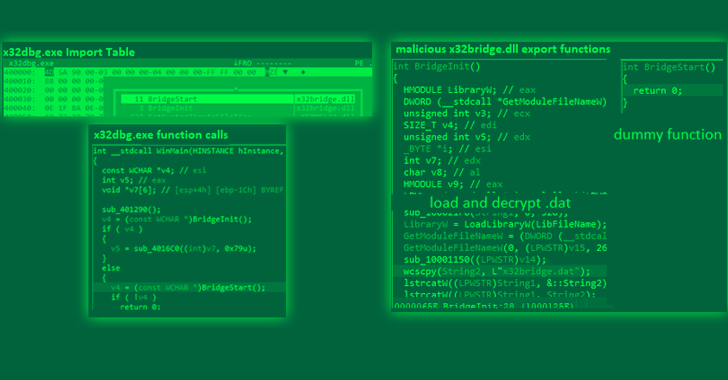
The PlugX remote access trojan has been
observed masquerading as an open source Windows debugger tool
called x64dbg in an attempt to circumvent security protections and
gain control of a target system.
“This file is a legitimate open-source debugger tool for Windows
that is generally used to examine kernel-mode and user-mode code,
crash dumps, or CPU registers,” Trend Micro researchers Buddy
Tancio, Jed Valderama, and Catherine Loveria said[1]
in a report published last week.
PlugX, also known as Korplug[2], is a post-exploitation
modular implant[3], which, among other
things, is known for its multiple functionalities such as data
exfiltration and its ability to use the compromised machine for
nefarious purposes.
Although first documented a decade ago in 2012, early samples of
the malware date as far as February 2008, according to a Trend Micro report[4]
at the time. Over the years, PlugX has been used by threat actors
with a Chinese nexus as well as cybercrime groups.
One of the key methods the malware employs is a technique
DLL side-loading[5]
to load a malicious DLL[6]
from a digitally signed software application, in this case the
x64dbg[7] debugging tool
(x32dbg.exe).
It’s worth noting here that DLL side-loading attacks leverage
the DLL search order mechanism[8] in Windows to plant and
then invoke a legitimate application that executes a rogue
payload.
“Being a legitimate application, x32dbg.exe’s valid digital
signature can confuse some security tools, enabling threat actors
to fly under the radar, maintain persistence, escalate privileges,
and bypass file execution restrictions,” the researchers said.
The hijacking of x64dbg to load PlugX was disclosed last month
by Palo Alto Networks Unit 42, which discovered[9]
a new variant of the malware that hides malicious files on
removable USB devices to propagate the infection to other Windows
hosts.
Persistence is achieved via Windows Registry modifications and
the creation of scheduled tasks to ensure continued access even
after system restarts.
Trend Micro’s analysis of the attack chain also revealed the use
of x32dbg.exe to deploy a backdoor, a UDP shell client that
collects system information and awaits additional instructions from
a remote server.
“Despite advances in security technology, attackers continue to
use [DLL side-loading] since it exploits a fundamental trust in
legitimate applications,” the researchers said.
“This technique will remain viable for attackers to deliver
malware and gain access to sensitive information as long as systems
and applications continue to trust and load dynamic libraries.”
Found this article interesting? Follow us on Twitter [10] and LinkedIn[11] to read more exclusive
content we post.
References
- ^
said
(www.trendmicro.com) - ^
Korplug
(www.cybereason.com) - ^
modular
implant (logrhythm.com) - ^
Trend
Micro report (web.archive.org) - ^
DLL
side-loading (attack.mitre.org) - ^
malicious DLL
(www.cybereason.com) - ^
x64dbg
(x64dbg.com) - ^
DLL
search order mechanism
(learn.microsoft.com) - ^
discovered
(thehackernews.com) - ^
Twitter
(twitter.com) - ^
LinkedIn
(www.linkedin.com)
Read more https://thehackernews.com/2023/02/plugx-trojan-disguised-as-legitimate.html