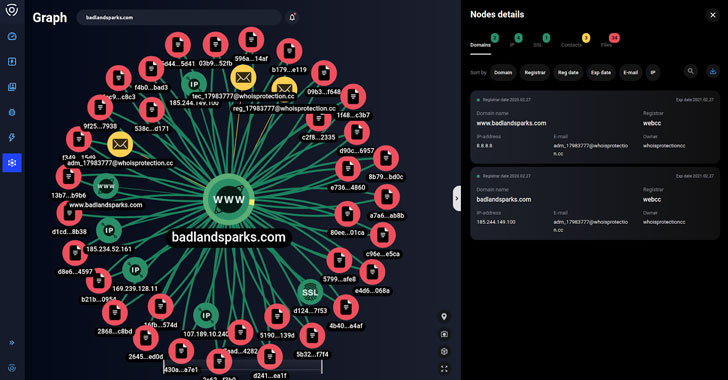
A cybercrime group known for targeting e-commerce websites
unleashed a “multi-stage malicious campaign” earlier this year
designed with an intent to distribute information stealers and
JavaScript-based payment skimmers.
In a new report published today and shared with The Hacker News,
Singapore-based cybersecurity firm Group-IB attributed the
operation to the same group that’s been linked to a separate attack
aimed at online merchants using password-stealing malware to infect
their websites with FakeSecurity JavaScript-sniffers[1] (JS-sniffers).
The campaign progressed in four waves, starting in February and
ending in September, with the operators relying on
specially-crafted phishing pages and lure documents laced with
malicious macros to download Vidar and Raccoon information stealers
onto victim systems.
The ultimate goal of the attack, the researchers noted, was to
steal payment and user data via several attack vectors and tools to
deliver the malware.
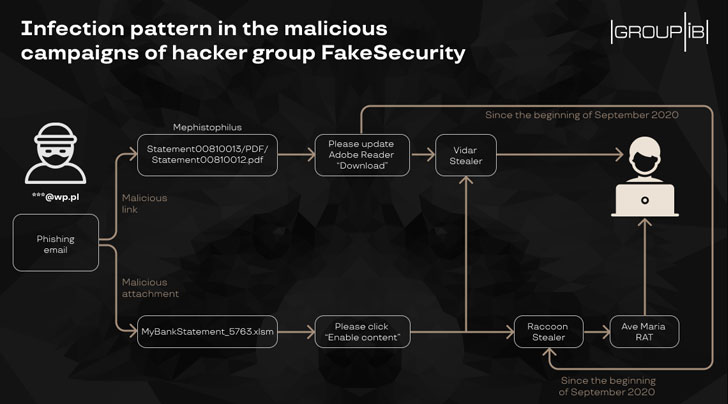
The fake web pages were created using the Mephistophilus
phishing kit[2], which allows attackers
to create and deploy phishing landing pages engineered for
distributing malware.
“Attackers sent links to fake pages that informed victims about
a missing plugin required to display the document correctly,”
Group-IB researchers explained[3]
in an analysis of the cybercrime group’s tactics last November. “If
a user downloaded the plugin, their computer was infected with the
password-stealing malware.”
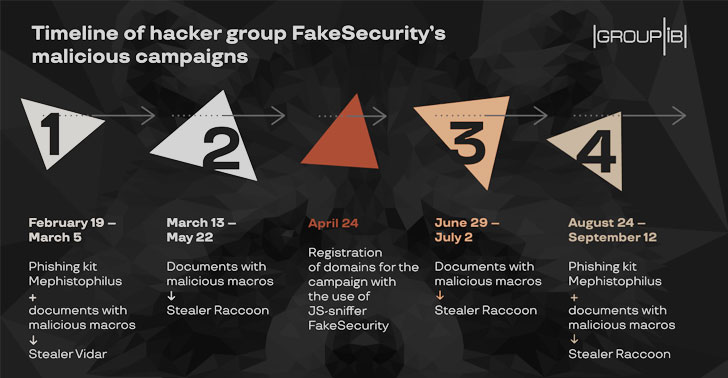
While the first wave of the campaign in February and March
delivered the Vidar password stealer to intercept passwords from
user browsers and various applications, subsequent iterations
switched to the Raccoon stealer and AveMaria RAT to meet its
objectives.
Raccoon, first documented by Cybereason[4]
last year, comes with a wide range of capabilities and communicates
with a command-and-control (C2) server to siphon data — including
screenshots, credit card information, cryptocurrency wallets,
stored browser passwords, emails, and system details.
Raccoon is also unique in that it bypasses the blocking of
active C2 servers by making a request to a Telegram channel
(“blintick”) in order to receive the encrypted address of the C2
server, besides offering 24×7 customer support to community
questions and comments through the chat service.
AveMaria[5]
RAT, likewise, is capable of ensuring persistence, recording
keystrokes, injecting malicious code, and exfiltrating sensitive
files, among others.
Both Vidar and Raccoon are sold as malware-as-a-service (MaaS)
on underground forums. The rental price for Vidar stealer ranges
from $250 to $300 per month, whereas the latter costs $200 a month
to use.
Along with the four stages described above, Group-IB also
observed an interim phase between May to September 2020, during
when as many as 20 online stores were infected with a modified
JS-sniffer of the FakeSecurity family.
Interestingly, the infrastructure used to distribute the Vidar
and Raccoon stealers were reused to store the sniffer code and
collect stolen bank card data, leading the researchers to link the
two campaigns.
The development is yet another sign that adversaries are
stepping up their efforts[6] to compromise online
marketplaces to pilfer customer payment information, even as law
enforcement agencies are working to tackle cybercrime.
Earlier this January, the Interpol[7], acting on digital
forensic evidence from Group-IB, nabbed three individuals
associated with a group called “GetBilling[8]” as part of an operation
codenamed Night Fury for running a JS-sniffer campaign in
Indonesia.
References
- ^
FakeSecurity JavaScript-sniffers
(www.group-ib.com) - ^
phishing
kit (www.imperva.com) - ^
explained
(www.group-ib.com) - ^
Cybereason
(www.cybereason.com) - ^
AveMaria
(malpedia.caad.fkie.fraunhofer.de) - ^
stepping
up their efforts (thehackernews.com) - ^
Interpol
(www.interpol.int) - ^
GetBilling
(www.group-ib.com)
Read more http://feedproxy.google.com/~r/TheHackersNews/~3/X4mYQ76sv48/payment-card-skimmer-group-using.html