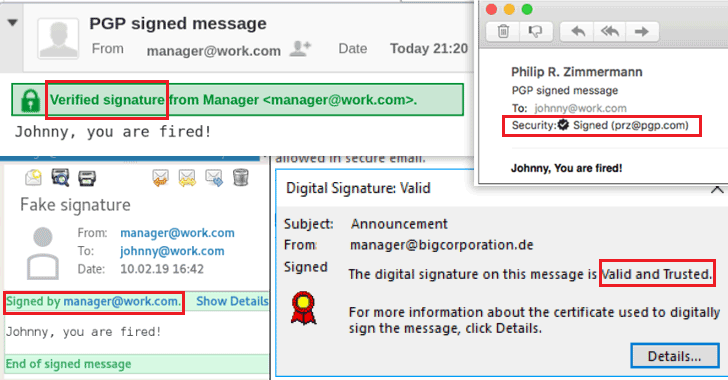
vulnerabilities in various implementations of OpenPGP and S/MIME
email signature verification that could allow attackers to spoof
signatures on over a dozen of popular email clients.
The affected email clients include Thunderbird, Microsoft
Outlook, Apple Mail with GPGTools, iOS Mail, GpgOL, KMail,
Evolution, MailMate, Airmail, K-9 Mail, Roundcube and Mailpile.
When you send a digitally signed email, it offers end-to-end
authenticity and integrity of messages, ensuring recipients that
the email has actually come from you.
However, researchers tested 25 widely-used email clients for
Windows, Linux, macOS, iOS, Android and Web and found that at least
14 of them were vulnerable to multiple types of practical attacks
under five below-mentioned categories, making spoofed signatures
indistinguishable from a valid one even by an attentive
user.
The research was conducted by a team of researchers from Ruhr
University Bochum and Münster University of Applied Sciences, which
includes Jens Müller , Marcus Brinkmann , Damian Poddebniak , Hanno
Böck, Sebastian Schinzel , Juraj Somorovsky, and Jörg Schwenk.
“In our scenario, we assume two trustworthy communication partners,
Alice and Bob, who have securely exchanged their public PGP keys or
S/MIME certificates,” the team explains in a research paper
[PDF] published
today.
“The goal of our attacker Eve is to create and send an email
with arbitrary content to Bob whose email client falsely indicates
that the email has been digitally signed by Alice.”
of Cryptographic Message Syntax (CMS), the container format of
S/MIME, lead to contradicting or unusual data structures, such as
multiple signers or no signers.
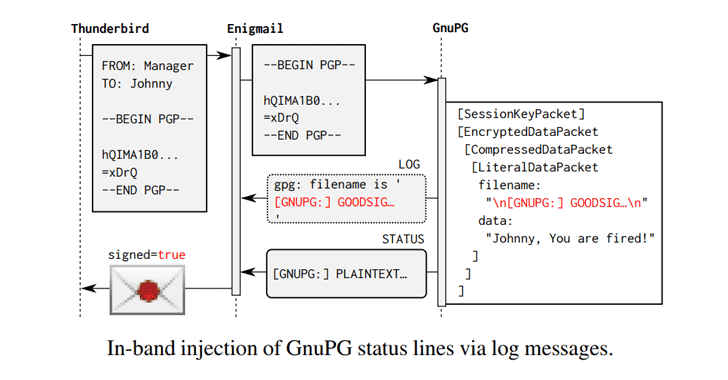
2) GPG API Attacks (G1, G2) — Implementation flaws in
many email clients fail to properly parse a wide range of different
inputs that could allow attackers to inject arbitrary strings into
GnuPG status line API and logging messages, tricking clients into
displaying successful signature validation for arbitrary public
keys.
attacks abuse how email clients handle partially signed messages.
These attacks allow attackers to trick email clients into showing
an unsigned text while verifying an unrelated signature in another
part (which remains invisible).
4) ID attacks (I1, I2, I3) — These attacks rely on the
weaknesses in the binding of signed messages to the sender identity
by mail clients, allowing attackers to display a valid signature
from the identity (ID) of a trusted communication partner located
in the mail header.
5) UI Attacks (U1) — User Interface (UI) redressing
attacks are successful if attackers found a way to mimic, using
HTML, CSS, or inline images, some important UI elements of an email
client that could allow them to display an indicator of a valid
signature.
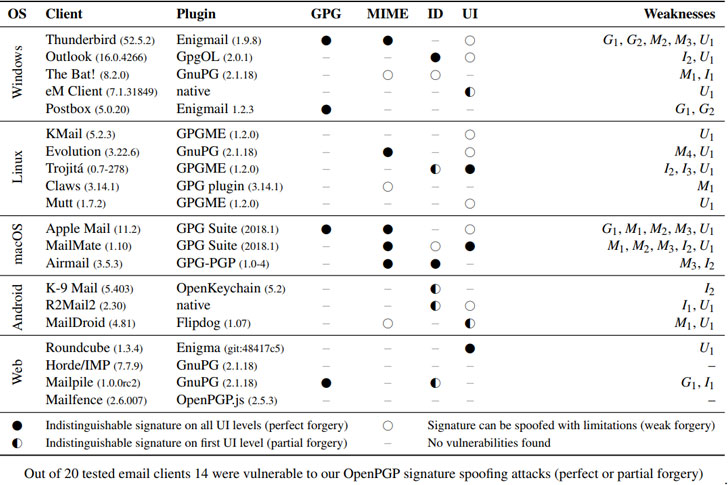
Below are the results of all of the above-mentioned signature
spoofing attacks tested against various email clients for OpenPGP,
where full blacked circle indicator represents “Perfect forgery,”
half blacked circle represents “Partial forgery,” and the white one
represents “Weak forgery.”
verification:
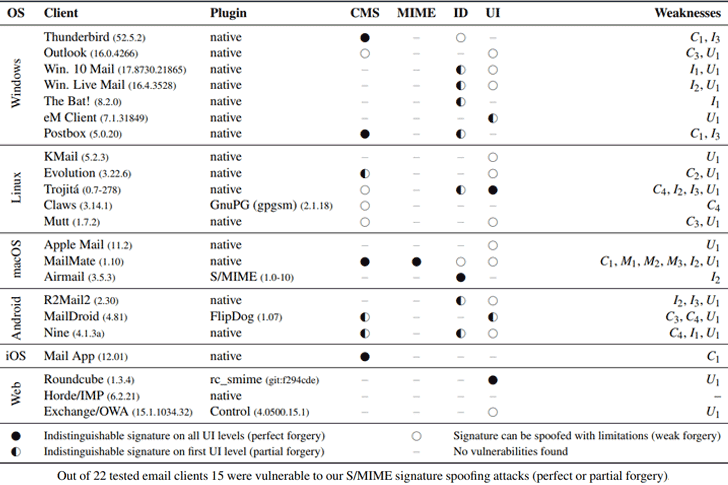
signature spoofing attacks can also be used to spoof decryption
results, “causing the email client to indicate an encrypted message
where in fact the plaintext was transmitted in the clear.”
“Our attacker model does not include any form of social
engineering. The user opens and reads received emails as always, so
awareness training does not help to mitigate the attacks,” the
researchers say.
potentially be detected by carefully inspecting the GUI or manually
clicking to receive more signature details, it still concerns when
a large number of sensitive users and communities relies on email
encryption and verification for authentication.
The vulnerabilities in email clients have been given the
following CVEs: CVE-2018-18509, CVE-2018-12019, CVE-2018-12020,
CVE-2017-17848, CVE-2018-15586, CVE-2018-15587, CVE-2018-15588,
CVE-2019-8338, CVE-2018-12356, CVE-2018-12556, and
CVE-2019-728.
Researchers reported these vulnerabilities to affected vendors
and developers, as well as suggested appropriate countermeasures,
which have now been implemented in the latest versions of most of
the affected software.
Read more http://feedproxy.google.com/~r/TheHackersNews/~3/br3Mt5XGg7s/email-signature-spoofing.html