
A wave of cyberattacks against retailers running the Magento 1.x
e-commerce platform earlier this September has been attributed to
one single group, according to the latest research.
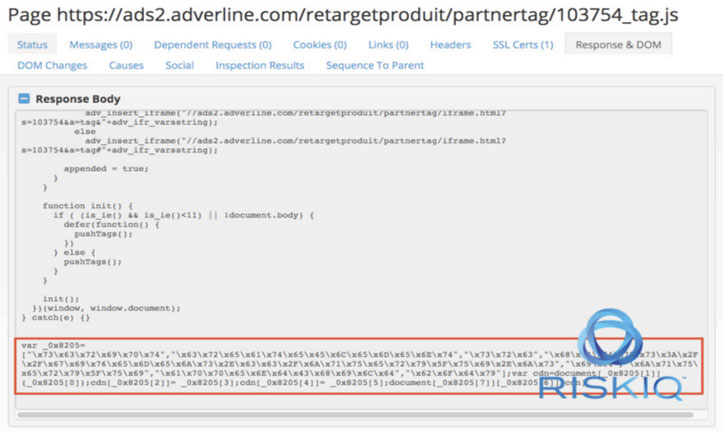
“This group has carried out a large number of diverse Magecart
attacks that often compromise large numbers of websites at once
through supply chain attacks, such as the Adverline incident[1], or through the use of
exploits such as in the September Magento 1 compromises,” RiskIQ
said in an analysis published[2]
today.
Collectively called Cardbleed[3], the attacks targeted at
least 2,806 online storefronts running Magento 1.x, which reached end-of-life[4]
as of June 30, 2020.
Injecting e-skimmers on shopping websites to steal credit card
details is a tried-and-tested modus operandi of Magecart, a
consortium of different hacker groups who target online shopping
cart systems.
These virtual credit card skimmers, also known as formjacking attacks[5], are typically
JavaScript code that the operators stealthily insert into an
e-commerce website, often on payment pages, with an intent to
capture customers’ card details in real-time and transmit it[6]
to a remote attacker-controlled server.
But in the last few months, the Magecart operators have stepped up in their efforts[7] to hide card stealer
code inside image metadata[8]
and even carry out IDN homograph attacks[9]
to plant web skimmers concealed within a website’s favicon
file.
Cardbleed, which was first documented by Sansec, works by using
specific domains to interact with the Magento admin panel and
subsequently leveraging the ‘Magento Connect’ feature to download
and install a piece of malware called “mysql.php” that gets
automatically deleted after the skimmer code is added to
“prototype.js.”
Now, as per RiskIQ, the attacks bear all the hallmarks of a
single group it tracks as Magecart Group 12 based on overlaps in
infrastructure and techniques across different attacks starting
with Adverline in January 2019 to the Olympics Ticket Resellers[10] back in February
2020.
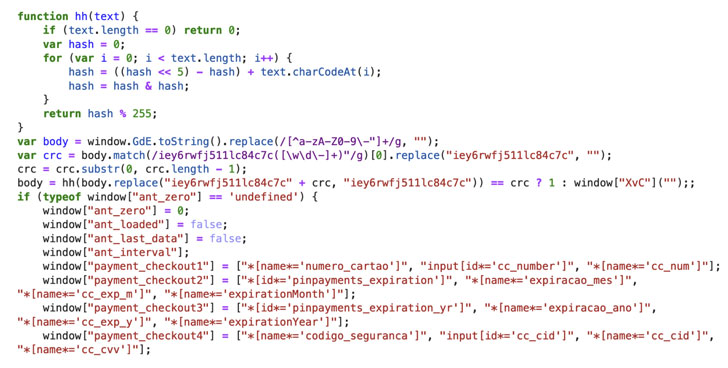
What’s more, the skimmer used in the compromises is a variant of
the Ant and Cockroach skimmer[11] first observed in
August 2019 — so named after a function labeled “ant_cockcroach()”
and a variable “ant_check” found in the code.
Interestingly, one of the domains (myicons[.]net) observed by
the researchers also ties the group to another campaign[12] in May, where a Magento
favicon file was used to hide the skimmer on payment pages and load
a fake payment form to steal captured information.
But just as the identified malicious domains are being taken
down, Group 12 has been adept at swapping in new domains to
continue skimming.
“Since the [Cardbleed] campaign was publicized, the attackers
have shuffled their infrastructure,” RiskIQ researchers said. “They
moved to load the skimmer from ajaxcloudflare[.]com, which has also
been active since May and moved the exfiltration to a recently
registered domain, consoler[.]in.”
If anything, the attacks are yet another indication of threat
actors continuing to innovate, playing with different ways of
carrying out skimming, and obfuscating their code to evade
detection, said RiskIQ threat researcher Jordan Herman.
“The prompting for this research was the widespread compromise
of Magento 1, which went end-of-life this June, sites via an
exploit,” Herman said. “So the particular mitigation would be to
upgrade to Magento 2, though the cost of upgrading might be
prohibitive for smaller vendors.”
“There is also a company called Mage One that is continuing to
support and patch Magento 1. They released a patch[13] to mitigate the
particular vulnerability exploited by the actor in late October.
Ultimately, the best way to prevent these types of attacks is for
e-commerce shops having a full inventory of the code running on
their site so they can identify deprecated versions of software and
any other vulnerabilities that could invite a Magecart attack,” he
added.
References
- ^
Adverline incident
(www.riskiq.com) - ^
published
(www.riskiq.com) - ^
Cardbleed
(sansec.io) - ^
reached
end-of-life (magento.com) - ^
formjacking attacks
(cyborgsecurity.medium.com) - ^
transmit
it (thehackernews.com) - ^
stepped
up in their efforts (thehackernews.com) - ^
image
metadata (thehackernews.com) - ^
IDN
homograph attacks (thehackernews.com) - ^
the
Olympics Ticket Resellers
(community.riskiq.com) - ^
Ant
and Cockroach skimmer (twitter.com) - ^
another campaign
(blog.malwarebytes.com) - ^
released a patch
(mage-one.com)
Read more http://feedproxy.google.com/~r/TheHackersNews/~3/Rgjd3zFkPPs/over-2800-e-shops-running-outdated.html