Jan 12, 2023Ravie Lakshmanan

Security researchers have disclosed multiple architectural
vulnerabilities in Siemens SIMATIC and SIPLUS S7-1500 programmable
logic controllers (PLCs) that could be exploited by a malicious
actor to stealthily install firmware on affected devices and take
control of them.
Discovered by Red Balloon Security, the issues are
tracked as CVE-2022-38773 (CVSS score: 4.6), with
the low severity stemming from the prerequisite that exploitation
requires physical tampering of the device.
The flaws “could allow attackers to bypass all protected boot
features, resulting in persistent arbitrary modification of
operating code and data,” the company said[1]. More than 100 models
are susceptible.
Put differently, the weaknesses are the result of a lack of
asymmetric signature verifications for firmware at bootup,
effectively permitting the attacker to load tainted bootloader and
firmware while undermining integrity protections.
A more severe consequence of loading such modified firmware is
that it could give the threat actor the ability to persistently
execute malicious code and gain total control of the devices
without raising any red flags.
“This discovery has potentially significant implications for
industrial environments as these unpatchable hardware root-of-trust
vulnerabilities could result in persistent arbitrary modification
of S7-1500 operating code and data,” the researchers said.
Siemens, in an advisory[2]
released this week, said it has no patches planned but urged
customers to limit physical access to the affected PLCs to trusted
personnel to avoid hardware tampering.
The lack of a firmware update is attributed to the fact that the
cryptographic scheme that undergirds the protected boot features is
baked into a dedicated physical secure element chip (called the
ATECC108[3]
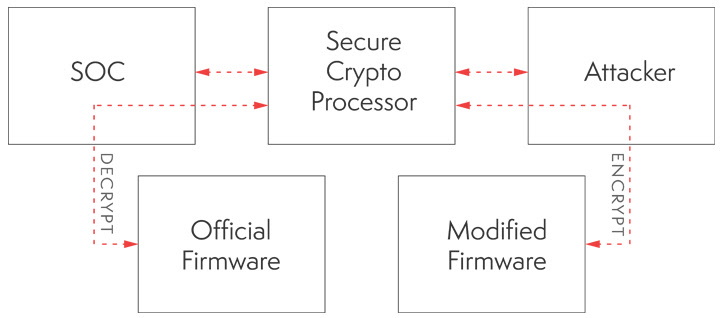
CryptoAuthentication coprocessor), which decrypts the firmware in
memory during startup.
An attacker with physical access to the device could therefore
leverage the issues identified in the cryptographic implementation
to decrypt the firmware, make unauthorized changes, and flash the
trojanized firmware onto the PLC either physically or by exploiting
a known remote code execution flaw.
“The fundamental vulnerabilities — improper hardware
implementations of the [Root of Trust] using dedicated
cryptographic-processor — are unpatchable and cannot be fixed by a
firmware update since the hardware is physically unmodifiable,” the
researchers explained.
However, the German automation giant said it’s in the process of
releasing new hardware versions for the S7-1500 product family that
come with a revamped “secure boot mechanism” that resolves the
vulnerability.
The findings come as industrial security firm Claroty last year
disclosed[4]
a critical flaw impacting Siemens SIMATIC devices that could be
exploited to retrieve the hard-coded, global private cryptographic
keys and completely compromise the product.
Found this article interesting? Follow us on Twitter [5]
and LinkedIn[6]
to read more exclusive content we post.
References
Read more https://thehackernews.com/2023/01/over-100-siemens-plc-models-found.html