
rely on Oracle’s E-Business Suite (EBS), make sure you
recently updated and are running the latest available version of
the software.
In a report released by enterprise cybersecurity firm Onapsis
and shared with The Hacker News, the firm today disclosed technical
details for vulnerabilities it reported in Oracle’s E-Business
Suite (EBS), an integrated group of applications designed to
automate CRM, ERP, and SCM operations for organizations.
The two vulnerabilities, dubbed “BigDebIT” and rated a
CVSS score of 9.9, were patched by Oracle in a critical patch
update (CPU) pushed out earlier this January. But the company
said an estimated 50 percent of Oracle EBS customers have not
deployed the patches to date.
[1]
The security flaws could be exploited by bad actors to target
accounting tools such as General Ledger in a bid to steal sensitive
information and commit financial fraud.
According to the researchers, “an unauthenticated hacker could
perform an automated exploit on the General Ledger module to
extract assets from a company (such as cash) and modify accounting
tables, without leaving a trace.”
attacker to steal financial data and cause delays in any financial
reporting related to the company’s compliance processes,” it added.
It’s worth noting that the BigDebIT attack vectors add to the
already reported PAYDAY
vulnerabilities[2]
in EBS discovered by Onapsis three years ago, following which
Oracle released a series of patches as late as April 2019.
Targeting General Ledger for Financial Fraud
Tracked as CVE-2020-2586 and
CVE-2020-2587, the
new flaws reside in its Oracle Human Resources Management System
(HRMS) in a component called Hierarchy
Diagrammer that enables users to create organization and
position hierarchies associated with an enterprise. Together, they
can be exploited even if EBS customers have deployed patches
released in April 2019.
“The difference is that with these patches, it is confirmed that
even with the systems up to date are vulnerable to these attacks,
and therefore need to prioritize the installation of January’s
CPU,” the company had stated[6]
in a note posted back in January.
One consequence of these bugs, if left unpatched, is the
possibility of financial fraud and confidential information theft
by attacking a firm’s accounting systems.
Oracle General
Ledger[7] is an automated
financial processing software that acts as a repository of
accounting information and is offered as part of E-Business Suite,
the company’s integrated suite of applications — spanning
enterprise resource planning (ERP), supply chain management (SCM),
and customer relationship management (CRM) — that users can
implement into their own businesses.
General Ledger is also used to generate corporate financial
reports as well as carry out audits to ensure compliance with the
SOX Act of 2002.
[8]
An attacker could break this trust by exploiting the flaws to
modify critical reports in the ledger, including fraudulently
manipulating transactions on a firm’s balance sheets.
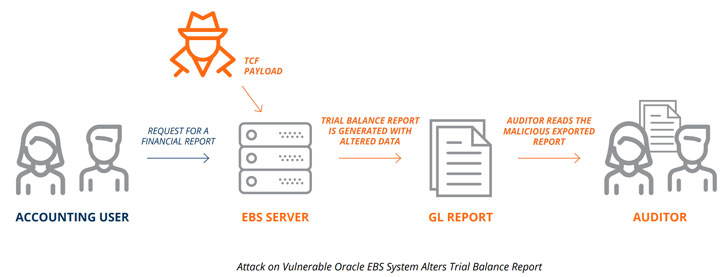
“For example, an attacker could modify the Trial Balance Report,
which summarizes accounting balances in a given period, virtually
unnoticed, resulting in inaccurately reported results flowing
undetected into the financial statements. This could result in
inaccurately filed or reported financial results,” Onapsis
said.
The Importance of Patching Critical Software
Given the financial risk involved, it is highly recommended that
companies using Oracle EBS run an immediate assessment to ensure
they are not exposed to these vulnerabilities, and apply the
patches to fix them.
“Organizations need to be aware that current GRC
tools[9] and other traditional
security methods (firewalls, access controls, SoD and others) would
be ineffective against preventing this type of attack on vulnerable
Oracle EBS systems,” the researchers cautioned.
“If organizations have internet-facing Oracle EBS systems, the
potential threat likelihood would be significantly magnified.
Organizations under attack will be unaware of the attack and not
know the extent of the damage until evidence is found by a very
extensive internal or external audit.”
References
- ^
critical patch update
(www.oracle.com) - ^
PAYDAY vulnerabilities
(www.onapsis.com) - ^
CVE-2020-2586
(nvd.nist.gov) - ^
CVE-2020-2587
(nvd.nist.gov) - ^
Hierarchy Diagrammer
(docs.oracle.com) - ^
company had stated
(www.onapsis.com) - ^
General Ledger
(www.oracle.com) - ^
SOX Act of 2002
(en.wikipedia.org) - ^
GRC tools
(en.wikipedia.org)
Read more http://feedproxy.google.com/~r/TheHackersNews/~3/ymN0bZ7Q76Q/oracle-e-business-suite.html