Mar 25, 2023Ravie Lakshmanan

OpenAI on Friday disclosed that a bug in the Redis open source
library was responsible for the exposure of other users’ personal
information and chat titles in the upstart’s ChatGPT service
earlier this week.
The glitch[1], which came to light on
March 20, 2023, enabled certain users to view brief descriptions of
other users’ conversations from the chat history sidebar, prompting
the company to temporarily shut down the chatbot.
“It’s also possible that the first message of a newly-created
conversation was visible in someone else’s chat history if both
users were active around the same time,” the company said[2].
The bug, it further added, originated in the redis-py library[3], leading to a scenario
where canceled requests could cause connections to be corrupted and
return unexpected data from the database cache, in this case,
information belonging to an unrelated user.
To make matters worse, the San Francisco-based AI research
company said it introduced a server-side change by mistake that led
to a surge in request cancellations, thereby upping the error
rate.
While the problem has since been addressed, OpenAI noted that
the issue may have had more implications elsewhere, potentially
revealing payment-related information of 1.2% of the ChatGPT Plus
subscribers on March 20 between 1-10 a.m. PT.
This included another active user’s first and last name, email
address, payment address, the last four digits (only) of a credit
card number, and credit card expiration date. It emphasized that
full credit card numbers were not exposed.
The company said it has reached out to affected users to notify
them of the inadvertent leak. It also said it “added redundant
checks to ensure the data returned by our Redis cache matches the
requesting user.”
OpenAI Fixes Critical Account Takeover
Flaw
In another caching-related issue, the company also addressed a
critical account takeover vulnerability that could be exploited to
seize control of another user’s account, view their chat history,
and access billing information without their knowledge.
WEBINAR
Discover the Hidden Dangers of Third-Party SaaS Apps
Are you aware of the risks associated with third-party app
access to your company’s SaaS apps? Join our webinar to learn about
the types of permissions being granted and how to minimize
risk.
The flaw, which was discovered[5]
by security researcher Gal Nagli, bypasses protections put in place
by OpenAI on chat.openai[.]com to read a victim’s sensitive
data.
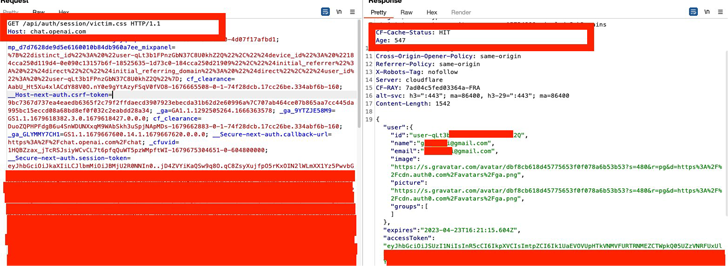
This is achieved by first creating a specially crafted link that
appends a .CSS resource to the
“chat.openai[.]com/api/auth/session/” endpoint and tricking a
victim to click on the link, causing the response containing a JSON
object with the accessToken string to be cached in Cloudflare’s
CDN[6].
The cached response to the CSS resource (which has the CF-Cache-Status header[7]
value set to HIT) is then abused by the attacker to harvest the
target’s JSON Web Token (JWT[8]) credentials and take
over the account.
Nagli said the bug was fixed by OpenAI within two hours of
responsible disclosure, indicative of the severity of the
issue.
Found this article interesting? Follow us on Twitter [9]
and LinkedIn[10] to read more exclusive
content we post.
References
- ^
glitch
(www.vice.com) - ^
said
(openai.com) - ^
redis-py
library (github.com) - ^
RESERVE YOUR SEAT
(thn.news) - ^
discovered
(twitter.com) - ^
Cloudflare’s CDN
(developers.cloudflare.com) - ^
CF-Cache-Status header
(developers.cloudflare.com) - ^
JWT
(thehackernews.com) - ^
Twitter
(twitter.com) - ^
LinkedIn
(www.linkedin.com)
Read more https://thehackernews.com/2023/03/openai-reveals-redis-bug-behind-chatgpt.html