
 Reconnaissance
 Password & Brute Force Attacks
 Exploitation
 Wireless Attacks
 Vulnerability Scanning
 Mobile Security
 Post-Exploitation
 Social Engineer & Phishing
 Network-based Attacks
 Reverse Engineering
 Reporting & Documentation
Offensive security tools are critical for ethical hackers and penetration testers to proactively identify weaknesses in systems and networks before malicious actors can exploit them. These tools mimic the techniques and exploit kits used by attackers, allowing security professionals to discover vulnerabilities, assess risks, and improve an organization’s overall security posture.
Here are some of the most popular offensive security tools for Linux:
-
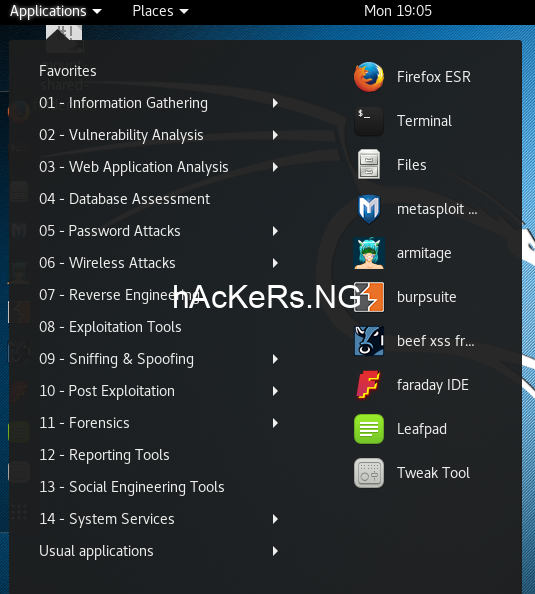
Kali Linux:
Kali Linux is a Debian-derived distribution specifically designed for penetration testing, vulnerability assessment, and security auditing. It comes pre-loaded with hundreds of security tools, making it a one-stop shop for security professionals. -
Metasploit: Metasploit is a powerful open-source framework for developing, testing, and deploying exploit code. It includes a vast database of exploits for various operating systems, applications, and services. Metasploit also provides tools for post-exploitation activities, such as privilege escalation and maintaining access to a compromised system.
-
Wireshark: Wireshark is a free and open-source network protocol analyzer that captures and analyzes network traffic. It allows security professionals to inspect network packets, identify potential security threats, and troubleshoot network issues.
-
Burp Suite: Burp Suite is a leading commercial web application security testing (WAST) platform that helps identify vulnerabilities in web applications. It provides a comprehensive suite of tools for manual and automated testing, including a web proxy, scanner, intruder, and repeater.
-
SQLmap: SQLmap is an open-source penetration testing tool that automates the detection and exploitation of SQL injection vulnerabilities in web applications. SQL injection is a common web application vulnerability that allows attackers to inject malicious SQL code into a database.
-
John the Ripper: John the Ripper is a fast password cracker that can be used to crack weak passwords. It supports a variety of password hashing algorithms and can be used to crack password files obtained from compromised systems.
-
Nessus: Nessus is a powerful vulnerability scanner that can identify a wide range of vulnerabilities in systems and networks. It provides detailed reports on vulnerabilities, including severity ratings, remediation steps, and exploit information.
-
Social-Engineer Toolkit (SET): The Social-Engineer Toolkit (SET) is a suite of tools designed to help penetration testers perform social engineering attacks. Social engineering is the art of manipulating people into divulging confidential information or taking actions that could compromise security. SET includes tools for creating phishing emails, websites, and social media profiles.
It’s important to note that these tools are powerful and should only be used by authorized security professionals with permission. Using these tools for malicious purposes is a crime.
chatgpt
Offensive security tools for Linux are used by penetration testers, security researchers, and ethical hackers to identify and exploit vulnerabilities in systems. Here are some popular tools used in this domain:
### 1. **Metasploit Framework**
– **Description**: A powerful platform for developing, testing, and executing exploits against target systems.
– **Features**: Includes a large database of exploits, payloads, and auxiliary modules.
### 2. **Nmap (Network Mapper)**
– **Description**: A versatile network discovery and security auditing tool.
– **Features**: Performs network discovery, hosts and services enumeration, and vulnerability detection.
### 3. **Wireshark**
– **Description**: A network protocol analyzer that captures and interactsively browses traffic running on a computer network.
– **Features**: Deep inspection of hundreds of protocols, live capture, and offline analysis.
### 4. **John the Ripper**
– **Description**: A fast password cracker.
– **Features**: Supports many password hash types and can be used to perform dictionary attacks, brute force attacks, and custom wordlist attacks.
### 5. **Aircrack-ng**
– **Description**: A suite of tools for assessing Wi-Fi network security.
– **Features**: Includes tools for monitoring, attacking, testing, and cracking Wi-Fi networks.
### 6. **Hydra**
– **Description**: A parallelized login cracker which supports numerous protocols.
– **Features**: Can perform brute force attacks against a variety of protocols like HTTP, FTP, SMB, and more.
### 7. **Burp Suite**
– **Description**: An integrated platform for performing security testing of web applications.
– **Features**: Includes tools for scanning, spidering, and exploiting web application vulnerabilities.
### 8. **Nikto**
– **Description**: A web server scanner that checks for various vulnerabilities.
– **Features**: Identifies outdated versions, potentially dangerous files, and other vulnerabilities.
### 9. **SQLMap**
– **Description**: An automatic SQL injection tool.
– **Features**: Supports a wide range of databases and can detect and exploit SQL injection vulnerabilities.
### 10. **BeEF (Browser Exploitation Framework)**
– **Description**: Focuses on client-side attack vectors by using web browsers as the attack surface.
– **Features**: Allows the exploitation of web browser vulnerabilities.
### 11. **OWASP ZAP (Zed Attack Proxy)**
– **Description**: An open-source web application security scanner.
– **Features**: Helps find security vulnerabilities in web applications during development and testing.
### 12. **Social-Engineer Toolkit (SET)**
– **Description**: An open-source penetration testing framework designed for social engineering.
– **Features**: Automates social engineering attacks such as phishing, credential harvesting, and more.
### 13. **Reaver**
– **Description**: A tool for performing brute force attacks against Wi-Fi Protected Setup (WPS) registrar PINs.
– **Features**: Can recover WPA/WPA2 passphrases from WPS-enabled networks.
### 14. **Ettercap**
– **Description**: A comprehensive suite for man-in-the-middle attacks on LAN.
– **Features**: Supports active and passive dissection of many protocols and includes features for network and host analysis.
### 15. **Responder**
– **Description**: A tool to respond to LLMNR, NBT-NS, and MDNS queries on a network.
– **Features**: Helps capture credentials from Windows-based systems.
These tools are powerful and should be used responsibly and legally, only in environments where you have explicit permission to perform security testing.