In a new joint cybersecurity advisory, U.S. cybersecurity and
intelligence agencies have warned about the use of Maui ransomware
by North Korean government-backed hackers to target the healthcare
sector since at least May 2021.
“North Korean state-sponsored cyber actors used Maui ransomware
in these incidents to encrypt servers responsible for healthcare
services—including electronic health records services, diagnostics
services, imaging services, and intranet services,” the authorities
noted[1].
The alert[2]
comes courtesy of the U.S. Cybersecurity and Infrastructure
Security Agency (CISA), the Federal Bureau of Investigation (FBI),
and the Department of the Treasury.
Cybersecurity firm Stairwell, whose findings formed the basis of
the advisory, said the lesser-known ransomware family stands out
because of a lack of several key features commonly associated with
ransomware-as-a-service (RaaS) groups.
This includes the absence of “embedded ransom note to provide
recovery instructions or automated means of transmitting encryption
keys to attackers,” security researcher Silas Cutler said[3]
in a technical overview of the ransomware.
Instead, analysis of Maui samples suggests that the malware is
designed for manual execution by a remote actor via a command-line
interface, using it to target specific files on the infected
machine for encryption.
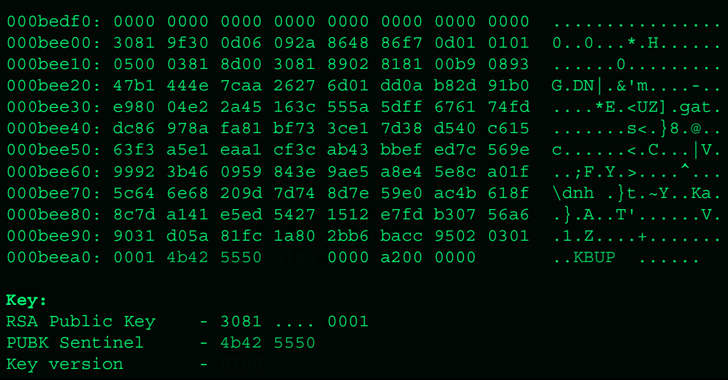
Besides encrypting target files with AES 128-bit encryption with
a unique key, each of these keys is, in turn, encrypted with RSA
using a key pair generated the first time when Maui is executed. As
a third layer of security, the RSA keys are encrypted using a
hard-coded RSA public key that’s unique to each campaign.
What sets Maui apart from other traditional ransomware offerings
is also the fact that it’s not offered as a service to other
affiliates for use in return for a share of monetary profits.
In some instances, the ransomware incidents are said to have
disrupted health services for extended periods of time. The initial
infection vector used to conduct the intrusions is unknown as
yet.
It’s worth noting that the campaign is predicated on the
willingness of healthcare entities to pay ransoms to quickly
recover from an attack and ensure uninterrupted access to critical
services. It’s the latest indication of how North Korean
adversaries are adapting their tactics to illegally generate a
constant stream[4]
of revenue[5]
for the cash-strapped nation.
According to the Sophos’ State of Ransomware in Healthcare
2022[6] report, 61% of
healthcare organizations surveyed opted to settle compared with the
global average of 46%, with only 2% of those that paid the ransom
in 2021 getting their complete data back.
That said, the use of a manually operated ransomware family by
an APT group also raises the possibility that the operation could
be a diversionary tactic designed to act as a cover for other
malicious motives, as recently observed in the case of Bronze Starlight[7].
“Nation state-sponsored ransomware attacks have become typical
international acts of aggression,” Peter Martini, co-founder of
iboss, said in a statement. “Unfortunately, North Korea
specifically has shown it is very willing to indiscriminately
target various industries, including healthcare, to secure
untraceable cryptocurrency that is funding its nuclear weapons
program.”
References
- ^
noted
(www.cisa.gov) - ^
alert
(www.cisa.gov) - ^
said
(stairwell.com) - ^
constant
stream (thehackernews.com) - ^
revenue
(thehackernews.com) - ^
State of
Ransomware in Healthcare 2022
(www.sophos.com) - ^
Bronze
Starlight (thehackernews.com)
Read more https://thehackernews.com/2022/07/north-korean-maui-ransomware-actively.html