issued another joint alert about a new piece of malware that the
prolific North Korean APT hacking group Hidden Cobra has actively
been using in the wild.
Hidden Cobra, also known as Lazarus Group and Guardians of
Peace, is believed to be backed by North Korean government and
known to launch cyber attacks against media organizations,
aerospace, financial and critical infrastructure sectors across the
world.
The hacking group was the same associated with the 2017 WannaCry
ransomware menace, the 2014 Sony Pictures
hack, and the SWIFT Banking
attack in 2016.
[1][2][3]
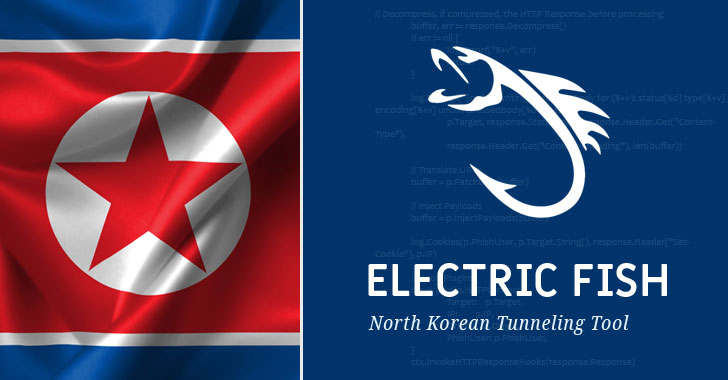
Now, the DHS and the FBI have uncovered a new malware variant,
dubbed ELECTRICFISH, that Hidden Cobra hackers have been
using for secretly tunneling traffic out of compromised computer
systems.
The malware implements a custom protocol configured with a proxy
server/port and proxy username and password, allowing hackers to
bypass the compromised system’s required authentication to reach
outside of the network.
The ElectricFish malware is a command-line utility whose primary
purpose is to quickly funnel traffic between two IP addresses.
The malware allows Hidden Cobra hackers to configure with a
proxy server/port and proxy username and password, making it
possible to connect to a system sitting inside of a proxy server,
which allows the attackers to bypass the infected system’s required
authentication.
“It will attempt to establish TCP sessions with the source IP
address and the destination IP address. If a connection is made to
both the source and destination IPs, this malicious utility will
implement a custom protocol, which will allow traffic to rapidly
and efficiently be funneled between two machines,” the alert reads.
“If necessary, the malware can authenticate with a proxy to be
able to reach the destination IP address. A configured proxy server
is not required for this utility.”
immediately attempts to establish a session with the destination IP
address, located outside of the victim network and the source IP
address. The attack would use command prompts to specify the source
and destination for tunneling traffic.
Though the US-CERT website doesn’t state whether or if yes, which
US organizations have already been infected with this new malware,
the joint malware analysis report (MAR) does say that the alert has
been issued “to enable network defense and reduce exposure to North
Korean government malicious cyber activity.”
This is not the very first time the DHS and the FBI have issued
a joint alert to warn users and organizations about the Hidden
Cobra malware.
Late last year, the U.S. departments warned about
the FastCash
malware[5] that Hidden Cobra had
been using since 2016 to compromise payment switch application
servers in banks in Africa and Asia in an attempt to cash out bank
ATMs.
Little less than a year ago, the DHS and the FBI also published
an advisory alerting users of two different
malware[6]—a fully functional
Remote Access Trojan (RAT) known as Joanap and a Server
Message Block (SMB) worm called Brambul—linked to Hidden
Cobra.
In 2017, the US-CERT also issued an alert detailing Hidden Cobra
malware called Delta
Charlie[7]—a DDoS tool that they
believed the North Korean hackers use to launch distributed
denial-of-service attacks against its targets.
References
- ^
2017 WannaCry ransomware menace
(thehackernews.com) - ^
2014 Sony Pictures hack
(thehackernews.com) - ^
SWIFT Banking attack
(thehackernews.com) - ^
alert
(www.us-cert.gov) - ^
FastCash malware
(thehackernews.com) - ^
two different malware
(thehackernews.com) - ^
Delta Charlie
(thehackernews.com)
Read more http://feedproxy.google.com/~r/TheHackersNews/~3/pHlq8lkRuRQ/north-korean-hacking-tool.html