
The prolific North Korean nation-state actor known as the
Lazarus Group has been linked to a new remote access trojan called
MagicRAT.
The previously unknown piece of malware is said to have been
deployed in victim networks that had been initially breached via
successful exploitation of internet-facing VMware Horizon servers,
Cisco Talos said in a report shared with The Hacker News.
“While being a relatively simple RAT capability-wise, it was
built with recourse to the Qt
Framework[1], with the sole intent of
making human analysis harder, and automated detection through
machine learning and heuristics less likely,” Talos researchers
Jung soo An, Asheer Malhotra, and Vitor Ventura said[2].
Lazarus Group[3], also known as APT38,
Dark Seoul, Hidden Cobra, and Zinc, refers to a cluster of
financial motivated and espionage-driven cyber
activities[4] undertaken by the North
Korean government as a means to sidestep sanctions imposed on the
country and meet its strategic objectives.
Like other umbrella collectives Winnti and MuddyWater, the
state-sponsored hacking collective also has “spin-off” groups such
as Bluenoroff and Andariel[5], which focus on specific
kinds of attacks and targets.
While the Bluenoroff subgroup is focused on attacking foreign
financial institutions and perpetrating monetary theft, Andariel is
devoted in its pursuit of South Korean organizations and
businesses.
“Lazarus develops their own attack tools and malware, can use
innovative attack techniques, works very methodically, and takes
their time,” cybersecurity firm NCC Group said[6]
in a report detailing the threat actor.
“In particular, the North Korean methods aim to avoid detection
by security products and to remain undetected within the hacked
systems for as long as possible.”
The latest addition to its wide-ranging malware toolset shows
the group’s ability to employ a multitude of tactics and techniques
depending on their targets and their operational goals.
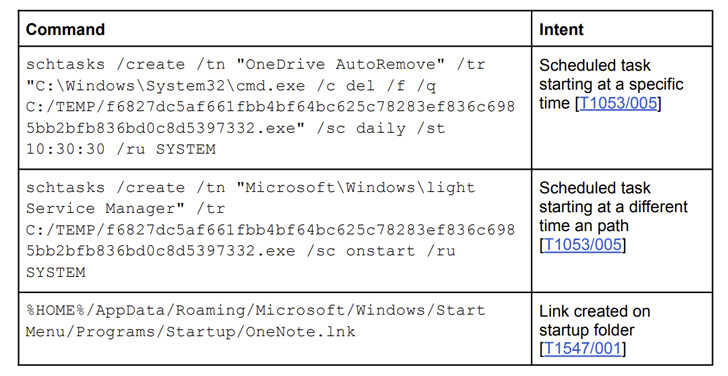
A C++-based implant, MagicRAT is designed to achieve persistence
by creating scheduled tasks on the compromised system. It’s also
“rather simple” in that it provides the attacker with a remote
shell to execute arbitrary commands and carry out file
operations.
MagicRAT is also capable of launching additional payloads
retrieved from a remote server on infected hosts. One of the
executables retrieved from the command-and-control (C2) server
takes the form of a GIF image file, but in reality is a lightweight
port scanner.
Furthermore, the C2 infrastructure associated with MagicRAT has
been found harboring and serving newer versions of TigerRAT[7], a backdoor[8]
formerly attributed to Andariel and is engineered to execute
commands, take screenshots, log keystrokes, and harvest system
information.
Also incorporated in the latest variant is a USB Dump feature
that allows the adversary to hunt for files with specific
extensions, alongside laying the groundwork for implementing video
capture from webcams.
“The discovery of MagicRAT in the wild is an indication of
Lazarus’ motivations to rapidly build new, bespoke malware to use
along with their previously known malware such as TigerRAT to
target organizations worldwide,” the researchers said.
References
- ^
Qt
Framework (www.qt.io) - ^
said
(blog.talosintelligence.com) - ^
Lazarus
Group (thehackernews.com) - ^
cyber
activities (www.cisa.gov) - ^
Bluenoroff and Andariel
(www.trendmicro.com) - ^
said
(www.nccgroup.com) - ^
TigerRAT
(malpedia.caad.fkie.fraunhofer.de) - ^
backdoor
(thehackernews.com)
Read more https://thehackernews.com/2022/09/north-korean-hackers-spotted-using-new.html