
The infamous Lazarus Group has continued its pattern of
leveraging unsolicited job opportunities to deploy malware
targeting Apple’s macOS operating system.
In the latest variant of the campaign observed by cybersecurity
company SentinelOne last week, decoy documents advertising
positions for the Singapore-based cryptocurrency exchange firm
Crypto.com.
The latest disclosure builds on previous findings from Slovak
cybersecurity firm ESET in August, which delved[1]
into a similar phony job posting for the Coinbase cryptocurrency
exchange platform.
Both these fake job advertisements are just the latest in a
series of attacks dubbed Operation In(ter)ception[2], which, in turn, is a
constituent of a broader campaign tracked under the name Operation Dream Job[3].
Although the exact distribution vector for the malware remains
unknown, it’s suspected that potential targets are singled out via
direct messages on the business networking site LinkedIn.
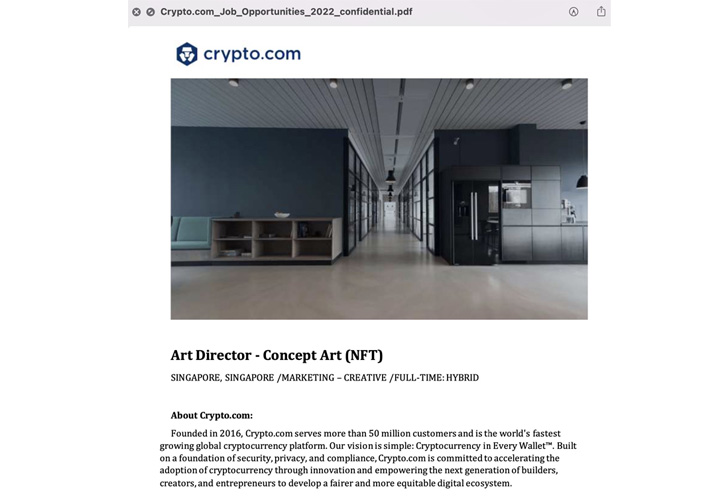
The intrusions commence with the deployment of a Mach-O binary,
a dropper[4]
that launches the decoy PDF document containing the job listings at
Crypto.com, while, in the background, it deletes the Terminal’s
saved state[5]
(“com.apple.Terminal.savedState”).
The downloader, also similar to the safarifontagent library
employed in the Coinbase attack chain, subsequently acts as a
conduit for a bare-bones second-stage bundle named
“WifiAnalyticsServ.app,” which is a copycat version of
“FinderFontsUpdater.app.”
“The main purpose of the second-stage is to extract and execute
the third-stage binary, wifianalyticsagent,” SentinelOne
researchers Dinesh Devadoss and Phil Stokes said[6]. “This functions as a
downloader from a [command-and-control] server.”
The final payload delivered to the compromised machine is
unknown owing to the fact that the C2 server responsible for
hosting the malware is currently offline.
These attacks are not isolated, for the Lazarus Group has a
history[7]
of carrying out cyber-assaults[8]
on blockchain and cryptocurrency platforms as a sanctions-evading
mechanism, enabling the adversaries to gain unauthorized access to
enterprise networks and steal digital funds.
“The threat actors have made no effort to encrypt or obfuscate
any of the binaries, possibly indicating short-term campaigns
and/or little fear of detection by their targets,” the researchers
said.
References
- ^
delved
(thehackernews.com) - ^
Operation In(ter)ception
(thehackernews.com) - ^
Operation Dream Job
(thehackernews.com) - ^
dropper
(www.virustotal.com) - ^
saved
state (www.crowdstrike.com) - ^
said
(www.sentinelone.com) - ^
history
(thehackernews.com) - ^
cyber-assaults
(thehackernews.com)
Read more https://thehackernews.com/2022/09/north-koreas-lazarus-hackers-targeting.html