Zeppelin, has recently been spotted in the wild targeting
technology and healthcare companies across Europe, the United
States, and Canada.
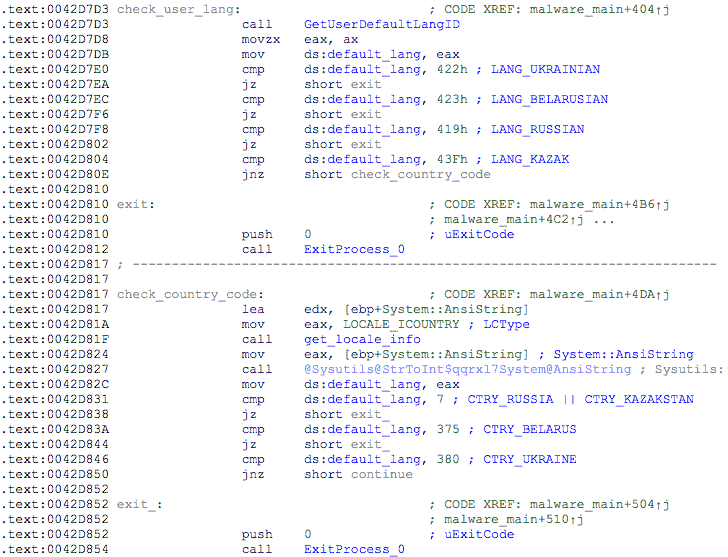
However, if you reside in Russia or some other ex-USSR countries
like Ukraine, Belorussia, and Kazakhstan, breathe a sigh of relief,
as the ransomware terminates its operations if found itself on
machines located in these regions.
It’s notable and interesting because all previous variants of
the Vega family, also known as VegaLocker, were primarily targeting
Russian speaking users, which indicates Zeppelin is not the work of
the same hacking group behind the previous attacks.
Since Vega ransomware and its previous variants were offered as
a service on underground forums, researchers at BlackBerry Cylance
believes either Zeppelin “ended up in the hands of different threat
actors” or “redeveloped from bought/stolen/leaked sources.”
According to a report[1] BlackBerry Cylance
shared with The Hacker News, Zeppelin is a Delphi-based
highly-configurable ransomware that can easily be customized to
enable or disable various features, depending upon victims or
requirements of attackers.
Zeppelin can be deployed as an EXE, DLL, or wrapped in a
PowerShell loader and includes the following features:
- IP Logger — to track the IP addresses and location of
victims - Startup — to gain persistence
- Delete backups — to stop certain services, disable the recovery
of files, delete backups and shadow copies, etc. - Task-killer — kill attacker-specified processes
- Auto-unlock — to unlock files that appear locked during
encryption - Melt — to inject self-deletion thread to notepad.exe
- UAC prompt — try running the ransomware with elevated
privileges
Based on the configurations attackers set from the Zeppelin builder
user-interface during the generation of the ransomware binary, the
malware enumerates files on all drives and network shares and
encrypts them with the same algorithm as used by the other Vega
variants.
encryption with randomly generated keys for each file (AES-256 in
CBC mode), and asymmetric encryption used to protect the session
key (using a custom RSA implementation, possibly developed
in-house),” the researchers explain.
“Interestingly, some of the samples will encrypt only the first
0x1000 bytes (4KB), instead of 0x10000 (65KB). It might be either
an unintended bug or a conscious choice to speed up the encryption
process while rendering most files unusable anyway.”
Besides what features to be enabled and what files to be
encrypted, the Zeppelin builder also allows attackers to configure
the content of the ransom note text file, which it drops on the
system and displays to the victim after encrypting the files.
“BlackBerry Cylance researchers have uncovered several different
versions, ranging from short, generic messages to more elaborate
ransom notes tailored to individual organizations,” the researchers
say.
provided email addresses and quote their personal ID number.”
To evade detection, Zeppelin ransomware relies on multiple
layers of obfuscation, including the use of pseudo-random keys,
encrypted string, using code of varying sizes, as well as delays in
execution to outrun sandboxes and deceive heuristic mechanisms.
Zeppelin was first discovered almost a month ago when it was
distributed through water-holed websites with its PowerShell
payloads hosted on the Pastebin website.
Researchers believe that at least some of the Zeppelin attacks
were “conducted through MSSPs, which would bear similarities to
another recent highly targeted campaign that used ransomware called
Sodinokibi[2],” also known as Sodin or
REvil[3].
The researchers have also shared indicators of compromise (IoC)
in its blog post. At the time of writing, almost 30 percent of
antivirus solutions are not able to detect this particular
ransomware threat.
References
- ^
report
(threatvector.cylance.com) - ^
Sodinokibi
(thehackernews.com) - ^
Sodin or REvil
(thehackernews.com)
Read more http://feedproxy.google.com/~r/TheHackersNews/~3/Er78UnmGkao/zeppelin-ransomware-attacks.html