An unknown threat actor has been targeting Russian entities with
a newly discovered remote access trojan called Woody RAT for
at least a year as part of a spear-phishing campaign.
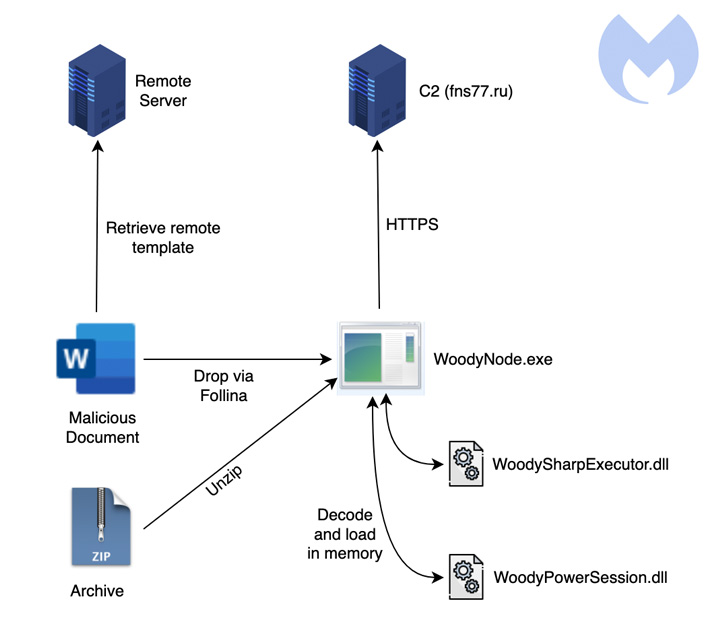
The advanced custom backdoor is said to be delivered via either
of two methods: archive files and Microsoft Office documents
leveraging the now-patched “Follina” support diagnostic tool
vulnerability (CVE-2022-30190[1]) in Windows.
Like other implants engineered for espionage-oriented
operations, Woody RAT sports a wide range of features that enables
the threat actor to remotely commandeer and steal sensitive
information from the infected systems.
“The earliest versions of this RAT were typically archived into
a ZIP file pretending to be a document specific to a Russian
group,” Malwarebytes researchers Ankur Saini and Hossein Jazi
said[2]
in a Wednesday report.
“When the Follina vulnerability became known to the world, the
threat actor switched to it to distribute the payload.”
In one instance, the hacking group attempted to strike a Russian
aerospace and defense entity known as OAK[3]
based on evidence gleaned from a fake domain registered for this
purpose.
Attacks leveraging the Windows flaw as part of this campaign
first came to light on June 7, 2022, when researchers from the
MalwareHunterTeam disclosed[4]
the use of a document named “Памятка.docx” (which translates to
“Memo.docx”) to deliver a CSS payload containing the trojan.
The document purportedly offers best security practices for
passwords and confidential information, among others, while acting
as a decoy for dropping the backdoor.
Besides encrypting its communications with a remote server,
Woody RAT is equipped with capabilities to write arbitrary files to
the machine, execute additional malware, delete files, enumerate
directories, capture screenshots, and gather a list of running
processes.
Also embedded within the malware are two .NET-based libraries
named WoodySharpExecutor and WoodyPowerSession that can be used to
run .NET code and PowerShell commands received from the server,
respectively.
Furthermore, the malware makes use of the process hollowing technique[5] to inject itself into a
suspended Notepad process and deletes itself from the disk to evade
detection from security software installed on the compromised
host.
Malwarebytes has yet to attribute the attacks to a specific
threat actor, citing a lack of solid indicators linking the
campaign to a previously known group, although Chinese and North
Korean nation-state collectives have targeted Russia in the
past.
References
- ^
CVE-2022-30190
(thehackernews.com) - ^
said
(blog.malwarebytes.com) - ^
OAK
(www.uacrussia.ru) - ^
disclosed
(twitter.com) - ^
process
hollowing technique (attack.mitre.org)
Read more https://thehackernews.com/2022/08/new-woody-rat-malware-being-used-to.html